
Manchester school committee discusses goals, community forums and strategic‑plan update
Get AI-powered insights, summaries, and transcripts
Subscribe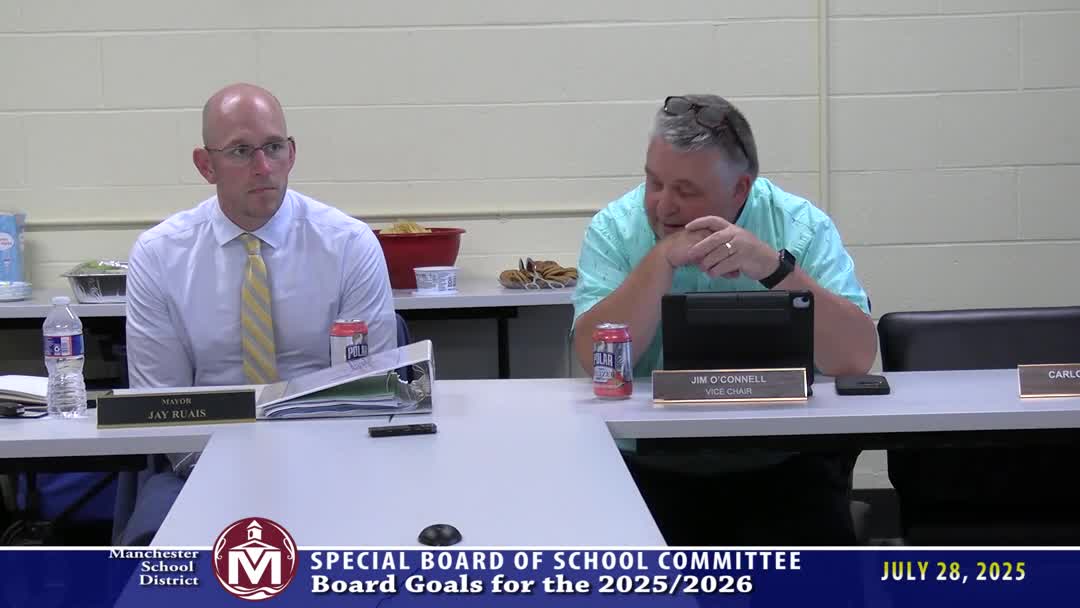
Summary
Committee members and district officials reviewed the board’s three core goals—communication, training and strategic‑plan support—mapped out quarterly community forums beginning in October and discussed next steps for updating the district strategic plan and required policy public‑input under recently passed state bills.
At a July 28 meeting of the Manchester Board of School Committee, members and district officials reviewed the board’s three core goals—communication, training and strategic‑plan support—and agreed informally to pilot quarterly "meet the board" community forums beginning in October.
The discussion focused on why clearer board communications, targeted trainings for members and a refreshed district strategic plan matter now. Baron Christina, representing the New Hampshire School Board Association, told the committee the session was intended to help the board with goal‑setting and process: "I believe this is the third time that you've invited the School Board Association here to assist the board and talk about process for some school board goal setting." Dr. Camille, a district representative, said district goal work is already under way and described the three buckets being used to organize goals: "Grow our learners, grow our educators, grow our systems. We goal set by early fall. So by September our goals are are solidified."
Vice Chair O'Connell opened the committee conversation by reviewing the board’s existing goals and asking whether members wanted to keep them or revise them. He said the three adopted board goals were communication, training and strategic‑plan support. Several members urged the board to make the communication goal more specific and measurable. Committee member Jess said the visibility piece should translate into direct engagement: "there was some hesitation... about people doing that together because of concerns about quorums... But I do think that we're all adult enough to understand what that so I think if we keep this goal in here... maybe creating a more, an objective related to that."
Members and district staff sketched how that engagement could work. Dr. Camille told the committee the district is preparing drafts and expects to present materials this fall: staff have been organizing district, department and school goals so they "dovetail" and said a consultant is being considered to guide a strategic‑plan update. The administration said it will present draft policies and materials on two state laws that require public input—the parental rights provision in House Bill 10 and the cell phone policy language tied to House Bill 2—and that a draft of the cell‑phone policy should be available for the committee’s August 20 meeting to begin review.
Committee members proposed concrete formats for community engagement: moderated town‑hall style forums, moderated by a third party when appropriate; quarterly events geographically distributed across the city; and in‑meeting digital feedback tools (for example, short surveys or QR codes) so attendees can register preferences about draft policies and see summary data. One board member suggested the events could also serve as a place to gather feedback on policies that statutorily require public input, and that the board should provide attendees a summary of how many people voiced each position and why the district may not be able to implement a given request.
Members identified training priorities for the coming year: budget/finance, special‑education processes (IEPs, timelines and required services) and the school‑labor negotiations process so board members understand their role in contract approval. Several speakers stressed that training should not expose the district to legal or funding risk; one member reminded the committee that the superintendent signs certifications to the state Department of Education and that training must be consistent with state law.
Several speakers reminded the committee that the meeting did not have a quorum and therefore could not ratify or adopt formal board actions on goals. Mayor Witt noted at the meeting's start, "Here. We don't have a quorum, but we will continue." The group nevertheless reached informal agreement on next steps: a pilot quarterly community forum to start in October, the administration will bring status and recommendations on the strategic plan in September, and policy drafts tied to HB10 and the cell‑phone policy will be presented to the committee for review beginning with the August 20 packet. Vice Chair O'Connell agreed to lead the board’s effort to plan the community forums and work with the clerk on logistics.
The only formal action recorded during the session was a motion to adjourn. The motion—moved by Vice Chair O'Connell and seconded by committee member Proctor—was called and the meeting was adjourned.
The committee scheduled future conversation and formal adoption for full board meetings when a quorum is present, including a September report on strategic‑plan status and follow‑up on proposed training and community engagement scheduling.