
Public commenter raises BAYADA accountability concerns; committee debates contractor indemnities, temp‑to‑hire clauses and billing for absences
Get AI-powered insights, summaries, and transcripts
Subscribe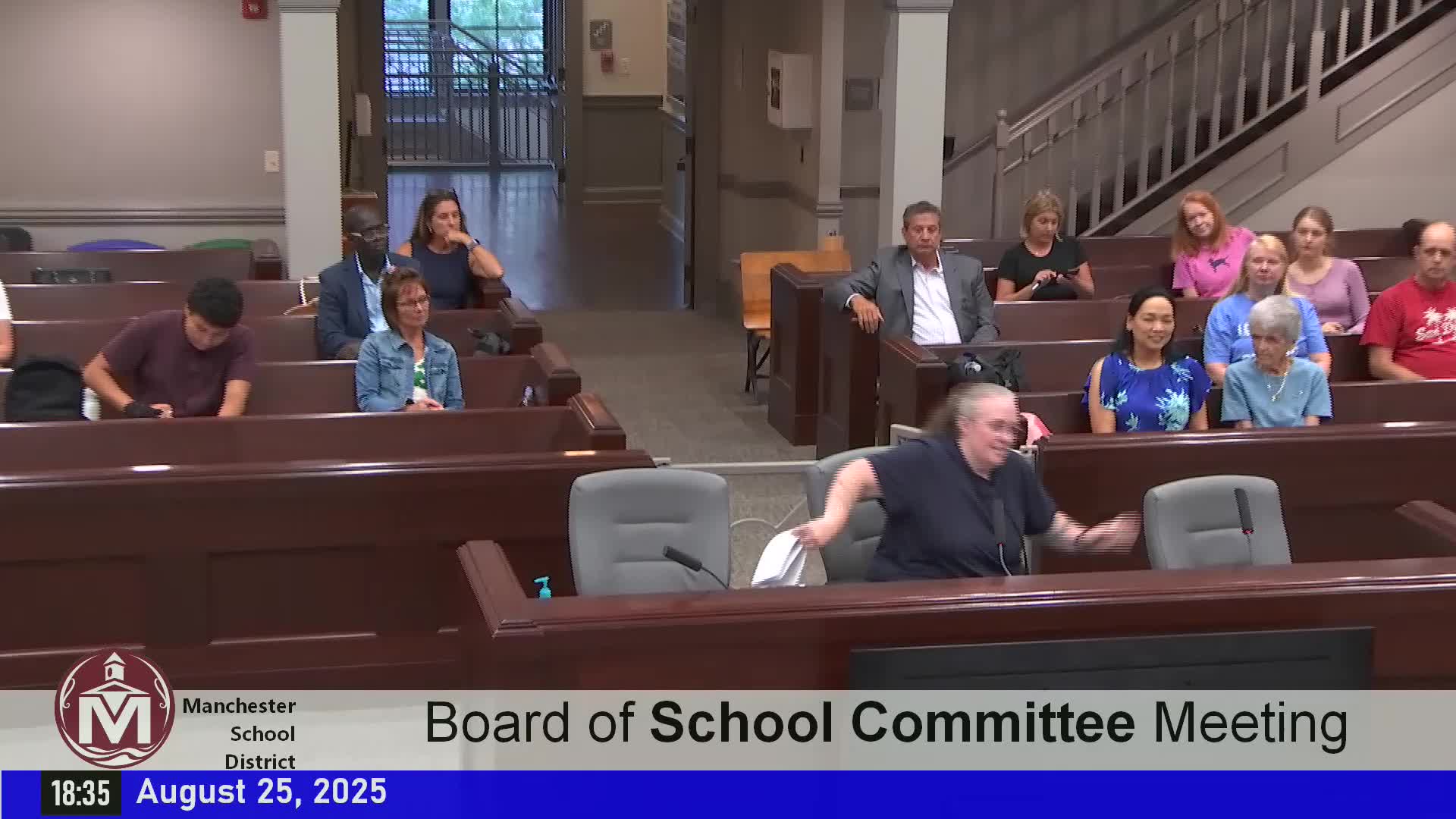
Summary
A school nurse raised concerns that a BAYADA one‑to‑one student service contract shifts clinical oversight and leaves the district financially exposed, prompting the Manchester School Committee to debate indemnification clauses, temp‑to‑hire penalties and billing rules before approving a packet of vendor contracts.
A resident and former school nurse told the Manchester Board of School Committee she believes the district lacks protections in a one‑to‑one nursing contract with BAYADA, and the board spent substantial time debating vendor indemnification language, temporary‑to‑hire clauses and whether the district is properly protected if contracted staff cannot be provided.
At the start of the meeting, Patricia Anglin, who identified herself as a school nurse and gave a Manchester address, spoke during public comment about an individual BAYADA student‑service contract. She said the contract provisions were problematic because they both shift clinical duties to the vendor and allow the district to be billed if the school cancels a nurse without guaranteeing the vendor will supply a replacement. “If the school district doesn't give 24 hour notice, the school district has to pay for the full day for the nurse,” Anglin said, and she said the contract provisions did not specify accountability if BAYADA could not find a qualified nurse.
Administration responded that the BAYADA engagement is an individual student service contract and that extended discussion of the specific student matter would require nonpublic review. The district later told the committee it has routes for raising concerns with the nursing supervisor and that it did not intend to exclude district nurses from care coordination.
The meeting then turned to a consent agenda that included seven contracts containing customary indemnification language. Committee members debated three recurring concerns: noncompete or temp‑to‑hire clauses that impose penalties if contractors’ employees later join the district; language that appears to require the district to pay for a contracted worker when a student is absent; and the practical difficulty of finding dedicated staff in hard‑to‑hire fields.
“Because we don't have people in house, we go to private enterprise... but we're then precluded from hiring that person because we're signing contracts that say that we won't employ that person who's working here as a contractor in the district for at least a year under penalty,” Vice Chairman O'Connell said, attacking the use of heavy financial penalties in temp‑to‑hire provisions. He described a sample penalty figure from a contract in the packet and said the penalties discourage converting quality contractors into district employees.
District administrators and counsel said the district has negotiated reductions in such penalties in the past and that legal changes at state and federal levels are limiting enforceability of noncompete‑style clauses. They also explained why providers sometimes bill the district for a day in which a dedicated one‑to‑one staff member could not be reassigned when a student is absent: the provider hired or reserved a dedicated person for the assignment. “The provider has to hire an individual in these circumstances to stay with a particular child,” an administrator said; if the district refuses such contract terms, administrators warned, the district risks losing access to dedicated personnel for students with significant needs.
After extended discussion the committee voted to approve the packet of contracts containing indemnification language. The motion to approve was made by Vice Chairman O'Connell and seconded by Committee member Bergeron; the board approved the motion on voice vote. The administration said it will continue to pursue hiring internally where possible, and noted recent tentative agreements that could improve recruitment (for example by awarding credit for hospital experience for nurses). Administrators also said they are pursuing an RFP strategy to lower contractor costs and that persistent shortages remain in speech‑language pathology, nursing and school psychology.
The exchange highlighted a tension the committee faces between limiting vendor contract terms that restrict hiring and ensuring the district can secure specialized, dedicated staff in a market with workforce shortages.