Get Full Government Meeting Transcripts, Videos, & Alerts Forever!
Get email alerts on the State Legislation topic
No spam. Unsubscribe anytime.
State legislative changes prompt new parental communications rules and questions about open enrollment and education freedom accounts
Summary
A New Hampshire School Boards Association briefing summarized recently enacted education-related bills, including the parental bill of rights, changes tied to the state budget (House Bill 2), new school ballot disclosure rules and continuing uncertainty around open enrollment and education freedom accounts.
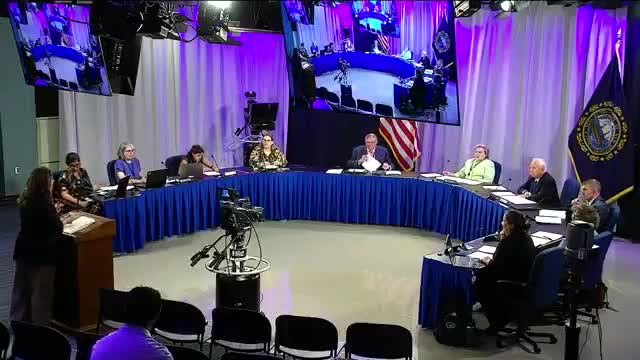
Becky Wilson, director of governmental relations for the New Hampshire School Boards Association, briefed the Salem School Board on legislation enacted during the 2025 session that affects school governance and operations. The association released a legislative summary listing bills signed into law, including changes placed in the state budget via House Bill 2, and standalone bills such as House Bill 10 (the parental bill of rights) and House Bill 557 (new school budget ballot disclosure requirements). Wilson described roughly 50–60 enacted bills that apply to public schools.
Wilson said the parental bill of rights largely consolidates existing rights but adds new specifics, including a provision that a parent who submits a written question to a district staff member should receive a “prompt, accurate, complete and truthful” response within 10 days. She and district legal advisers warned that the statute does not define terms such as “prompt” or “complete,” and that federal student-privacy law (FERPA) and mandated-reporting obligations to the New Hampshire Department of Children, Youth and Families (DCYF) may limit what staff can disclose. "A complete truthful answer is 'I'm sorry but because of student privacy I cannot give you this other information,'" Wilson said.
Board members asked how the 10-day timeline would work when staff consult supervisors or local counsel. Wilson said districts should acknowledge receipt and work with administrators and counsel, noting most inquiries are handled informally by phone or email and do not rely on the parental bill of rights. She said the state board of education must write rules tied to new responsibilities for educators under the educator code of conduct, and those rules are pending.
Wilson also reviewed open enrollment changes. She said House Bill 771 requires districts to include line items in their budgets for expected open-enrollment revenues and expenditures, but that the association’s interpretation is that both sending and receiving districts still must agree to be open-enrollment partners; absent a district vote to participate the budget lines should list zero. She noted litigation at the New Hampshire Supreme Court over whether a receiving district may require payment when a sending district never agreed to open-enroll students.
On education freedom accounts (EFAs), Wilson said eligibility rules were broadened this year, income limits were removed and the program has exceeded its numeric cap. She said the program is "wildly over budget" and that changes to adequacy and eligibility rules (including simplified documentation for certain differentiated aid) complicate state budgeting and auditing. Wilson said EFAs currently draw from the Education Trust Fund and that, if the trust fund is depleted, agencies may seek general-fund transfers, which would compete with other state priorities.
Wilson also summarized ballot-content changes: House Bill 557 requires additional information printed immediately before the school budget question, including recent subject-area scores and per-pupil cost, and the law requires school-budget ballots be prepared following new clerk procedures. She urged districts to review the association's legislative addendum listing new ballot and budget tasks and to coordinate with local counsel and municipal clerks.
Wilson offered to answer follow-up questions and said the association will hold a webinar in mid-September to review enacted bills in detail. She advised districts to work with legal counsel when district staff receive sensitive parental inquiries and to rely on FERPA and mandated-reporting rules where applicable.
Why it matters: Several enacted provisions change district duties, create new disclosure or response obligations, and introduce potential liabilities or costs (for EFAs and ballot production). District leaders and staff need clear procedures for parental communications, open-enrollment decisions, and budget-ballot preparation to avoid legal or operational missteps.