Get Full Government Meeting Transcripts, Videos, & Alerts Forever!
Get email alerts on the Urban Forestry topic
No spam. Unsubscribe anytime.
Urban Forestry Commission: University City canopy at 37%; commission urges annual KPIs, resident outreach
Summary
At a June 9 study session the Urban Forestry Commission reported University City’s tree canopy at 37%, outlined key performance indicators, flagged 519 state- and county-managed trees at risk, and recommended annual reporting and expanded resident communication.
The University City City Council on June 9 received a presentation from the Urban Forestry Commission that described the city’s tree inventory, recommended annual key performance indicators (KPIs) for tracking canopy health and maintenance, and urged additional outreach and intergovernmental talks over trees managed by the county and state.
Tim Schroeder, chair of the Urban Forestry Commission, told the council the city’s current canopy covers about 37% of University City, compared with a commonly cited 40% target from the U.S. Forest Service for similar communities. Schroeder said the commission recommends tracking canopy coverage, tree counts and planting/removal rates, species diversity, size-class distribution, contractor versus in‑house work and resident communication on an annual basis: “We wanna consistently report on these KPIs every year to you so that you we can identify if there’s issues growing or if we’re improving,” Schroeder said.
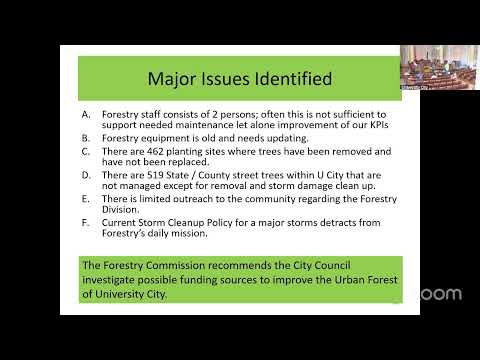
The commission said the city maintains an inventory created in 2020 that records size, species and geolocation for city‑managed trees and that the i-Tree Canopy tool was used to estimate coverage. The report lists 7,721 street trees and 2,978 park trees in the inventory (Ruth Park Woods was excluded from that park count), about 170 different species, and roughly 519 trees on high‑profile streets that are managed by the county or state — about 7.6% of the city’s managed trees. Commission members said those external agencies historically remove trees but often do not replace street trees, creating a risk to the city canopy unless University City pursues management agreements or other remedies.
Commissioners and staff also flagged several operational issues: planting rates have fallen over the last four years while pruning and removals have risen; the city operates on a five‑year pruning cycle aligned to trash‑pickup zones; there are about 462 planning sites where trees were removed but not yet replaced; city forestry staffing is small (commission members estimated roughly 5,000 trees per forestry staff person); and some forestry equipment is aged or was damaged by recent floods. The commission recommended continuing contractor use for large pruning and removals while tracking the balance of contract versus in‑house work.
Council members pressed on resident communication, liability for trees on county or state right‑of‑way, and practical matters such as species selection. Council Member Clay praised the work and emphasized resident concerns about hazardous limbs and sidewalk damage: “Our trees are certainly, assets. It’s 1 of the things that attracts many people to University City,” Clay said. Council Member Timon asked who would be responsible if the city replaced a county tree and said legal and liability questions would need exploration. City Forester Jacob Kaiser said pin oaks are overrepresented in the inventory and noted the challenge of replacing mature trees: “They are mature pin oaks. We are starting to lose them at a rapid rate,” Kaiser said.
Other council members suggested potential next steps: outreach to the county and state to determine whether management responsibilities or funding could transfer, exploring shared equipment agreements with neighboring cities, producing a public list of available tree species for resident plantings, and using professional planting for larger specimens while involving community groups for smaller “whip” plantings.
Schroeder said the commission will provide a written KPI report next year and recommended the council consider the commission’s forestry management plan for formal adoption and periodic review. There were no formal votes at the meeting; the presentation was received for discussion and follow up.
The Urban Forestry Commission presentation and the council’s questions foregrounded three immediate issues for University City policymakers: maintaining planting rates to sustain the canopy, clarifying management and liability for county/state‑managed street trees on several major corridors, and boosting resident outreach so private‑property stewardship complements city-managed assets.