Get Full Government Meeting Transcripts, Videos, & Alerts Forever!
Get email alerts on the Enrollment And Staffing topic
No spam. Unsubscribe anytime.
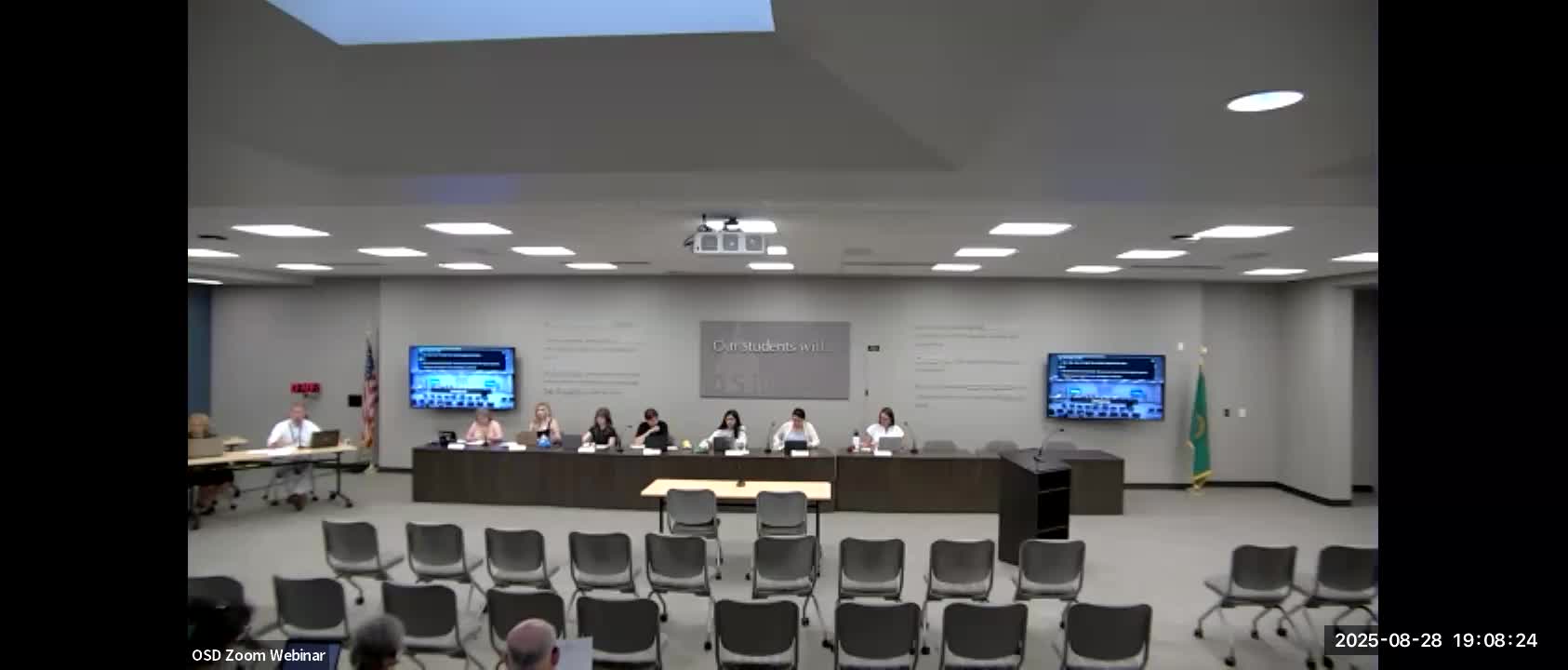
Olympia School District presents 2025–26 enrollment projections; board presses on boundaries and transfer process
Summary
Superintendent Murphy told the Olympia School District Board at its August meeting that the single largest driver of district revenue is student enrollment and that the district’s current numbers are still projections until students are counted after the start of school.
Superintendent Murphy told the Olympia School District Board at its August meeting that the single largest driver of district revenue is student enrollment and that the district’s current numbers are still projections until students are counted after the start of school. “We really don't know what the enrollment is going to be. We got a pretty good guess,” Superintendent Murphy said, adding that the official beginning-of-year count is the fourth day of school.
The presentation, led by the superintendent with Executive Director Kate Davis and Assistant Superintendent Whitehead, summarized how last year’s projection errors affected staffing and how enrollment typically shifts in the first weeks of school. Superintendent Murphy noted that the district had projected a decline of about 100 students for 2024–25 but ended up about 77 full‑time‑equivalent (FTE) students higher than projected. He also said kindergarten last year arrived about 35 FTE below projections, and the district will not know final numbers until early September when attendance stabilizes.
Executive Director Kate Davis told the board that elementary enrollment often grows after August by “about a 100 students from where we're at right now,” while high schools typically lose students over the first weeks as students take Running Start or other programs. Davis projected that high schools could decline 100 to 150 students districtwide, with Capital High School likely to fall by 70–80 and Olympia High School by 30–40. Middle schools generally shift less, “plus or minus 20 students,” she added.
Board members pressed staff on how local housing patterns and school boundaries affect enrollment volatility. Director Maria asked whether neighborhoods with more rental housing and apartments (for example, the area feeding LP Brown Elementary) have higher mobility and therefore more variable enrollment; Executive Director Davis said those neighborhood patterns often produce midyear enrollment changes and that principals and staff are noting different “personalities” for each school.
Several directors asked staff to bring follow-up analysis. Director Hillary asked for the enrollment math behind assumptions that cohorts would regain students as they progress through grades and whether consultants’ long-range projections were assuming recurring cohort gains. Superintendent Murphy said staff would return with more detail and that the district would request follow-up from the external consultant who produced draft projections.
Board members also discussed the operational tension between not wanting to overenroll (which strains staffing) and not leaving families waiting on out‑of‑district transfer lists. Superintendent Murphy said the district begins taking out-of-district transfer requests in February and that earlier commitments help staffing decisions, but that many names currently on rosters will be absent when school begins and other families may arrive late. “The sooner we can get that commitment, the better,” he said.
Directors sought clearer, earlier communication for families about transfer and wait‑list status. Director Darcy said she had not received a reminder as a parent and asked staff to outline the transfer process and timing. Executive Director Davis and Assistant Superintendent Whitehead said they would collect and share current communications practices with the board and consider policy or procedure changes to encourage earlier commitments.
The board agreed that boundary review should be part of future planning. Vice President Turtilat Palumbo and others noted the district has traditionally addressed boundaries during periods of growth; with enrollment shifts, directors said they want a discussion of how reboundering might balance building populations even if it does not change the total number of students districtwide.
Actions and immediate procedural items at the meeting included approval of the meeting agenda, previous minutes and the consent agenda; the consent agenda vote passed on a voice vote of “ayes.” Directors asked staff to post an updated board planning calendar and to schedule a fall work session that will revisit the district’s equity allocation and the enrollment and boundary questions.
The district will report final enrollment figures at the first board meeting in September after the district’s fourth‑day count and will return with more detailed cohort math, consultant follow-up and recommended next steps on boundaries and transfer procedures.