
Council delays vote on bond-backed tax incentive for Wildwood town-center apartments
Get AI-powered insights, summaries, and transcripts
Subscribe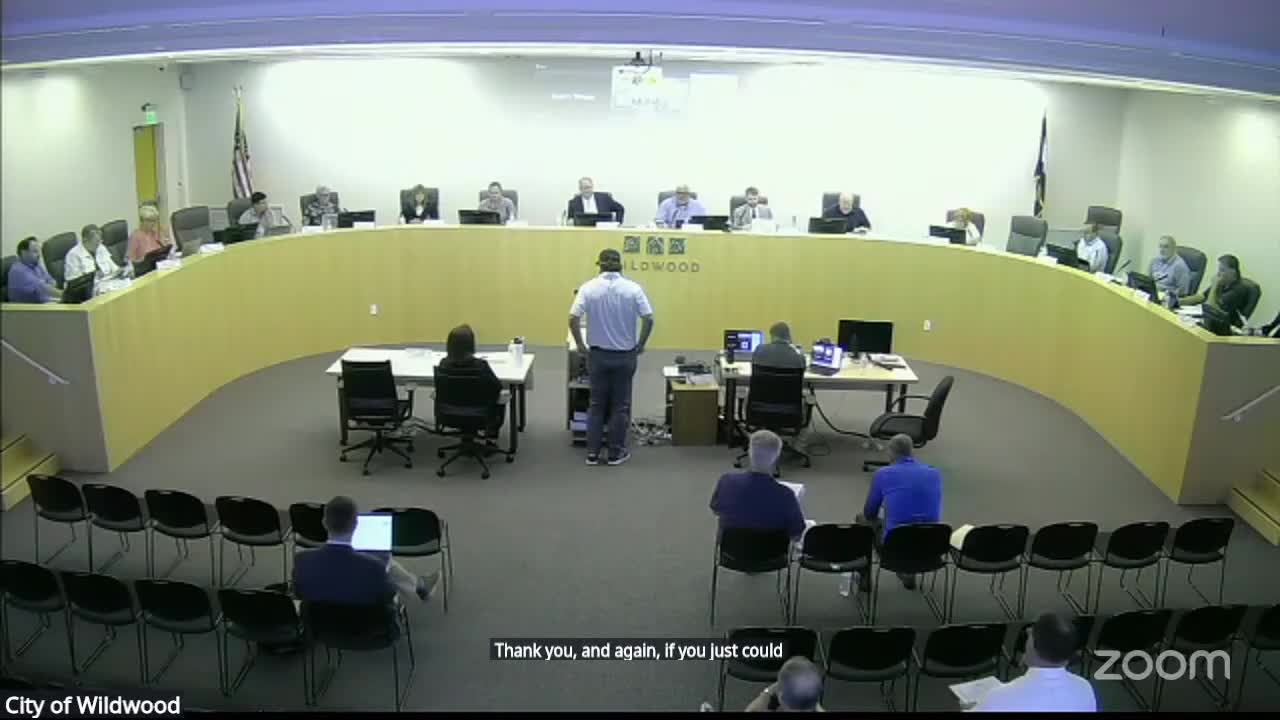
Summary
Developers seeking to build a mixed‑use apartment and retail project in Wildwood’s town center asked the City Council on Aug. 11 to accelerate consideration of a Chapter 100 industrial revenue bond and associated tax abatement; councilors declined to approve an immediate second reading, leaving the incentive request for later consideration.
Developers seeking to build a mixed‑use apartment and retail project in Wildwood’s town center asked the City Council on Aug. 11 to accelerate consideration of a Chapter 100 industrial revenue bond and associated tax abatement, but the council stopped short of granting the expedited vote needed to move the incentive forward this month.
The developer team — represented by Tom Keiman of MiaRose Holdings and partners including Greenberg Development and Ed Cohen — told the council the Chapter 100 financing is a necessary piece of the capital stack that would allow the Wildwood Luxury Living project to meet lender thresholds and begin construction this fall. Keiman said the developer has replacement financing from Southern Bank and asked the council for two readings of the ordinance so work could start this year. “We are anxiously looking forward to getting the project started,” Keiman said.
Why it matters: The proposal would put roughly 300 market‑rate apartments and about 7,000 square feet of retail in the heart of Wildwood’s town center, a location city leaders and several council members described as critical for downtown activation. The incentive would reduce taxes on construction materials and property for a limited period to help the developer offset extraordinary site costs developers say make the project infeasible without help. Opponents and several council members said the incentive shifts tax receipts away from other taxing jurisdictions, most notably the local school district, and asked for clearer contractual limits and tighter timelines before approving a long incentive period.
What council and developer discussed - Developer case and bank condition: Keiman said a bank commitment was canceled and later replaced; the new lender conditions lending on a Chapter 100 incentive because, without it, the project’s debt‑service coverage ratio would fall below the bank’s minimum. Keiman said the project’s financial analysis showed “about $4,200,000 of what we call extraordinary costs,” items he said are atypical for their other projects and that push the capital needs up. - Commitments to the school district: Keiman said the team met with the school district and committed to offering teachers and staff the same rental discount the developer offers emergency‑service workers. He described a recent meeting with district leaders as productive and said the developer will consult the district before seeking incentives on other properties in the district. - Developer timeline request: Keiman asked the council for two readings that night to preserve construction and financing milestones and said the team hoped to be pouring foundations by the end of the calendar year. - Council concerns: Council members pressed the developer on the source and reasonableness of extraordinary costs, the net financial impact to the city and other taxing districts, the precedent created by approving incentives, and how the City would verify contractor claims when invoices and subcontractor lists are lengthy. Several council members asked for more specificity on the developer’s proposed relief and on limits to any extension or other contract terms.
Extraordinary costs developers listed The developer presented a line‑by‑line summary of site‑specific items they called extraordinary (developer figures): retaining walls and fencing $525,000; exterior elevation/architectural enhancements $475,000; drive‑through structure $175,000; additional fire‑code work $310,000; rock/soil remediation $215,000; rooftop patio $180,000; intersection/public‑facing improvements $75,000; exterior lighting $50,000; interior enhancements $1,100,000; structural stem walls $110,000; and an Ameren substation and related infrastructure $465,000 — totaling about $4,230,000. (Amounts were provided to the council by the developer team during the Aug. 11 discussion.)
How the incentive would work and near‑term city revenue: City staff described the incentive vehicle as a taxable industrial revenue bond issued by the city, with standard reporting and administrative fees. Staff estimated the city could receive a one‑time bond issuance fee and net modest additional revenues through local sales and utility tax receipts once the project is occupied, while the school district and other taxing jurisdictions would receive reduced levies during any abatement period and full collections after the abatement expires.
Outcome at the meeting: Council members voted on a motion to hold a second reading of the ordinance that would begin the formal Chapter 100 process that night. The motion needed a supermajority to proceed immediately; the roll call returned 10 yes and 5 no, short of the supermajority required for a same‑night second reading. Because the developer had asked for an expedited two‑reading adoption, the failure to secure the supermajority means the Chapter 100 ordinance will remain at first reading and return to a future agenda for additional consideration.
Next steps and outstanding issues: Council members and staff said they want clearer, written limits on excusable‑delay clauses, additional documentation around the developer’s monetization assumptions (the present value calculation used to show the abatement’s effect), and a more formal process for verifying construction invoices and subcontractor reporting if an incentive is granted. City staff said they will revise the developer agreement language and provide additional supporting financial detail at a future meeting before the council acts on any incentive ordinance.