Get Full Government Meeting Transcripts, Videos, & Alerts Forever!
Get email alerts on the Parks And Recreation topic
No spam. Unsubscribe anytime.
Wildwood committee outlines $2.3M in park priorities, flags urgent trail and bridge maintenance
Summary
Committee members reviewed eight parks priorities for FY2026 — from Village Green Phase 2 fundraising to trail repairs and bridge stabilization — and discussed using reserves to fund immediate needs.
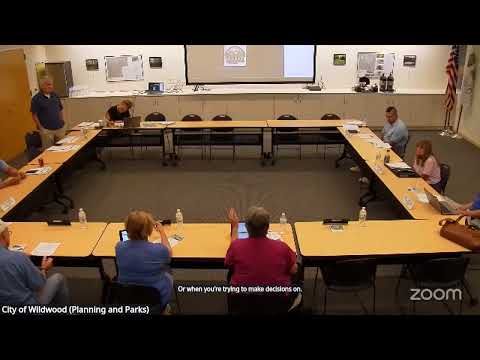
Wildwood’s Planning and Parks Committee on Aug. 18 reviewed a department list of eight priority park projects for fiscal 2026 and identified several maintenance items that staff called urgent, including trail repairs and creek abutment work on bridges.
Director Rudich presented the priorities list and told the committee that, aside from stormwater (covered separately), Village Green Phase 2 is a near-term priority because the project has $575,000 in grant funding committed and an estimated overall cost of about $2.5 million before fundraising. “Phase 2 of Village Green is the second priority...it also is grant funded. We have $575,000 of grant money that Melanie was able to apply for and achieve,” Rudich said.
Other projects identified by staff included: - Anniversary Park parking-lot resurfacing (staff cited a 2024 estimate of $35,000 and said the work was deferred for a safety project on Route 100); - Trail repair and resurfacing (staff said about $150,000 had been set aside in 2025 but was shifted and that the lake loop and Cherry Hills segments are among the worst); - Green Pines Connector Trail (roughly $500,000 with $267,000 in grant funding); - Incremental ADA improvements across parks (staff estimated $20,000–$25,000 per year to fund adult changing tables, accessible hard surfaces and inclusive play equipment); - Portner Park design and engineering (staff carried a $100,000 placeholder but said a lower design cost is likely); - Route 100/109 roadside sound mitigation pilot (a previously endorsed pilot, about $40,000).
Staff also described 13 bridges in the system with several that need immediate abutment or creek-bed stabilization. Rudich and parks superintendent Chris Neger described options for hard stabilization, including a poured-in-place anchored wall tied to bedrock, which staff said could be expensive but prevent moving the trail. “If we fix those bridges or address the bridges in the creek, they'll be fine,” Rudich said, citing a Great Rivers Greenway inspection and contractor input.
Committee members discussed homeowner responsibilities where trails cross private subdivisions (Cherry Hills) and whether the city could expect contributions. Rudich said the trail is on a public easement and that no funding commitment had been received from the subdivision; he noted residents had suggested placing trash cans but cautioned the ongoing maintenance cost. The department said options for Cherry Hills — trimming, rerouting, permeable surfacing or tree removal and replanting — would be examined if trail maintenance funding is approved.
On funding, staff set a combined figure of roughly $2.3 million for several priority projects after grant funds are removed; they also said typical annual replacement/repair contingency for park equipment has been about $50,000 and that one replacement (a disc swing) cost about $5,000. Committee members debated tapping reserves to begin work sooner; City Administrator Thomas Lee summarized prior financial analysis and staff said the city could consider dipping into reserves under a formal policy and a plan to replenish them.
No final appropriations were approved; the committee asked staff to return with clearer cost estimates, timelines and funding options during the budget process.