Get Full Government Meeting Transcripts, Videos, & Alerts Forever!
Get email alerts on the Municipal Budget topic
No spam. Unsubscribe anytime.
Jefferson City officials present mayors FY26 budget; council preliminarily approves revenue projection
Summary
The mayor presented a $87 million mayors proposed FY26 budget focused on personnel, public safety, roads and HVAC upgrades; council preliminarily approved the revenue projections to give staff a baseline for department discussions.
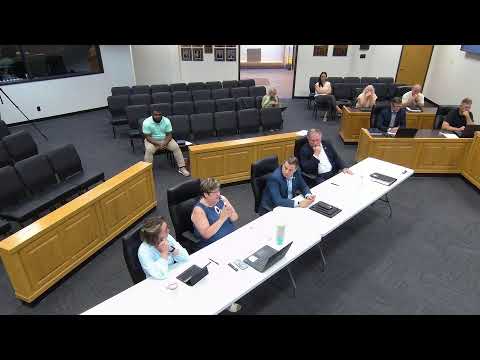
Mayor (unnamed) on Wednesday presented the mayors proposed fiscal year 2026 budget to the Jefferson City Council and said the proposal is intended to be a starting point for council deliberations and department reviews. Council members then voted to approve the revenue projections as the baseline for upcoming budget work.
The mayor said the document covers roughly an $87,000,000 investment in city services and called it a "bare bones" balanced recommendation that prioritizes employees, public safety, infrastructure and facility maintenance. "I first want to just thank our staff," the mayor said, acknowledging the work of City Administrator Mr. Crane and Miss Perry, who led the staff presentation.
Why it matters: Approving revenue projections lets staff and council proceed with department presentations and amendment planning; it also sets the assumptions that underlie spending requests and the five-year forecast. Councilmembers and staff flagged specific tradeoffs in the proposal, including a proposed transfer from the wastewater utility to support street infrastructure and a multi-year plan to address aging HVAC systems in city facilities.
Key details: The mayors letter and packet describe a budget that covers all city funds (the packet describes the total near $87 million), with about half of that in general fund activities and the rest in enterprise and special funds. Personnel costs are the largest single category: staff said personal services account for more than 75 percent of general fund expenditures and nearly half of total expenditures across funds. The mayor proposed a 2.5 percent pay increase across general city staff (matching public safety contract requirements) and built in health insurance increases of roughly 10 percent and dental increases of about 5 percent.
Revenue and a council vote: Finance staff (Miss Perry) explained the revenue assumptions, including a sales-tax projection set about 1 percent below the current-year budget (presented as $14.0355 million in the packet). Staff also described an intent to apply a gross-receipts-style utility charge on the citys wastewater operation and move those receipts into a streets infrastructure account; staff estimated that reallocation at roughly $815,000 for the year and said it would be directed to street infrastructure, not equipment. After the presentation councilmembers moved and seconded a motion to approve the revenue projections as the working baseline; the motion passed with council approval on the record.
Major spending proposals and tradeoffs: The proposal includes a capital improvements total of about $6.9 million, with line items noted in the packet for parks (about $700,000), fire (about $800,000), and police (about $560,000). The mayor also proposed addressing urgent facility needs uncovered by an energy audit: a roughly $1,055,000 upfront investment to replace or modernize HVAC in city facilities (with a roughly $400,000 ongoing annual financing cost if the city finances the entire project). Staff presented modeling showing that an upfront contribution from a sales-tax fund would reduce lifetime financing costs versus spreading the entire cost out over time.
Wastewater and the GRUT transfer: Finance staff and the city administrator described a plan to apply a gross-receipts utility tax (GRUT) approach to the city-owned wastewater system that would not raise customer rates but would move a portion of wastewater receipts into the general fund to pay for streets. Staff said wastewater had proposed roughly $1.2 million in capital spending and also proposed to add about $1.2 million to reserves; the councils recommended approach captures about $815,000 from wastewater gross receipts and directs it into the street-infrastructure budget. Bond counsel reviewed the concept and staff said the transfer would not breach wastewater bond covenants based on the review.
Five-year forecast and risks: Staff presented five-year forecasts for the general fund, public safety tax fund and enterprise funds. Under the budget assumptions (2 percent revenue growth, 2.5 percent salary growth, and higher inflation assumptions for materials and insurance), the public safety tax fund and some enterprise funds show declining fund balances in later years. The finance presenter cautioned that revenue changes are difficult to reverse once enacted and urged council members to be conservative in proposing additional revenue reductions.
Process and next steps: Staff posted the full mayors packet and the budget book online and encouraged council members to submit questions by email so staff can answer and distribute them uniformly. The packet includes a budget calendar and a deadline for council budget amendment submissions; staff said amendments will be due to finance by the date listed in the calendar and council will consider amendments and votes in subsequent scheduled budget meetings. The preliminary vote on revenues will be replaced by a formal adoption if and when council approves the final budget later this fall.
Ending: Council and staff agreed to continue the department-level presentations and follow the calendar for amendment submissions; staff said they will distribute answers to council questions and that bond counsel confirmed that the wastewater transfer would not violate bond covenants as presented.