Get Full Government Meeting Transcripts, Videos, & Alerts Forever!
Get email alerts on the Charter Review topic
No spam. Unsubscribe anytime.
Charter Review Commission presents recommendations; council directs staff to bring five items for ballot consideration, several motions fail
Summary
The Charter Review Commission presented recommended charter amendments and the Blue Springs City Council directed staff to return ballot language for a subset of items — including administrative-organization changes and petition procedures — while several proposed changes (term-limit and mayor voting rotation changes) failed in council votes.
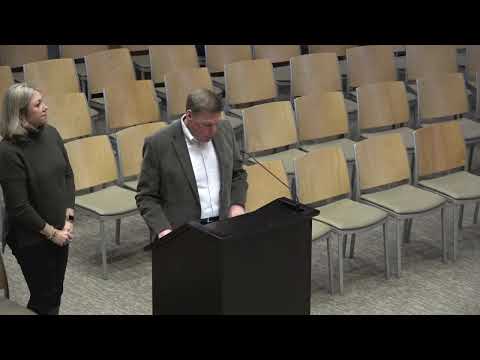
The Charter Review Commission presented a package of recommended charter amendments to the Blue Springs City Council on Jan. 7 and the council directed staff to prepare ballot language for several of the commissionrecommendations.
Ken (chair) and Kelly Montgomery (vice chair) summarized the commission's work, noting the city has required charter review at least every five years. The commission recommended several clarifying and substantive changes grouped into categories including council and mayor provisions, administrative organization, initiatives/referendums/recall procedures, and several housekeeping clarifications to modernize language and references (examples cited: changing "comprehensive development plan" to "comprehensive plan" and updating audit language to reference Governmental Accounting Standards Board principles).
Key council directions and votes
- Item 2 (administrative organization): The council voted to direct staff to draft ballot language to permit establishment of a city health department by ordinance and to rename/clarify the comprehensive plan update cycle to match state law. (Voice vote; approved.)
- Item 3 (initiatives/referendums/recall): The council directed staff to put the commission's proposed clarifications to petition procedures on the ballot, including requiring petition committee members be registered voters, removing anachronistic references (for example, to an "indelible pencil"), adding printed-name requirements next to signatures, and extending the filing window from 60 to 90 days. (Approved by voice vote.)
- Item 1a (public comment timing and related clarifications): The council directed staff to return language for a narrow change to move the public-comment opportunity so citizens may be heard prior to approval of an ordinance; the council emphasized procedural limits would be set by council rules of procedure. (Approved by voice vote.)
- Item 4 (audit/capital budget clarifications): Council directed staff to place the housekeeping recommendations on the ballot (including audit language referencing GASB and clarity about budget and capital improvement program postings). (Approved by voice vote.)
- Item 1c (timeline to appoint a replacement for a vacant council member): Council approved directing staff to place language on the ballot to allow two regular council meetings (instead of the next council meeting) to appoint a replacement and to clarify the appointed replacement serves until the end of the term. (Approved by roll-call vote.)
Votes that failed or were not approved for ballot direction
- Item 1b (term limits): A motion to set council term limits (discussion centered on 12 years for council members, 16 for mayor in one proposal) was debated and rejected in roll call.
- Item 1d (placing the mayor in the roll-call voting rotation rather than voting last): Council defeated a motion to change the mayor's roll-call placement; council members argued both for transparency and for preserving the mayor's role as meeting chair.
Discussion highlights and process notes
Commission chair and vice chair described recommendations that clarify petition filing, circulation procedures, and filing timelines; many recommendations came from resident submissions. Council members debated process trade-offs: some argued a required separate meeting between first and second readings of ordinances would improve deliberation and allow additional public input; others said it would slow routine business and complicate development approvals. The council and city attorney clarified that the charter amendment could require only that citizens be given an opportunity to be heard before an ordinance is approved, with operational details left to the council' rules of procedure. Several council members expressed preferences for limiting public comment to items on that evening's agenda via council rules rather than by charter language.
Next steps
Council asked staff to return proposed ballot language and an ordinance at the next council meeting; the commission noted an upcoming election timeline (the commission stated an election would be held on April 8 and mentioned a certification deadline reported in the presentation, which the transcript renders imprecisely). The council will consider final ballot language and ordinances at the Jan. 21 meeting.