Get Full Government Meeting Transcripts, Videos, & Alerts Forever!
Get email alerts on the Zoning Rezoning topic
No spam. Unsubscribe anytime.
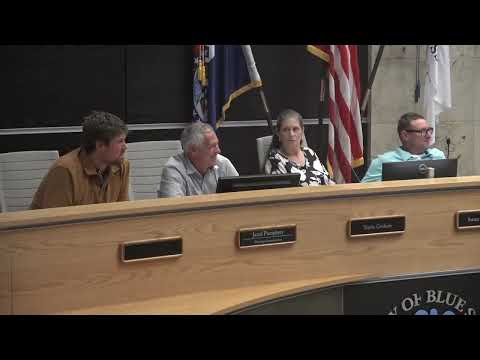
Blue Springs planning commission tables rezoning for Rampage Athletics after neighbor concerns
Summary
The Blue Springs Planning Commission voted to table a rezoning request for 2001 Southwest Ninth Street, proposed to allow Rampage Athletics to operate from a church-owned gym, after neighbors raised traffic and long-term land-use concerns; the item will return to the commission on July 28, 2025.
The Blue Springs Planning Commission on June 14 voted to table a rezoning request for 2001 Southwest Ninth Street that would have changed the property from MF-14 (moderate-density multifamily) to General Business to allow Rampage Athletics to operate evenings inside a church-owned gym. Chantelle Fry, associate planner for the city of Blue Springs, told commissioners the property is one 1.74-acre parcel and that the request is “strictly a rezoning from the MF-14 to the General Business.” Fry said there are no site modifications or new construction proposed as part of this application. The rezoning was filed by Michael Scott, pastor at Saint Peter United Methodist Church, who told the commission the church bought the property about three years ago and has partnered with Rampage to allow evening youth programming in the existing gym. “We are trying to do the right thing and get it rezoned to the proper zoning so that we can operate as necessary,” Scott said. Neighbors opposed the rezoning at the public hearing. Sherry Frost, who lives directly behind the church property, said she is “extremely concerned about it being changed, like rezoned for a business,” citing worries about increased traffic and the possibility that a future owner could replace the current tenant with a less compatible use. Bob Frost, a local contractor who helped develop homes in the area, said the potential for other business types to move in after a sale was his main concern and called the change “a lifetime change.” Staff and commissioners discussed zoning alternatives and limits. Fry noted that the 2014 Comprehensive Plan designates the site as part of a neighborhood area but that rezoning to General Business could allow neighborhood-serving commercial uses. City staff explained that some uses in a General Business zone still would require conditional use permits and that a Planned Development (PD) zoning could be used to stipulate specific allowed uses and conditions. The assistant director clarified the city's interpretation of assembly use thresholds: depending on assembly size, a PD or a General Business designation could be required for groups too large to be permitted under MF-14. Commissioners also asked whether a condition could be written so that if ownership changed the property would revert to MF-14; the city attorney (Jennifer) said reasonable restrictions can be placed on a rezoning but raised practical questions about how the city would track and enforce a reversion condition if the property sold. Staff said some restrictions can be included but would require follow-up to determine enforceability and mechanics. After extended discussion, Commissioner (name not specified in the public record) moved to table the application and the commission amended the motion to set a date certain for reconsideration at the next meeting on July 28, 2025. The motion passed on a roll call of all present: Commissioner Egersoll (aye), Commissioner Pumphrey (aye), Commissioner Stonenberg (aye), Commissioner Kratoff (aye), Commissioner Graham (aye), Commissioner Howe (aye) and Chairperson Henning (aye). The formal action is recorded as a tabled motion to reconvene consideration on 07/28/2025. Discussion versus decision: the commission’s action was procedural (table to a date certain) and not a recommendation for approval or denial. Commissioners explicitly debated whether to recommend General Business, PD, or SF-7 (single-family) zoning, and asked staff to research whether a PD could incorporate the current athletic use while limiting future incompatible uses. The city attorney advised commissioners that rezoning is a legislative decision where broader considerations — including potential future uses — are proper to weigh. No rezoning was approved at the June 14 meeting. Next steps: staff will return to the commission with follow-up information requested during the hearing about PD options and the mechanics of possible conditions tied to future ownership. The item will be scheduled for the Planning Commission meeting on July 28, 2025, and will later go to City Council for final action. Why it matters: Rezoning from a residential multifamily district to General Business can broaden the set of permitted uses on a parcel, which neighbors said could change noise, traffic, and truck activity patterns in an established neighborhood if the property is resold in the future.