Get Full Government Meeting Transcripts, Videos, & Alerts Forever!
Get email alerts on the Hotel Topeka Repayment topic
No spam. Unsubscribe anytime.
Transient guest tax committee backs plan to use Hotel Topeka revenue to repay city costs
Summary
The Transient Guest Tax Committee voted 2-0 to forward a proposal that would impose an 8% transient guest tax (TGT) at Hotel Topeka to help the city recoup $17.7 million spent to date; the committee favored a hotel-specific approach over a citywide capture of future TGT increases.
TOPEKA, Kan. — The Transient Guest Tax Committee voted 2-0 Aug. 27 to forward to the City Council a plan that would impose an 8% transient guest tax (TGT) on Hotel Topeka and use revenues above a 2025 base year to help the city recover costs it has already paid on the property.
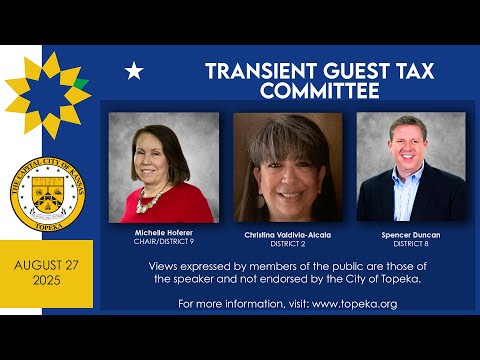
The committee chair, Michelle Hoefer, and committee member Spencer Duncan approved the motion to advance what staff labeled “option 2.” Deputy City Manager Braxton Copley briefed the committee on two policy options for repaying the city’s Hotel Topeka expenses and the fiscal projections supporting each option.
Why it matters: City staff told the committee the total of operating, capital, bond principal and interest related to Hotel Topeka through the current accounting is $17.7 million. Staff said those figures include $3.6 million in operating and capital expenses to date, about $8.7 million in bond principal and roughly $5.3 million in interest over 20 years. Under option 2, the city would assign an 8% TGT at Hotel Topeka (higher than the citywide rate) and apply the increment above a 2025 base year toward repayment until the costs are recouped.
What staff presented: Braxton Copley, deputy city manager, described two approaches. Option 1 would capture citywide transient guest tax increases that occur when scheduled TGT sunsets reduce the citywide rate from the current 7% to 6% on Jan. 1, 2028, and then to 5% on Jan. 1, 2033. That option would temporarily divert the increment to reimburse the city and then revert the TGT to 5% once repayment is complete. Option 2 would keep the citywide structure intact while imposing a hotel-specific 8% TGT at Hotel Topeka; the hotel-specific increment would be dedicated to repaying the project.
Copley said projections for option 2 — which are calculated on the increment above a 2025 base year — show slower repayment: the city would collect roughly $14.8 million by an intermediate forecast year and could extend toward the 17.7 million total in a much longer timeframe, likely decades, depending on future occupancy and revenue growth. Staff told the committee the 2025 base year is a projection drawn from 2024 actuals and receipts through July 31, 2025, and that it is unlikely to materially change before the sale and conveyance to the purchaser, Endeavor Group.
Committee discussion and vote: Committee members discussed the policy trade-offs. Hoefer asked how the $1 million down payment on the hotel would affect the recoupment total; staff replied the packet and calculations use the total expended to date and that removing the $1 million would reduce the total to about $16.7 million. Copley emphasized that some portions of the current 7% TGT are contractually obligated and therefore must be protected in any proposal. Those obligations include: a 1% allocation for Sunflower Soccer bond payments that runs through the scheduled sunset date for that obligation and an additional 1% divided among Jayhawk Theater, Constitutional Hall, Evergy Plaza and the Downtown Ice Rink that is contractually obligated through Dec. 31, 2027. Staff also said that of the remaining 5% TGT, 79% currently is allocated to Visit Topeka for the remainder of the year, 11% is allocated to the city’s bidding or event fund commonly referred to as the BID/contribution fund, and about 5% of the remainder goes to the general fund.
Spencer Duncan said he preferred option 2 because it tracks the hotel’s own revenue stream and is consistent with the governing body’s prior conceptual approval; he moved to approve option 2. Hoefer seconded the motion. The committee voted 2-0 to forward option 2 to the City Council for consideration.
What the vote does and does not do: The committee’s action sends the staff recommendation implementing an 8% Hotel Topeka TGT structure to City Council; it does not itself change the citywide TGT rate, nor does it execute the conveyance to Endeavor. The motion instructs staff to move the proposal forward for Council review and to continue the sale process.
Next steps and uncertainties: Staff and committee members noted the repayment timetable under option 2 depends on actual occupancy and the purchaser’s investment in the hotel. Copley said projections contain numerous assumptions and that future occupancy increases projected from the renovation are already built into the model where appropriate. The City Council will consider the committee’s recommendation at a future meeting. Committee materials indicated the base year used for calculations is 2025, and staff said the sale closing and improvements by Endeavor are unlikely to materially change that base for the purposes of the repayment schedule.
Source excerpts from the committee meeting include Copley’s explanation of the options and the committee’s votes.