
Council approves Lawrence Bay RHID despite resident objections about past unpaid assessments
Get AI-powered insights, summaries, and transcripts
Subscribe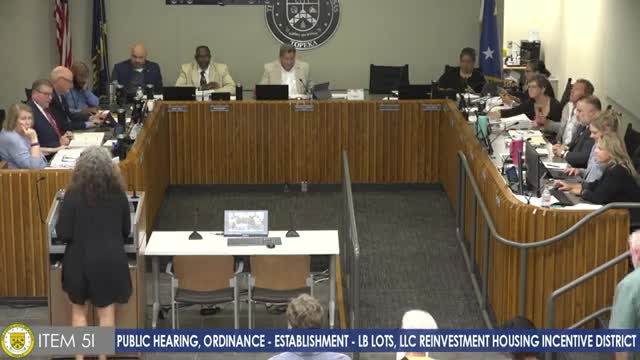
Summary
The council approved a reinvestment housing incentive district (RHID) for a Lawrence Bay parcel amid sharp public criticism that the developer has unpaid special assessments and limited financial assurances; staff said the RHID includes conditions and a cap on developer return.
The City Council voted to establish a reinvestment housing incentive district (RHID) for L.B. Lots LLC(Lawrence Bay) on Aug. 12 after a contentious public hearing in which opponents warned the deal would redirect tax revenue and relieve a developer of prior financial obligations.
At the hearing Danielle Tremlo, a resident and community advocate, urged the council to reject the RHID and described a wide-ranging financial picture that she said advantages the developer at taxpayers' expense. Tremlo asserted the developer had outstanding special assessments on many properties and said the RHID and CID structure would shift costs to future homeowners. "This shifts this money to the special assessments to future homeowners avoiding any responsibility," Tremlo said; she also said the city's financial-adviser report contained cautionary language about the application's lack of third-party guarantees or evidence of private financing.
A city staff presenter summarized the background to the council: the county had prepared to auction parcels in late 2024; the council in September 2024 approved removing a set of 16 lots from tax-foreclosure auction in return for negotiated payment terms and a development agreement. Since March 2025, staff and the developer negotiated a development agreement that the council previously approved. The RHID application seeks to use a portion of future property-tax increments to reimburse vertical construction costs under the terms negotiated in the development agreement.
Staff emphasized three protections included in the RHID ordinance and development agreement: certification of total construction costs supported by paid invoices, proof of sales prices via closing statements when lots are sold, and an annual developer certification (by Jan. 31) showing the developer's effective cap rate will not exceed the 7.5% cap in the development agreement. Staff said those provisions are intended to limit developer returns and protect the city; they described the RHID as the final step in a multi-stage process that included prior council approvals and formation of the related CID.
Council members debated the policy choice. One council member noted that the September 2024 council action had already granted the developer an exception from a city policy that ordinarily prevents RHID awards to parties with outstanding special assessments; staff said they were unaware of other cases where the city granted a similar exception. Another council member and other speakers voiced concern about precedent and the financial implications for the city, schools and other taxing entities if revenue is diverted for incentives.
Council approved the RHID ordinance on a 7-3 vote; Councilmembers Valdivia Acala, Banks and Hofer voted no. Council discussion and the staff presentation noted the RHID's 7.5% cap on developer return, the certification requirements and the city's oversight steps. Opponents said those protections were insufficient and argued the developer had not proven access to private financing or third-party guarantees. Proponents said the RHID was needed to allow the project to proceed and that the negotiated protections limit city exposure.