Get Full Government Meeting Transcripts, Videos, & Alerts Forever!
Get email alerts on the City Budget topic
No spam. Unsubscribe anytime.
Manhattan commissioners weigh up to 2-mill levy to fund 2026 budget, staff pay and reserves
Summary
City Manager Danielle Doon presented a recommended 2026 budget that would use a mill-levy increase to cover employee cost-of-living adjustments, vehicle/equipment needs and shore up reserves; commissioners asked staff to run scenarios including a 1.75-mill option and a lower 1.134-mill option and did not adopt a final levy.
City Manager Danielle Doon presented the citycommission with a recommended 2026 budget on Aug. 12 that would rely on a mill-levy increase of as much as 2.0 mills to fund employee pay adjustments, equipment replacements and to rebuild the citygeneral-fund reserve.
Doon said the recommended package contains an increase that would raise the citymill levy to about 55.109 and would capture roughly $1,495,000 from an additional 2-mill increase; the revision shown to commissioners also reflects $1,400,000 in additional property-tax revenue from market growth and community improvements. "This is the recommended budget that I did put before you," Doon said during the presentation.
Why it matters: commissioners framed the discussion as balancing pressure on property taxpayers with the city—s need to retain staff and maintain service levels. Commissioners acknowledged both rising operating costs (asphalt, cement, vehicle maintenance) and retention problems: Doon said half the city workforce has been with the city one to five years and cited an example of a street superintendent leaving for the county for a roughly $9,000 annual pay increase.
Most important facts
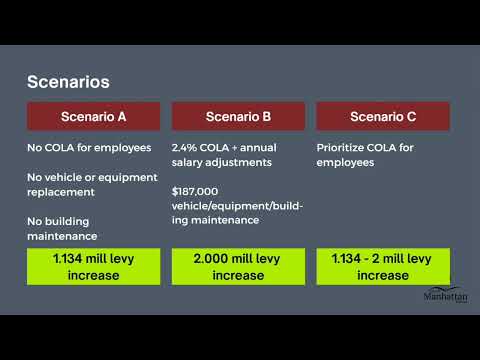
- Staff presented three scenarios: Scenario A (a 1.134-mill increase, presented July 8, with no cost-of-living adjustments or vehicle/equipment replacements); Scenario B (the full 2-mill proposal, which includes a 2.4% cost-of-living adjustment and annual salary adjustments plus $187,000 for vehicle/equipment or building maintenance); and Scenario C (a middle option for discussion). Doon said the 2-mill package would bring the total mill levy to 55.109.
- The recommended change increases projected property-tax revenue for 2026. Doon told commissioners the change produces an approximately $648,000 increase in general-fund revenue compared with the July 8 presentation; the general fund expenditures shown in the new proposal are about $186,000 higher than the adopted 2025 budget.
- Staff recommends budgeting for a 2%--3% delinquency rate on property-tax receipts (Doon: "we've seen a trend of, a 2 to 3 percent delinquency rate"), and said the city should begin building a cash reserve specifically for the Riley County Police Department (RCPD) fund once delinquencies arrive so the city does not have to budget for them each year.
- Commissioners did not set a final mill levy at the meeting. Instead they directed staff to run additional scenarios and return with numbers. Doon said staff will present scenarios including the existing 1.134-mill option, a 1.75-mill scenario (which staff estimated would allow a 2.4% COLA and annual adjustments while cutting the $187,000 for vehicles/equipment), and a version aligned to a 4.5% city tax increase for comparison. The commission scheduled further discussion at upcoming public budget open houses (Aug. 16 and Aug. 21) and planned to review scenarios before the Sept. 16 hearing and single reading of the budget ordinance.
Public comment and community concerns
Two residents who addressed the commission said the cumulative property-tax increases this year felt large. Andrew Von Lintel, of Winds Court, said his statement showed about a 10.25% increase for his property on the preliminary paperwork and that the change would be "rough on a lot of people." Gary Owls (who provided his street address) reviewed his own multi-year property-tax history and urged clearer presentation of city-only taxing impacts, telling the commission it is confusing when RCPD and other taxing entities are folded into one display.
RCPD funding and statutory context
Commissioners and staff repeatedly distinguished the citygeneral fund from the Riley County Police Department (RCPD) funding arrangement. Doon and other speakers said the law board (the governing entity for RCPD) submits a dollar amount the city is required to fund; Doon described that arrangement as similar to a contract. A commissioner noted that "the statute says it's all supposed to be funded by property tax," a point used to explain why the police funding picture complicates city-only mill-levy calculations. Commissioners discussed but did not change the current allocation method at the meeting.
Other budget items and numbers discussed
- Doon said staff will continue to assume a 3% increase in water and wastewater utility rates and a 6% stormwater rate increase for modeling, plus 1.5% sales-tax growth.
- Examples circulated in the presentation showed different household impacts depending on appraisal changes: a Colbert Hills home increased to about $515,000 with a 3.45% appraised-value rise and a roughly 4.37% total tax increase; a Miller Ranch example used a 9% property-value increase producing a 13% tax increase; a Ward 3 example showed a 6.76% value increase and an 8% tax increase.
- Staff reported a projected general-fund ending balance of about $11.8 million at the end of 2026 (Doon: "we are planning on ending the year at 11.8").
Community services and special requests
Doon said the proposed budget currently includes $557,000 for community-services support; applications closed Aug. 5 and the city received requests totaling $645,000. The commission discussed the timing for special-alcohol and social-services grant deliberations and asked staff and the SISFAB group to prioritize basic human-need requests as part of that review.
Next steps and direction
The commission did not adopt any mill-levy change at the Aug. 12 work session. Commissioners asked staff to prepare a 1.75-mill scenario (staff said that would fund a 2.4% COLA and annual adjustments while cutting the $187,000 vehicle/equipment line) and to present a 4.5% city-side comparison. Doon confirmed the single public hearing and ordinance adoption is scheduled for Sept. 16 and that staff will present revised scenarios and public-feedback summaries from the Aug. 16 and Aug. 21 open houses before final action.
Actions and formal votes
The only recorded formal motion during the work session was a procedural motion to allow public comment, which passed by roll call (all commissioners present voted yes). No formal votes on the budget, mill-levy or specific expenditures were taken.
Ending
Commissioners closed the work session with direction for staff to run the agreed scenarios, present results at the public hearing and continue outreach at the open houses. No final levy or budget adoption occurred at this meeting.