
AHAB revenue subcommittee forms plan to research new funding for affordable housing
Get AI-powered insights, summaries, and transcripts
Subscribe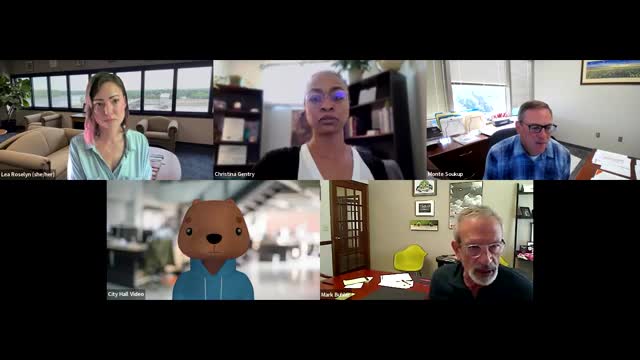
Summary
Members of the Affordable Housing Advisory Board’s revenue subcommittee met to clarify that a recent sales-tax increase did not raise the trust fund, set a work plan to research alternative revenue models and scheduled a follow-up meeting for Sept. 11.
The Affordable Housing Advisory Board (AHAB) revenue subcommittee met virtually and agreed to research additional revenue sources for the city’s affordable housing trust fund, after staff confirmed a recent voter-approved sales-tax increase is not increasing the trust fund’s current allocation.
The clarification came as the panel — chaired by Christina Gentry, Chair, Affordable Housing Advisory Board Revenue Subcommittee — took its first meeting under new advisory-board public-meeting rules and sketched a work plan to analyze other cities’ funding models.
"But I'm here for the discussion and any ideas or any other notes and next steps that we can take in this group," Gentry said at the start of the session.
Why it matters: residents and AHAB members said many voters expected the recent sales-tax increase to produce more money for on-the-ground housing construction. Instead, staff said the new revenue stream is being routed to homelessness services and the trust fund’s annual allocation has not changed. The subcommittee will compile comparative research and present recommended revenue options to the full AHAB.
Leah, a staff member supporting AHAB, told the group that "right now, our sole revenue source is through the affordable housing sales tax. That generates...approximately we're estimating around $2,400,000 annually, after the latest election doubling the sales tax. However, the AHAB amount going into the affordable housing trust fund has remained the same." She added that the additional half-cent approved by voters is currently allocated to the homelessness solutions division.
Members pressed for detail on how the sales-tax revenue is split. Leah said the division of funds is not dictated by the ballot language and is determined through the city's annual budget process, with recommendations from the city manager and final approval by the City Commission. She also told the subcommittee that the 2026 budget split had been set at 50–50 between homelessness and the trust fund.
Panel members discussed program priorities. Mark Bueller, a subcommittee member, said he prefers spending trust-fund dollars on permanent housing: "I would say...we would spend affordable housing money on bricks and mortar and permanent upstream solutions." Several members contrasted that long-term approach with what they called short-term uses such as emergency rental assistance or vouchers.
Leah confirmed how vouchers have been treated: "We've...met about that, and it's been communicated that if that is going to be funded through the city, that that is going to come through the AHAB." She added that AHAB can make recommendations for the portion of sales-tax revenue that feeds the affordable housing trust fund but not for the half currently directed to homelessness services.
On next steps, the subcommittee agreed on a work plan: members will review a set of compiled resources that Leah shared and each return to the group with two or three revenue models they think merit deeper study. The resources include a National Low Income Housing Coalition compilation of local housing trust-fund revenue models and links to examples such as recording-fee increases, redirected municipal fines, and other local funding tools.
The subcommittee also agreed to create a shared document repository for research. Leah said the city uses Microsoft tools for official subcommittee work and offered to coordinate with IT to make a Microsoft-based shared folder available for members and to post public items to meeting agendas.
The group scheduled a follow-up meeting for Sept. 11 at 4:30 p.m., with the City Manager's Conference Room listed as the tentative in-person location. "Okay. Well, Alright. I will get that, booked and sent out to you in a calendar invite as a confirmation," Leah said.
There were no formal motions, votes or policy actions at the meeting; the subcommittee is chartered to research and make recommendations to the full AHAB and the City Commission. Public comment was opened at the end of the session; no public speakers were recorded on the transcript.
The subcommittee instructed staff and members to: assemble the resource folder; each review the compiled models and pick two or three avenues for deeper review; and prepare to present findings at the Sept. 11 meeting. The committee also discussed, as possible lines of inquiry, whether some existing trust-fund uses (for example short-term rental assistance) could be shifted to the homelessness services budget so the trust fund could prioritize permanent housing projects.
Less critical details: members discussed restrictions on certain financing tools — for example, the city does not currently have tax-increment financing available — and noted that some options in other cities (such as inclusionary zoning) are not feasible locally. The subcommittee agreed members will forward research to Leah for public posting or distribution as required by open-meeting rules.