Get Full Government Meeting Transcripts, Videos, & Alerts Forever!
Get email alerts on the Planning Priorities topic
No spam. Unsubscribe anytime.
Steering committee reviews survey-based strategy rankings for Lawrence Bikes Plan
Summary
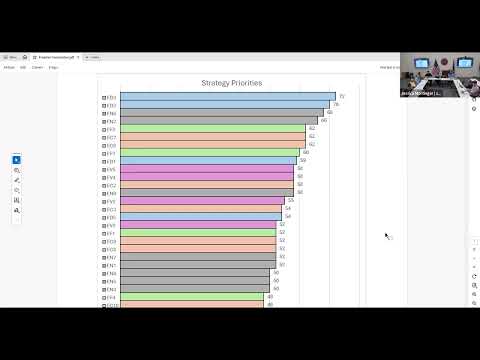
City planners presented results from a stakeholder survey that ranked hundreds of proposed bicycling strategies using the five “E” categories and an exponential point scale; committee members discussed prioritization, level of effort and how to present priorities in the final plan.
The Lawrence Bikes Plan steering committee reviewed results from a recent stakeholder survey and discussed how to convert scored strategy options into an implementable set of priorities. Planner (city staff) told the committee the survey grouped strategies under the five “E” categories used in bicycling planning (education, engineering, encouragement, enforcement and evaluation) and used a weighted ranking scale so higher importance responses carried exponentially greater weight. Why it matters: the rankings are being used to shape the plan’s recommended toolbox and to identify which strategies merit active pursuit, which should be “back burner” items and which should be documented for future reference. Committee members agreed the raw ranking is only a starting point. Committee member Jenny said strategies must be considered alongside “level of effort,” likely including cost, staff capacity and political resistance, and recommended a two-dimensional presentation that pairs priority with implementation difficulty or time horizon. Planner (city staff) said the team intends to present prioritized strategies in the final plan with short-, medium- and long-term labels and an estimated level-of-effort band for each strategy. The group discussed how some highly ranked strategies (for example, engineering projects to close bikeway gaps) have very different cost and delivery models than education or encouragement programs. A committee member noted that programs run by nonprofits or community organizations can be lower-cost but require different coordination than City-built engineering projects. Participants asked staff to clarify vague strategy language before the plan is finalized. One committee member said several strategies read as high-level goals rather than discrete projects — for example, “construct low-stress bikeways along priority networks” — and asked the planning team to link such language to specific project types or actions so the final plan can be used as an implementation tool. Planner (city staff) replied the team will refine language, add examples of delivery mechanisms (standalone capital projects, complete-streets-driven projects, private-development requirements, education programming), and include a “toolbox” that explains who typically leads each type of action. Ending: the planning team said it will fold these suggestions into a revised draft and present summary priorities at a public open house. The committee was invited to review the updated language in a later draft and to help test the priority/effort framing before the plan is finalized.