Get Full Government Meeting Transcripts, Videos, & Alerts Forever!
Get email alerts on the Municipal Budget topic
No spam. Unsubscribe anytime.
Lenexa adopts $260.6 million 2026 budget, approves 26.209 mill levy above revenue-neutral rate
Summary
The Lenexa City Council on a unanimous vote approved the fiscal year 2026 budget totaling $260.6 million and adopted a property tax rate of 26.209 mills, exceeding the revenue-neutral rate of 25.142 mills. City officials and residents debated tax impacts on seniors and possible adjustments to local rebate and homestead programs.
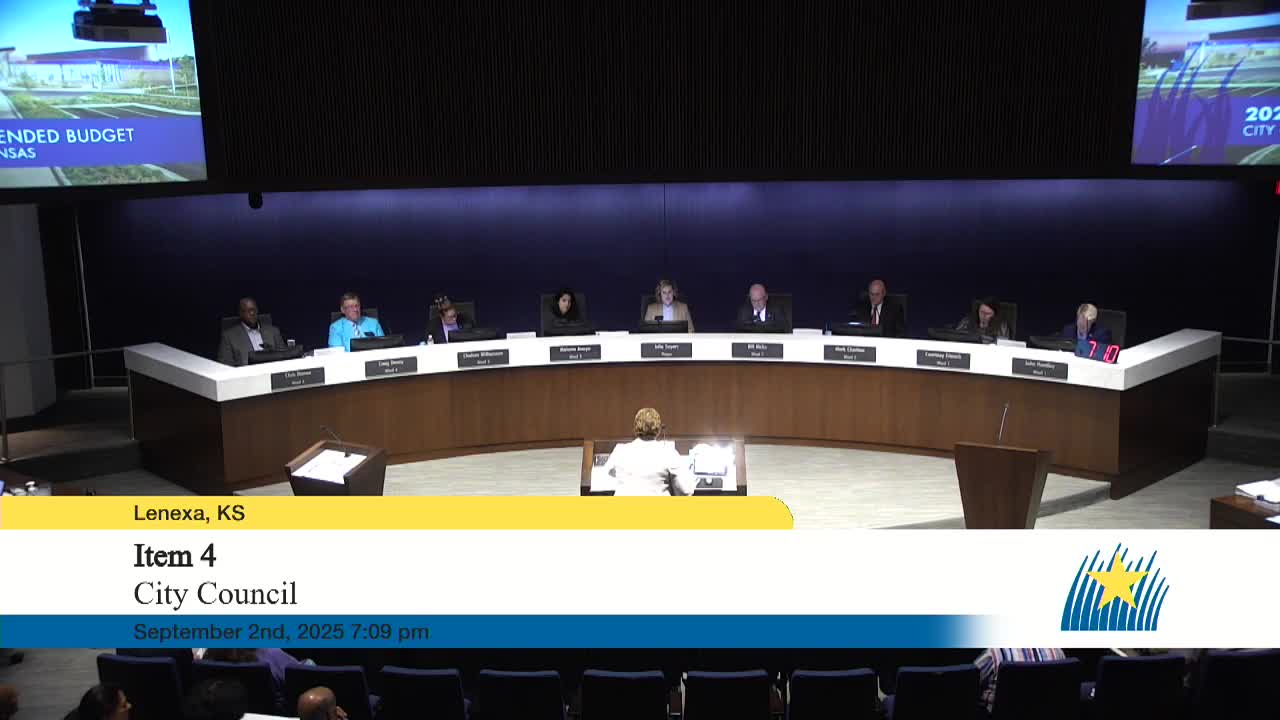
The Lenexa City Council voted unanimously to adopt the fiscal year 2026 budget and to levy a property tax rate of 26.209 mills, exceeding the revenue-neutral rate of 25.142 mills.
City Manager Becky Yocom and Finance Director Nate Bloom presented the recommended budget during the council’s September public hearings, characterizing it as “foundational” to ongoing city services and the result of months of work by staff and departments. Bloom said the city’s total recommended budget is $260,600,000 and that operational expenditures, excluding economic-development pass-through funds and reserves, are under $150,000,000.
Why it matters: the budget sets the city’s spending and tax rate for the coming year and affects homeowners’ property tax bills. Council members and residents pressed officials on whether the city could hold the tax rate steady and on protections for seniors on fixed incomes.
Key details: Yocom and Bloom told the council the city’s assessed valuation rose to $1,950,000,000 from $1,820,000,000 in 2025, with new growth accounting for roughly a third of the increase. Bloom said property taxes are estimated at about $75,000,000 (43.7% of total revenues) and sales-and-use taxes at about $72,700,000 (42.4%). The recommended budget adds 2.75 full-time-equivalent positions — new roles in parks and recreation, municipal services, the public market and community development — bringing total authorized FTEs to 569.15.
Bloom and Yocom explained the 26.209 mill levy reflects an additional quarter-mill rollback the council adopted during the budget process; they said the rollback was funded by ongoing 2025 savings in compensation allocations. Council members noted the city has reduced its mill levy by 5.623 mills over eight years, returning an estimated $10.6 million annually to taxpayers compared with past rates.
Public comment: More than a dozen residents spoke during the two public hearings. Several senior residents urged the council to hold the rate at the revenue-neutral level or to expand local relief programs. Gene Senesak, who identified himself as an Olathe-area resident and 2026 county commission candidate, urged officials to “look at your budgets hard” and consider reductions. Mary Abraham and other speakers described living on fixed incomes and asked the council to consider measures similar to homestead relief used in other states.
Council response and direction: Mayor Julie Sayers and multiple council members said they understand seniors’ concerns but defended the adopted budget as measured and necessary to sustain city services. Sayers said she preferred local voters and leaders making budget decisions rather than state-level limits. Several council members asked staff to research options to bolster the city’s rebate program and to provide more information about the state homestead program; staff said they would return with information.
Formal actions: the council adopted a resolution levying a property tax rate exceeding the revenue-neutral rate (motion by Bill; second by Courtney) and then adopted the FY2026 budget (motion by Craig; second by Mark). Both motions passed on unanimous roll-call votes.
Context and next steps: Bloom and Yocom noted that a large portion of the budget increase is tied to special revenue and economic-development funds that are pass-throughs by state law and not operational expenditures. The presentation also estimated the average Lenexa home value rose from $467,000 to $493,000 and projected the average homeowner’s tax impact at about $2.98 per month (about a 2.46% increase). Council members asked for a clearer “return on investment” accounting for local incentives and for staff to follow up on senior relief options.
The council closed both public hearings and adopted the budget and tax rate during the same meeting; staff said they would follow up on questions raised during public comment and by council members.