
Budget committee hears $29–30 million water improvement plan; engineer urges third‑party operations support
Get AI-powered insights, summaries, and transcripts
Subscribe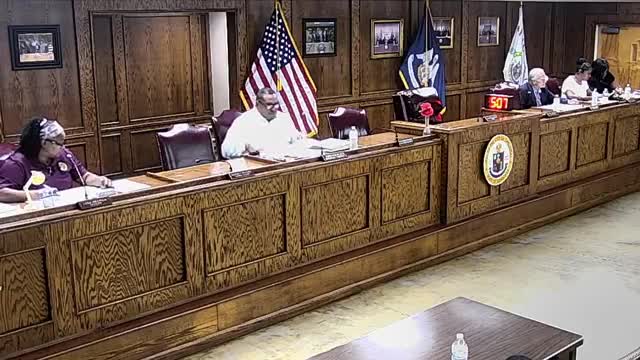
Summary
An engineering presentation to the Budget Committee on Aug. 25 outlined $29–30 million in recommended water-system improvements, described completed and pending loan applications with LDH, and urged hiring outside technical management and on‑site oversight to operate and maintain new treatment equipment.
The Budget Committee heard an engineering update Aug. 25 on the city—s water system that recommends roughly $29 million to $30 million in improvements, describes two LDH loan packages already in process and urges the city to hire third‑party technical management immediately, an engineer who prepared the system improvement plan said.
The engineer, identified in the meeting as Gerald, told the committee the system improvement plan assessed the city—s treatment, production (wells), distribution and storage facilities and recommended projects divided across two LDH loans. "We recommended about '29. I don't remember exactly. Between 29 and $30,000,000 in improvements," Gerald said.
The consultant said the loan work is split because treatment funds are coming from a separate LDH revolving loan program and that much of the treatment money is expected to be forgivable. "The first loan was for $17,000,000 which was for your distribution facilities and your storage and your water wells," Gerald said. He added a second loan for the treatment facility had not closed.
Gerald said the city has six water wells and that contractors are performing work at the Med South site. He told the committee that one well at Med South is out of service and "we can't take more than one well out of service" at a time, so work on other wells is on hold until the Med South repair is finished. He also said plans to replace ground storage at Med South call for two above‑ground tanks, each with a capacity of roughly 83,000 gallons.
The presentation included a project to replace galvanized steel mains and service lines that Gerald estimated at about $8,000,000; he said plans for that work are scheduled for completion in October and will be submitted to LDH for permitting and bidding. He said treatment facility design work encountered issues this summer and is expected to be submitted to LDH for review within a few weeks.
Gerald warned the committee that the city—s existing staff lack sufficient technical capacity to operate and maintain a modern treatment plant. "I'm not saying that your operators need to go," he said. "I recommended that they get 3 people. 1 for the water system, 1 for the wastewater or your sewer system, and 1 for your business office." He recommended bringing in a third‑party operations and maintenance firm or at least an on‑site manager who could supervise local staff, call on a firm—s resources when needed, and ensure daily procedures and scheduled maintenance are followed.
Gerald described manufacturer start‑up and training requirements that will accompany new equipment: site installation testing and manufacturer technicians to perform start‑up and operator training, plus comprehensive operations and maintenance manuals that LDH requires for treatment, wells and distribution equipment.
The consultant said a bidder contract for the well work has been executed and approved by LDH, but that some work is paused while the contractor repairs the Med South well. He named Wagner Engineering as an example of a firm that has provided onsite operations and assistance to other municipal systems in the region.
Committee members asked whether LDH loan funds could pay for on‑site staff or consultants. Gerald and a committee member said they believed loan funds are typically limited to capital, and not ongoing operations; another committee member said LDH would be consulted for confirmation. "I asked him that specific question, and he said that he had to check with LDH about the loan," the committee noted.
The committee did not take a formal vote on hiring or staffing at the meeting; discussion focused on completing plans, receiving LDH permits, bidding the replacement projects and clarifying whether loan/forgivable funds could be used for consultant or temporary management support.
Next steps described at the meeting include finishing design details, addressing LDH comments, submitting treatment and distribution plans for LDH permitting, and moving the galvanized mains replacement and the Med South storage/tank work to bid once permits are received.