Get Full Government Meeting Transcripts, Videos, & Alerts Forever!
Get email alerts on the Taxation Public Safety topic
No spam. Unsubscribe anytime.
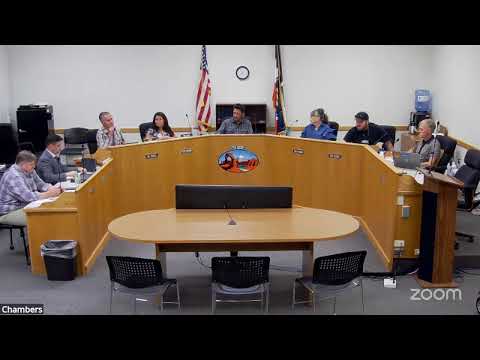
County hears consultant presentation on state-enabled "fixed‑guideway" public-safety sales tax option
Summary
Consultants briefed the commission on a state law allowing counties to impose up to 0.3% sales tax for public safety (a so‑called fixed‑guideway or 2216 levy); commissioners discussed applications for a justice/public‑safety center and bonding uses but took no formal action.
Consultants presented an overview of a state sales-tax vehicle (sometimes called the fixed‑guideway or 2216 public‑safety sales tax) that third‑through‑sixth class counties can enact to raise dedicated revenue for public‑safety capital projects such as jails, sheriff complexes and emergency service facilities. Jamieson Keller (presenter) and a financial advisor explained the statutory mechanism, typical exclusions (unprepared grocery foods), and how counties have used the levy to fund capital projects and bond repayments.
The presentation summarized revenue estimates: using county 2023 and 2024 taxable collections, a 0.30% countywide levy would have generated about $1.88M (2023) to $1.95M (2024) for Grand County. Consultants said stacking that revenue with existing county option sales taxes could support $29.5M to $45M in bonds (30–40 year terms) depending on pledge structure, potentially funding a justice center or sheriff complex without a direct property‑tax increase.
Commission discussion focused on timing, the administrative steps to enact the tax, and tradeoffs between sales and property taxes. Commissioners asked whether the levy could be placed to voters or enacted by resolution; consultants and the county attorney said the statute allows the county legislative body to enact the tax by resolution or ordinance without a public vote but noted many counties have not taken it to a public ballot. Commissioners discussed whether the tax burden would fall mainly on visitors or residents; advisors cited a typical visitor/local split around 70/30 in some resort counties and showed examples used by other Utah counties.
Several commissioners expressed interest in forming a workshop or subcommittee to study a possible justice/combined public-safety center and how to use the revenue (save for capital, not O&M). Commissioners also asked staff to run scenarios including debt payoffs and the county’s current obligations. Some commissioners raised concerns about timing, economic pressures on residents, and the possibility of future legislative changes. There was no vote to enact a tax at the meeting; commissioners asked consultants to help prepare next steps and modeling for workshops.
Ending: Commissioners directed staff to arrange workshops, ask the consultants to prepare debt‑service and project‑cost scenarios, and to provide more detailed local revenue projections. No formal action was taken at this session.