
Fargo committee clarifies P3 options, budgets and timeline for proposed convention center
Get AI-powered insights, summaries, and transcripts
Subscribe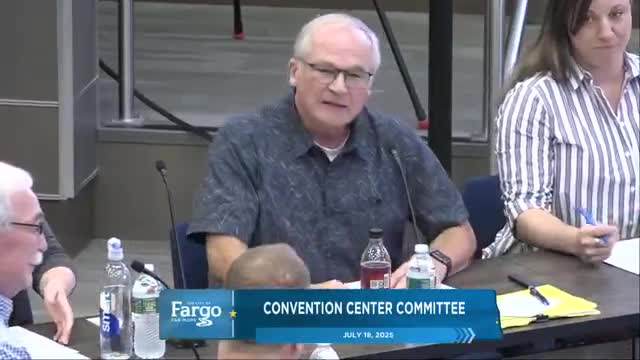
Summary
City officials and staff reviewed developer questions on the convention center RFP, highlighting the state public-private partnership statute, a $37–$41 million public budget cap, an anticipated early operating subsidy and a schedule for finalist selection and negotiations.
FARGO, N.D. — City officials and staff on Tuesday reviewed answers to developer questions for the proposed Fargo convention center, stressing that private partners could alter project scale through public-private partnership (P3) agreements, that the city’s public contribution is capped at an estimated $37 million to $41 million, and that the city has budgeted for up to a $300,000 annual operating shortfall in early years.
The meeting served as a public check on the request-for-proposals process for a convention center and related private development. Charlie, mayor, told the group the point of the session was "to go over these questions" from prospective proposers and to clarify how the city expects proposals to be structured before the RFP response window closes.
Why it matters: The RFP answers and the committee’s guidance will shape how developers size meeting and exhibit space, whether a hotel is attached or privately funded, and what financing or incentives the city might consider. Those choices affect downtown land use, parking and future tax revenues.
Most important details
• P3 statute and examples: Eric, staff member, gave a plain-language explanation of the state P3 statute and how it can change risk allocation and project scale. Using an interstate-highway example, he said P3 "is one of them where you can maybe make a big enough project that somebody really big is interested in coming in," letting a private partner finance and manage construction to accelerate delivery and assume operating risk.
• Public budget cap and private funding: Committee members repeatedly said the city’s public contribution is limited to the $37–$41 million estimate in the RFP. "There are no additional funds set aside for the convention center," the draft answers state. Developers may propose additional privately funded space or private dollars for portions of the facility; the P3 statute permits private financing or asset transfers as part of negotiated agreements.
• Operating subsidy and reserves: Staff said the city has budgeted for up to a $300,000 operating loss after the first two years to support initial operations. The group discussed building reserve balances from tax collections and bonding proceeds so that the facility opens with some operating reserves. The committee did not adopt a formal, time-limited pledge; details would be negotiated in a developer agreement.
• Size, scope and the budget/area trade-off: The RFP lists a range of total facility size and also cites a larger square-footage figure in a consultant study (84,800 square feet in the RFP versus a 155,000-square-foot HBS/HVS study). Staff advised proposers to match proposed square footage to the available budget and business plan; proposers may include additional meeting space in private components, such as an attached hotel, to meet demand.
• Hotel connection and operations: The RFP states a preference for a full-service hotel attached or connected to the facility; city staff said an attached hotel of at least 150 rooms is a stated goal in the solicitation. The developer should propose management and governance plans. "At the very least, Visit FM would promote the facility and deliver leads to its management," Charlie said, describing the city’s expectation that Visit Fargo Moorhead continue to market the region and share suitable leads with the convention center operator.
• Ownership, equipment and operations: The draft answers say the city "expects to own any equipment assets that are purchased with convention center funds," while developers may propose ownership of assets they contribute. Staffing, liquor licensing and food-and-beverage exclusivity were left to proposers and subject to negotiation in a developer agreement.
• Parking, connectivity and program uses: The committee left detailed parking requirements to developer analysis and potential parking studies, noting existing land development code requirements. Committee members encouraged proposers to consider direct connections (Skyway or indoor walking connections) to downtown hotels where feasible and to design ceiling heights and power distribution to allow flexible uses, including concerts, sports competitions and large exhibitions.
• Timeline and selection process: Staff said the goal is to name finalists within about three months and give finalists roughly three months to prepare final proposals; negotiating and executing a P3 agreement would take additional months. The group noted that legal, financing and third-party consultants (HVS, financial consultants such as Baker Tilly) will be reengaged for detailed evaluation during later phases.
Discussion versus direction versus decisions
Discussion: Committee members and staff debated program size, connectivity (Skyway/indoor access), ceiling heights for concerts and sports uses, and how to score hotel-linked versus standalone meeting rooms. Multiple participants urged proposers to use the city’s budget cap as the baseline for costing and to propose additional private elements if desired.
Direction/assignment: Staff agreed to post the P3 statute synopsis and the written Q&A to the city website and coordinate with the communications team so proposers can download answers when available. Committee members agreed to meet next on August 15 to begin reviewing proposals after the RFP window closes.
Formal action: The meeting produced no formal vote on procurement policy or incentives. Several answers recorded in the RFP Q&A reflect prior city direction: tax collections tied to the project will not begin until a project is selected, and the city has included an operating subsidy assumption (up to $300,000 per year in early years) in its financial modeling.
Quotes
"The city expects to own any equipment assets that are purchased with convention center funds," said Jim Gilmore, staff member, summarizing the draft answer about equipment ownership.
"If developers can figure out a way to pay for some of it with fees, tolls, great," Eric said in an example describing how P3s can finance long-term projects; "All we want is a 4 lane highway that... lasts for at least 50 years." He used the example illustratively to explain how risk and financing can shift under P3 arrangements.
"At the very least, Visit FM would promote the facility and deliver leads to its management," Charlie said while explaining Visit Fargo Moorhead’s expected role in lead generation and marketing.
Next steps and context
Staff plans to publish the Q&A and the P3 synopsis on the city’s RFP portal and the city website; the committee will reconvene on August 15 to begin reviewing proposals after the RFP window closes on August 7. Staff and members said they expect to reengage independent consultants to evaluate design and financial proposals as the process moves from shortlist to developer negotiations.
Background: Committee members referenced prior local uses of P3 arrangements, including recent parking garage projects and a large regional diversion/flood project as examples of alternative delivery and risk-sharing. The RFP and answers repeatedly stress that proposers should align proposed scope and square footage to the public funding cap and present their own financial plans for additional private elements.