
Council declines to cut gaming site cap; adopts residency rules for charitable gaming organizations
Get AI-powered insights, summaries, and transcripts
Subscribe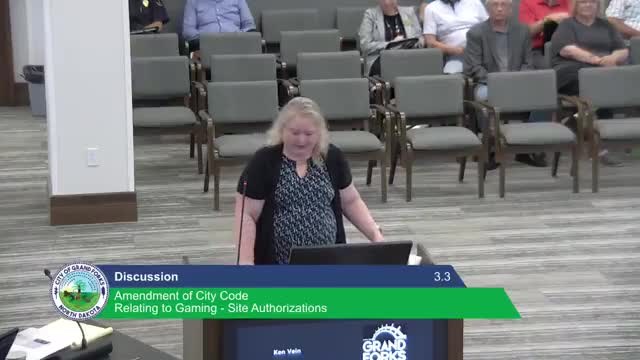
Summary
Councilmembers debated amendments to charitable gaming site authorizations, rejected a proposed reduction in the cap from 10 to 7, and approved revised residency and governance requirements for organizations that hold site authorizations.
The Grand Forks City Council Committee of the Whole on Aug. 11 debated proposed changes to city code governing charitable gaming site authorizations, rejected a motion to lower the citywide cap on sites, and approved new local residency and governance requirements for organizations that hold site authorizations. City staff presented background information and a draft ordinance and distributed a list showing 37 site authorizations currently in the city; one organization holds 10 sites and another holds nine. Staff also provided House Bill 1615 (state legislation) language that authorizes local governments to adopt qualifications for organizations seeking site authorizations. Vice President Weigel said he brought the item to open opportunities for other nonprofits and proposed returning the cap to seven (the level used in 2018). "I would make a motion that we take the ordinance as written by the city attorney and instead of 5, I would ask for 7," Weigel said. A roll-call vote on that motion failed; Weigel and one other councilmember voted yes while the majority voted no. Councilmembers and nonprofit representatives voiced differing perspectives. Councilmember Berg said she could not support restricting businesses' choice of partners and expressed concern that limiting sites would reduce opportunities for businesses to offer live gaming. Councilmember Osowski and others described operational challenges for smaller organizations and said some nonprofits had successfully expanded into gaming by hiring managers and negotiating with bar owners. Following discussion, the committee voted to leave the total number of authorized sites unchanged but to adopt stricter local-qualification rules for organizations seeking site authorizations. The adopted changes require that a charitable organization’s principal executive office be located in Grand Forks County, that a specified share of employees and board members reside in the county (council discussion suggested 75 percent), and that local board composition be documented; the city attorney’s draft also included an effective-date provision so existing organizations do not immediately lose authorizations (effective July 1, 2026, for renewals). A councilmember noted the state statute forbids conditioning where organizations spend their charitable proceeds, so the ordinance limits itself to qualifications for organizations (residency and board composition) rather than directing donation destinations. The committee approved the residency and governance changes unanimously in a roll-call vote.