Get Full Government Meeting Transcripts, Videos, & Alerts Forever!
Get email alerts on the Easement Vacation topic
No spam. Unsubscribe anytime.
Commission votes to vacate sidewalk/access easement after residents report harassment
Summary
Facing testimony from neighbors who described repeated harassment tied to use of a sidewalk/access easement, the commission voted to vacate the easement while preserving utility access; the decision generated debate about connectivity and enforcement alternatives.
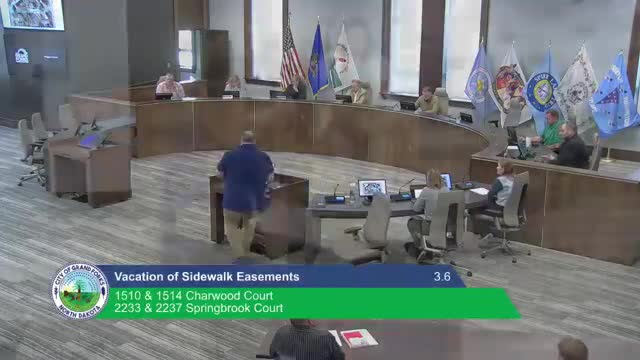
The Planning and Zoning Commission voted to vacate a sidewalk/access easement in the Charwood Court/Springbrook Court neighborhood on Sept. 3 after multiple neighbors testified they felt unsafe and said one nearby resident used the easement to harass households.
Stella Hakila, a resident at 1514 Charwood Court, told the commission: "I'm here tonight because my neighbors and I don't feel safe in our own cul de sac," and described behavior she said included "harassment firsthand," "peeking through fences" and threatening her children. Stephen Miller, 1510 Charwood Court, said the court had issued a disorderly conduct restraining order that he described as having "no teeth," and said the judge permitted continued use of the easement even though it was the primary avenue cited for harassment.
Chair Wazwick and commissioners discussed the neighborhood's long history with the easement, including earlier planning commission consideration about five years ago. Planning staff member Mr. Brooks summarized that utilities — sanitary sewer and a water line — run through the corridor and must be preserved; the request from property owners was to vacate the easement to reduce the path's use as a thoroughfare.
Some commissioners expressed concern about losing pedestrian connectivity. Commissioner Budke and others noted the easement was intended to connect cul‑de‑sacs and provide pedestrian shortcuts; Budke said that connectivity "is really what we look for" but that abuse by a single resident had become an issue. Several neighbors testified they rarely saw children using the path and that it lacked paving and lighting.
After public comment and commissioner discussion, Commissioner Megan (surname not specified in transcript) moved to vacate the sidewalk easement; the motion was seconded. The commission voted in favor and the motion carried. During a post‑vote exchange commissioners requested that the minutes reflect which members voted no. The record shows Commissioners Reichert and Budke were identified by the chair when asking for those no votes.
Staff and neighbors urged the city to consider layered solutions for future developments — including installing sidewalks at the time of development, adding signage to clarify restricted use, and exploring supports such as increased community policing, mediation, or crisis outreach for the individual reportedly causing problems. The commission's action vacates the sidewalk/access easement while staff noted utility easements must be preserved for sanitary sewer and water lines.