Get Full Government Meeting Transcripts, Videos, & Alerts Forever!
Get email alerts on the Land Use Sign Variance topic
No spam. Unsubscribe anytime.
Grand County hearing officer takes Crescent Junction sign variance under advisement after debate on height and LED use
Summary
A Grand County land use hearing officer said he would take under advisement a request to install a 65-foot pole sign with an LED price display at Crescent Junction and issue a written decision within a day or two.
A Grand County land use hearing officer said he would take under advisement a request to install a 65-foot pole sign with an LED price display at Crescent Junction and issue a written decision within a day or two.
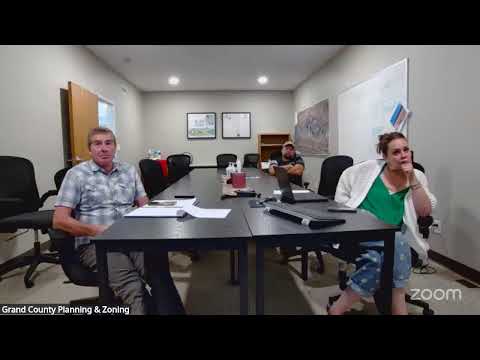
The hearing on Aug. 28 addressed a variance application from Texas Republic Signs to locate a tall, LED-equipped pole sign on a fueling station site partly below the Interstate 70 elevation. Land use hearing officer Craig Kahl opened the hearing and framed the issues as whether LED displays are prohibited by the county code and whether special circumstances justify a height variance that would make price information visible to motorists.
The variance applicant, represented by Michael Everett, permit manager for Texas Republic Signs, said the company seeks a 65-foot pole sign so prices are legible from I-70. "What I am requesting here is for a 65 foot pole sign to be installed, with an LED," Everett said. He told the hearing the LED display would not flash or move and that price changes would occur infrequently and remotely.
County staff and the applicant discussed two discrete legal and factual issues: (1) whether the county sign code prohibits LED displays and (2) whether the property's lower elevation relative to the interstate creates a unique hardship that justifies a taller sign. Kahl read the code language for prohibited signs (transcript reference to a “prohibited signs” section) and said his reading of state law and Utah Supreme Court precedent favors allowing nonflashing LED displays unless the ordinance expressly bans them. "On its face an ordinance doesn't clearly prohibit the use of property, then that use must be allowed," Kahl said.
Andrew Jackson, a certified city planner working as a planning consultant with Horox Engineering under contract to Grand County, agreed with Kahl's interpretation that the code bars flashing or moving lights but does not categorically ban steady LED displays. County staff recommended conditions if a variance were granted, including limiting the LED to steady operation (no flashing), shielding to prevent upward glare consistent with dark-sky concerns, and a reclamation mechanism or bond to ensure removal if the facility ceases operating.
Applicant representatives said shielding, internal backlighting and built-in dimmers would limit upward light trespass. Everett said the LED cabinets would be shielded behind sign faces and that the company could reduce brightness if staff or commissioners found it too intense. On bonding, the county argued a surety or reclamation bond increases the likelihood the sign will be removed if a business closes; the applicant responded that a removal requirement as a condition of approval would suffice.
The parties also debated measurement methodology for allowable height. County staff suggested a condition limiting the top of the sign to 24 feet above the adjacent roadway (the overpass/bridge elevation). The applicant said that measuring from the roadway grade rather than the property grade would still leave the top of the sign lower than requested and argued the requested height was needed because the site sits below the interstate and the distance to the exit is substantial. Staff and the applicant discussed approximate dimensions: the applicant described the sign assembly as roughly 14 feet of cabinet height; at certain measurements that would produce a total structure height near the 49-foot to 65-foot range depending on how the top-of-roadway offset is calculated.
Other factual points recorded in the hearing: county staff said aerial photos from 2006 show signs existing on the site area and raised the possibility that the signs could be preexisting nonconforming features; staff noted the county's sign ordinance was updated in 2021 and reflected community preferences against large signs. Dan Stenta, a Horox Engineering consultant who formerly worked for the county, and Grand County staff including interim planning director Kristen Hopine and county engineer Sean Yates participated in the discussion. Road and bridge staff were asked for topo/elevation detail; a county representative said the available topo did not extend onto the overpass surface and that more precise measurements could be pulled from site plans.
Kahl repeatedly framed the variance review against the five statutory factors required under Utah law for variances and said economic hardship alone is insufficient. He flagged safety and commercial visibility as elements the applicant raised: "If a person driving an 18 wheeler decides to make an exit, they certainly should be able to do it in a manner that's safe and accessible," he said. The hearing closed without a decision; Kahl said he planned to issue a written decision and might communicate a conclusion to the parties before issuing the full written findings.
What happened next: the hearing officer took the matter under advisement and closed the public hearing, saying he expected to issue a written decision by the end of the next business day.
Notes and context: the application was accepted about 80 days earlier and staff said turnover in the planning office delayed processing. Staff estimated a text amendment to the land-use code (if the applicant instead chose to pursue a targeted code change) would require at least two public hearings and could take roughly six weeks under an expedited schedule, or about 60 days on average.
Votes: none — no formal vote or final decision was recorded at the hearing; decision to follow in writing.