Get Full Government Meeting Transcripts, Videos, & Alerts Forever!
Get email alerts on the Prevention topic
No spam. Unsubscribe anytime.
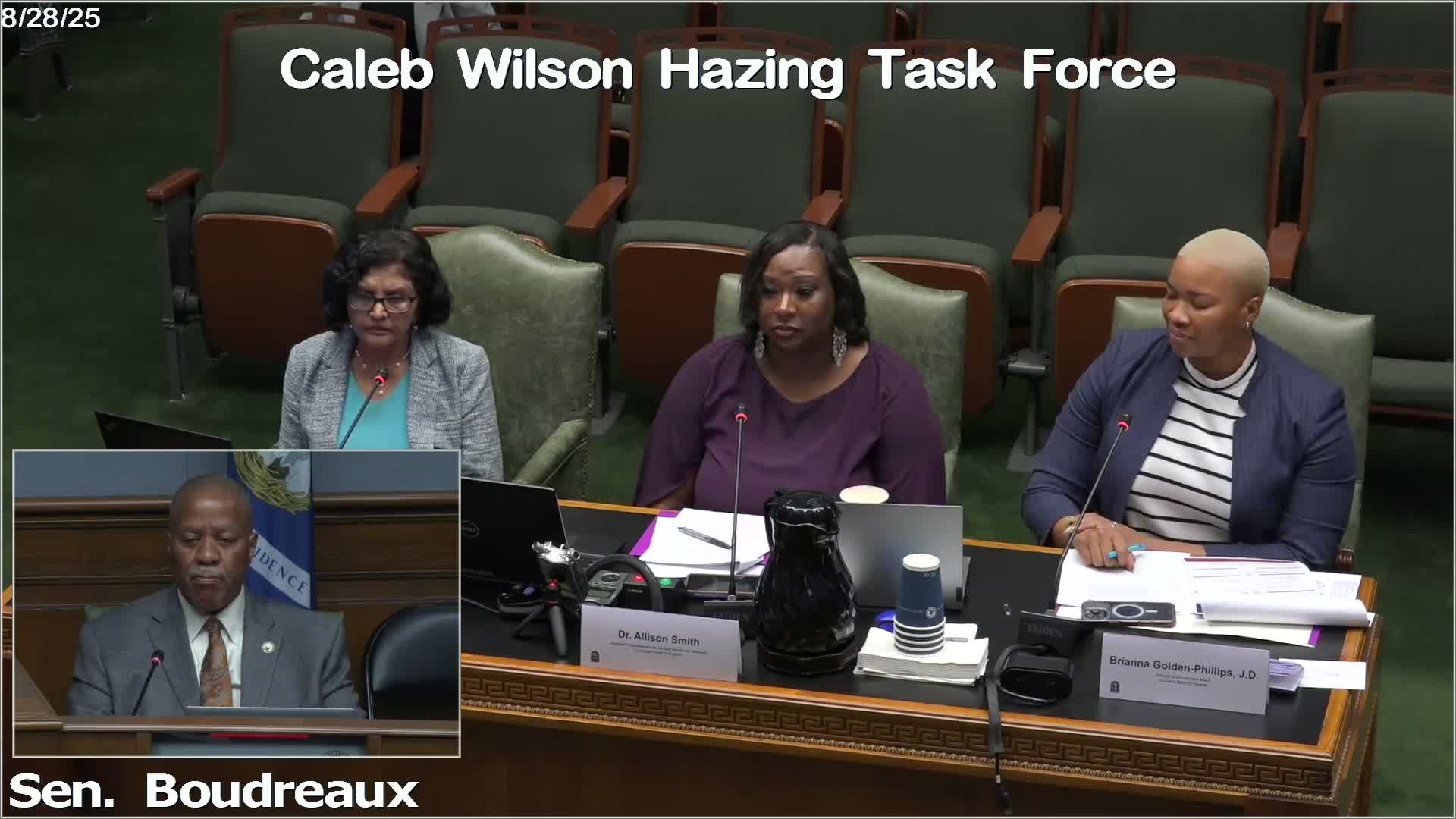
Task force members press for prevention: mandatory training, simulations and K–12 outreach
Summary
During the inaugural meeting, members emphasized prevention over after‑the‑fact reporting. Proposals included mandatory annual training for all students, simulation exercises, K–12 outreach, anonymous reporter protections and exploring financial or accountability levers to compel campus action.
Task force members used the first meeting to press for prevention strategies that extend beyond reporting and transparency.
Prevention proposals and rationale - Mandatory, repeated training: Several members urged making hazing prevention training mandatory for every student, not only organization members. Representative Jason Hughes said annual, authenticated completion should be required for all students and suggested penalties for noncompliance that would motivate participation. - Simulations and experiential learning: Board of Regents staff and campus leaders recommended simulation exercises that demonstrate the lived consequences of hazing; Dr. Smith and Amy Cable both cited simulations as a willingness-to-pay prevention tool that can change culture more effectively than a single orientation video. - K–12 outreach: LSU and task force members urged reaching students earlier. Dr. Francie Brown McClure and others said hazing behavior is often socialized before college and recommended coordination with K–12 systems. - Reporter protections and anonymous reporting: Student members proposed protections or limited immunity for students who report hazing so that victims or participants who come forward are not punished solely for admitting past participation. Task force student Pamela Williams recommended accessible training tools (Canvas or an LMS) and supported both anonymity and protections for reporters. - Accountability levers for institutions: Some members suggested stronger institutional accountability — including discussion of financial penalties or withholding formula funds — to motivate campuses to prioritize prevention and enforcement. Uma Subramanian said current law criminalizes individuals who knowingly fail to report but does not impose a global penalty on a university; lawmakers said the Legislature could create such mechanisms.
Standards of proof and enforcement Lawyers and campus counsel discussed the evidentiary burden for campus adjudications. Trey Jones (LSU General Counsel) described investigative difficulties and said higher burdens of proof make responsibility findings harder to achieve. Representative Joseph Stagney and others asked whether a preponderance standard would enable faster institutional action than a clear‑and‑convincing standard currently used at some campuses.
Why it matters: Participants repeatedly said that improving reporting and transparency alone will not save lives; prevention — through repeated training, validated experiential modules and earlier intervention in K–12 — is critical. Members asked staff to develop recommendations on implementation, including cost, verification and administrative access for system offices.