Get Full Government Meeting Transcripts, Videos, & Alerts Forever!
Get email alerts on the Hazing Law Reporting topic
No spam. Unsubscribe anytime.
State and federal changes expand hazing reporting and campus transparency
Summary
Speakers at the task force’s first meeting reviewed the state’s anti‑hazing statutes (the Max Gruber Act and later amendments) and recent federal requirements that add hazing to Clery reporting and create a campus hazing transparency report with new collection and submission dates.
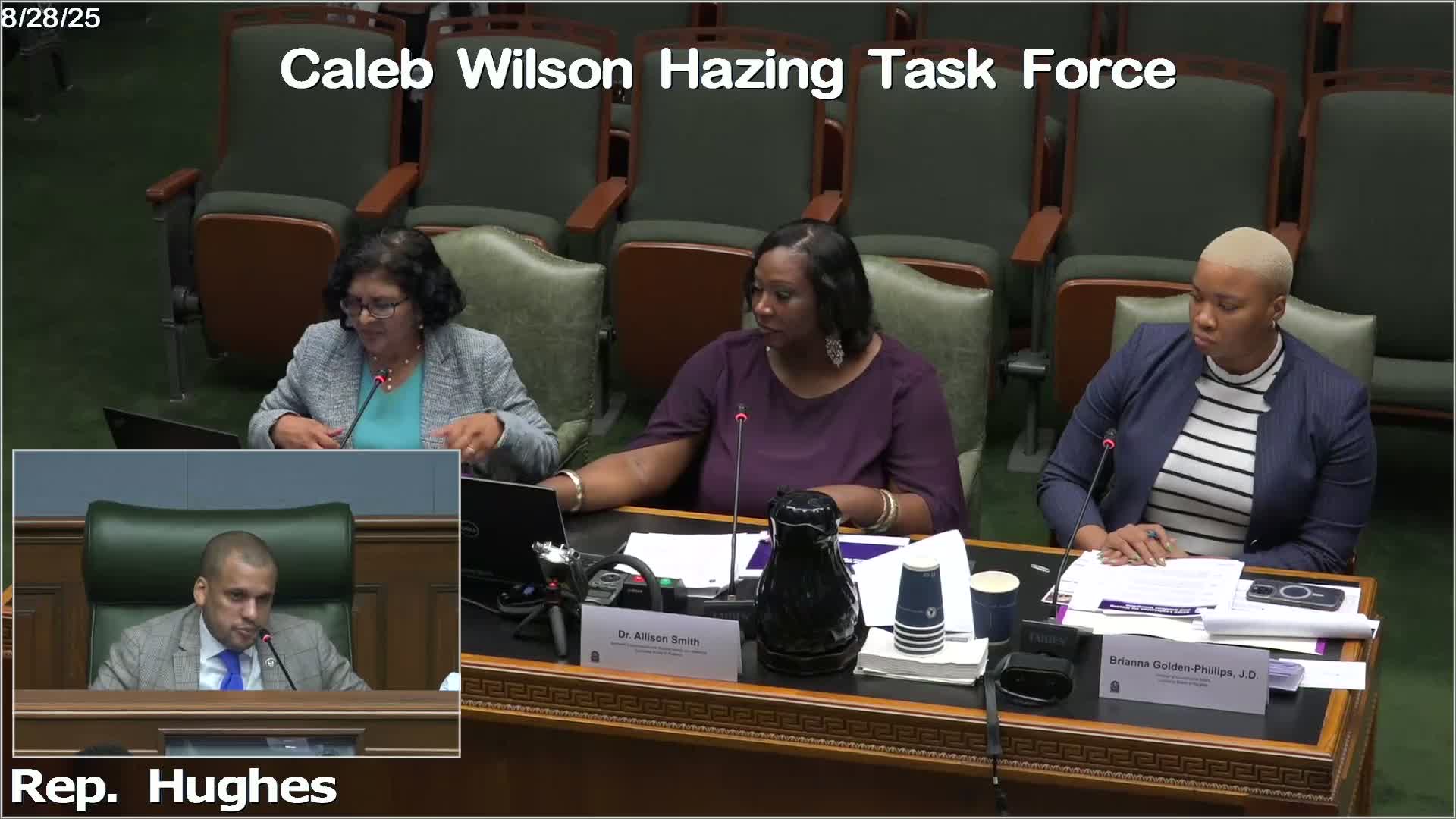
Task force staff and legal counsel reviewed state and federal legal frameworks for hazing reporting during the inaugural meeting Aug. 28, outlining what campuses must now collect and publish.
Uma Subramanian, general counsel for the Board of Regents, described the core state framework: the anti‑hazing statutes passed in 2018 under the Max Gruber Act, subsequent reporting enhancements in 2019 and additional amendments through 2022 and 2024–2025. “The Max Gruber Act defines the key terms. It prohibits hazing in any form at higher education institutions,” she said, and noted the law includes civil and criminal penalties and requires institutions to adopt uniform Board of Regents policies.
On the federal side, Dr. Kim Hunter‑Reid and Board of Regents staff summarized the Stop Campus Hazing Act’s changes to campus security reporting under the Clery framework. Dr. Smith told the task force that the federal law added hazing as a reportable category to annual and semiannual campus security reports and mandated a separate campus hazing transparency report. Under the new federal timetable described at the meeting, institutions are to include hazing dispositions in Clery‑style security reports beginning Oct. 10 (semiannual disclosures on Oct. 10 and April 10), and the separate campus hazing transparency report collection period began July 1, 2025, with a submission deadline of Dec. 23, 2025; annual Clery‑linked reporting was noted to begin reporting incidents annually on Oct. 1 with an implementation window through 2026.
What the laws require - State (Max Gruber Act and amendments): uniform definitions; mandatory institutional policies; mandatory reporting from organizations to institutions and up the system to the Board of Regents; civil and criminal penalties for organizations and individuals; institution-level requirements for student training and disciplinary processes. - Federal (Stop Campus Hazing Act / Clery changes): hazing added to campus security reporting with a required disposition field (status, investigation timeline and sanctions), a campus hazing transparency report that must include organization names, descriptions and timelines, and expanded geography (on‑ and off‑campus incidents must be included).
Legal limits and gaps discussed Task force members pressed staff on institutional liability. Uma Subramanian said the current state law criminalizes knowingly failing to report and imposes penalties on individuals who fail to report, but “the university itself, there's no type of global penalty on the university itself” under current law. She added that if the Legislature chooses, it could create mechanisms to impose penalties on institutions, but none exist now.
Why this matters: The combined state and federal changes increase public transparency by requiring institutions to publish detailed hazing data and case timelines. Task force members said the new reports should make it harder for incidents to be hidden, but they also asked staff to map how reporting timelines, privacy laws (FERPA, HIPAA) and criminal investigations intersect with campus publication obligations so the transparency is meaningful and compliant with privacy protections.
At the end of the session, members asked staff to circulate a one‑page legal summary and to use the reporting deadlines as milestones for the task force’s work.