Get Full Government Meeting Transcripts, Videos, & Alerts Forever!
Get email alerts on the Climate Superfund topic
No spam. Unsubscribe anytime.
Lawmakers hear broad support for "polluters-pay" climate superfund to fund adaptation, with 40% for environmental‑justice communities
Summary
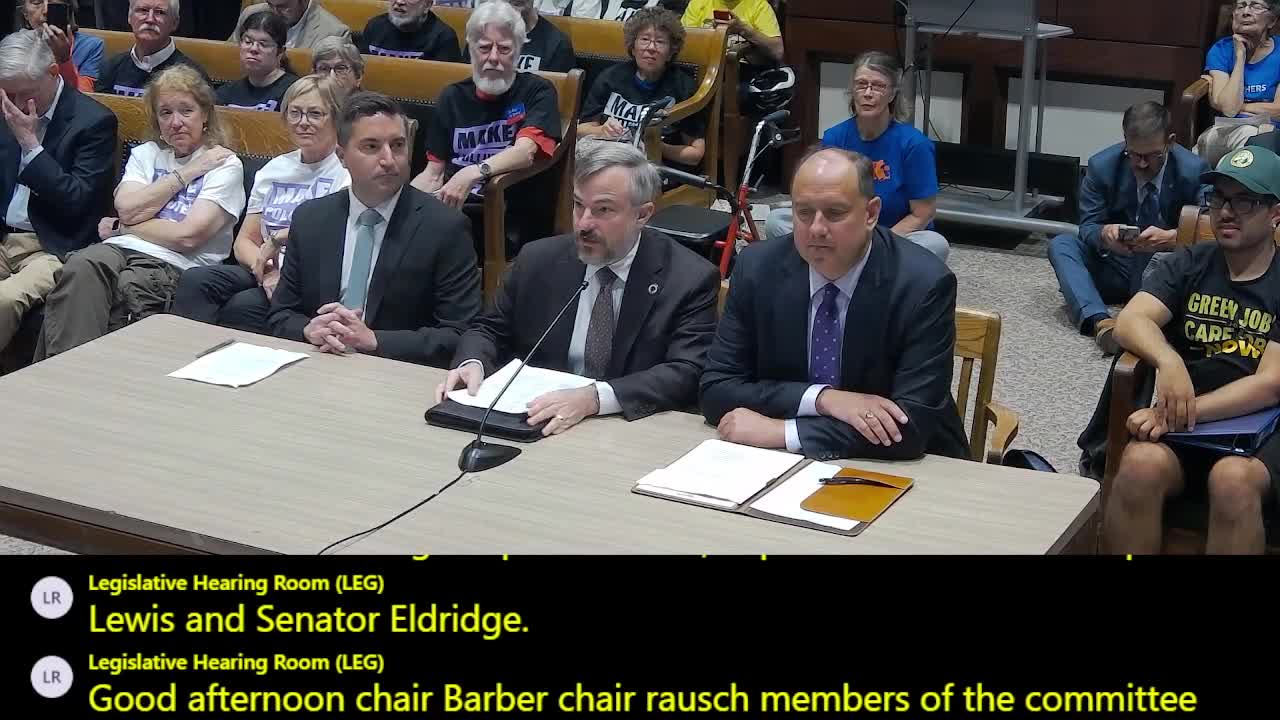
BOSTON — Lawmakers and scores of witnesses on Tuesday told the Joint Committee on Environment and Natural Resources that the state should adopt a “polluters‑pay” climate adaptation fund that would require the largest fossil‑fuel companies to finance repairs and resilience work for harms linked to greenhouse‑gas emissions.
BOSTON — Lawmakers and scores of witnesses on Tuesday told the Joint Committee on Environment and Natural Resources that the state should adopt a “polluters‑pay” climate adaptation fund that would require the largest fossil‑fuel companies to finance repairs and resilience work for harms linked to greenhouse‑gas emissions.
The bill before the committee, H.1014 / S.588, would charge an assessment based on historical emissions and deposit proceeds into a Climate Change Adaptation Superfund to pay for projects including coastal protection, wetland restoration, urban tree canopy, transit resilience, and building weatherization. Proponents told the panel the plan would direct 40% of funds to environmental‑justice communities.
Supporters said Massachusetts faces urgent local costs as federal funding has become less reliable and that attribution science can produce a transparent way to determine each company’s fair share. “The principle of polluters pay is very simple,” Representative Steven Owens told the committee. “Those who make a mess should be the ones who clean it up.”
Why it matters
Witnesses described mounting local damage and shrinking outside aid. Representative Owens and Senate sponsor Jamie Eldridge framed the bill as a cost‑recovery mechanism — not an ongoing carbon tax — and cited examples of storm and flood damage that have already strained municipal budgets. “We have the opportunity to join states like Vermont and New York in enacting legislation that holds companies accountable and funds climate adaptation efforts,” Eldridge said.
How the bill would work
- The proposal would use attribution science to calculate an assessment on fossil‑fuel producers for their historical contribution to climate harms in the Commonwealth (the draft discussed by witnesses referenced the period 1995–2024). - Revenue would flow into a dedicated state fund administered for resilience and adaptation projects; sponsors said roughly 40% of spending would benefit environmental‑justice (EJ) communities. - Proponents emphasized labor and equity conditions, including prevailing‑wage and apprenticeship provisions for funded projects.
Testimony and evidence presented
Legal and technical panels: Attorneys and legal scholars urged the committee that retroactive cost‑recovery statutes can be constitutional if implemented with procedural safeguards. Anthony Irapino, an attorney who testified remotely, said the measure is a “revenue raising” cost‑recovery tool grounded in the state’s police powers and defended similar laws recently enacted in other states. Paul Schorb, a long‑time environmental lawyer, said retroactivity is not per se unconstitutional and urged the committee to consider how administrative implementation and comment opportunities could address due‑process concerns.
Opponents and legal cautions: At least 1 law professor asked the committee to examine preemption and causation risks, warning courts could see conflicts with federal law or find traceability and attribution legally fraught. That testimony flagged the need for careful statutory drafting to reduce litigation risk.
Economic analysis: A Political Economy Research Institute (PERI) study presented to the panel estimated that if the fund were deployed at roughly $1 billion per year, the spending would support about 7,600 jobs annually across Massachusetts, more than the same dollars spent in existing fossil‑fuel industries. Supporters said much of the revenue would replace or supplement grants no longer available from the federal government.
Community and public‑health witnesses: City councilors from Malden and Medford described municipal needs — seawall and floodgate upgrades, cooling infrastructure, urban canopy expansion and housing weatherization — that exceed local budgets. Public‑health doctors warned rising extreme heat, vector‑borne illnesses and other climate impacts are already increasing hospitalizations and emergency calls. Environmental‑justice activists, labor leaders and clergy urged passage, saying wealthy fossil‑fuel corporations should bear a fair share of adaptation costs.
Points of debate
- Scope and targets: Sponsors said the bill targets the largest global fossil‑fuel producers and would not impose wide‑scale, recurring taxes on consumers. Representative Owens said the bill is a one‑time cost‑recovery assessment rather than an ongoing carbon tax. - Retroactivity and litigation: Several legal witnesses argued statutes that look backward can be structured to withstand constitutional review; others cautioned that courts may scrutinize traceability, due process and federal preemption claims. Committee members sought more case law and briefs on those points. - Implementation details: Witnesses urged the committee to clarify governance, attribution methods, administrative review and how funds would be allocated and audited, especially the 40% EJ allocation.
What proponents say it would buy
Advocates outlined projects that could be funded: coastal flood barriers and living shorelines, urban heat‑island mitigation (trees and cooling centers), upgrades to transit and port infrastructure, weatherization of housing (particularly public and low‑income housing), and community health programs. Labor witnesses emphasized that funded projects would include prevailing‑wage requirements and apprenticeship pathways to create good‑paying local jobs.
No formal vote; next steps
The committee took testimony from dozens of panels and did not record a formal vote at the hearing. Sponsors, advocates and experts asked the committee to request follow‑up written briefs and evidence, particularly on the legal questions and the attribution science. Committee staff asked that written testimony be sent to the committee e‑mail (jacob.newman@mahouse.gov). The bill’s supporters urged the committee to report the measure out favorably so the Legislature can consider it during the session.
Ending
Supporters told the committee they view the fund as a practical, familiar policy tool — modeled on existing Superfund cost‑recovery approaches and recently enacted state laws — to raise dedicated revenue for climate adaptation without increasing property taxes or relying solely on federal grants. Opponents and several committee members asked for more legal analysis and tighter drafting to reduce litigation risk before a vote.