Get Full Government Meeting Transcripts, Videos, & Alerts Forever!
Get email alerts on the Childcare Ffn topic
No spam. Unsubscribe anytime.
Committee Hears Calls to Raise Pay, Expand Access for Family, Friend and Neighbor Childcare
Summary
Witnesses, many caregivers and community organizers, urged the Joint Committee on Education to support H542/S341 to raise payments to family, friend and neighbor (FFN) childcare providers to at least minimum wage, fix voucher flexibility and create supports and outreach for informal providers.
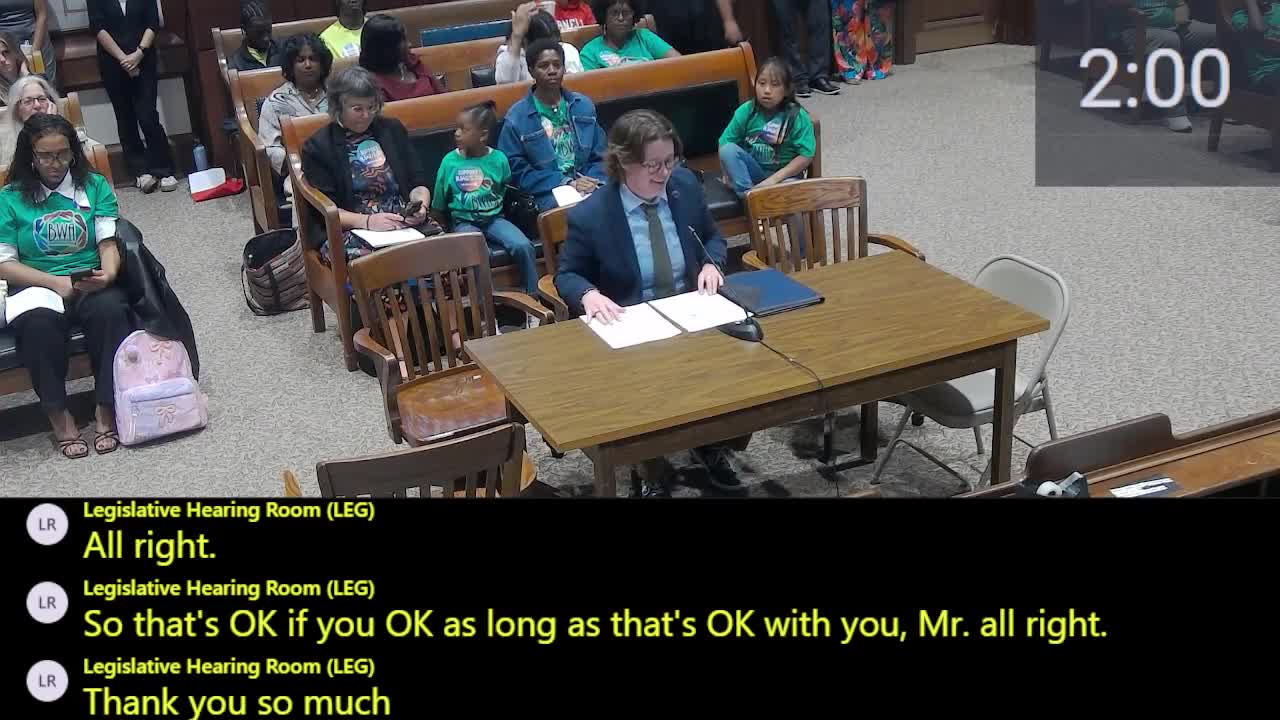
House Chair Kenneth Gordon and Senate Co-chair Jason Lewis presided over a joint education committee hearing at the State House where dozens of caregivers, grandparents and union representatives urged lawmakers to back H542/S341, legislation to expand access to family, friend and neighbor (FFN) childcare. Witnesses said the bills would raise pay for FFN providers, make state childcare vouchers more flexible across formal and informal care, and build outreach and training supports for largely invisible home-based providers.
The bill “would strengthen state support for FFN providers by guaranteeing they earn at least the state minimum wage,” said Alejandra Dehaev, family childcare coordinator with Local 509, arguing that improving payment and flexibility would “provide a much needed boost for their families.” Lindsey Kenny, legislative director for the Mass AFL-CIO, told the committee that fewer than 1 percent of state childcare subsidy dollars go to FFN providers and that the current maximum daily voucher rate is “just $24 a day per child.” “Many of these workers are paid below the minimum wage,” Kenny said, adding that some are paid “just $5 an hour.”
The proposal would ensure FFN providers who enroll in the voucher system receive at least the state minimum wage, allow families to use the full value of a day’s voucher flexibly across both licensed centers and FFN care, and establish an FFN advisory council to promote best practices. Testifying on behalf of Brockton-based caregivers, Daniela Fuentes and Susana Moraes described FFN care as the only practical option for many families who work nonstandard hours or lack access to center-based seats. “For many families, FFN is the only option,” Fuentes said, adding that the care is often “invisible” and provided by immigrants and relatives.
Multiple grassroots witnesses described caregiving patterns in Dorchester, Mattapan, Roxbury and Brockton and said current payments do not cover the labor required. Betty McGuire of the New England Community Project said the present subsidy range—she cited “$10 to $24 a day”—is far short of a living wage. Yolanda Miranda said she provided full‑time care for a grandchild for a year but received no pay and estimated caregivers often provide 10‑hour days bridging early and late work shifts.
Committee members asked practical questions about enrollment and barriers. Witnesses and coalition representatives noted the state permits FFN providers to register for vouchers but that the registration process includes background checks, fingerprinting, a criminal-record check with emphasis on sex‑offense screening, possible EEC visits, and some health-and-safety training such as CPR. Alejandra Dehaev said non‑relative FFN care must typically take place in the child’s home. Witnesses acknowledged fingerprinting can deter immigrant caregivers and said the coalition is discussing ways to reduce barriers.
Witnesses also described recent work with the Department of Early Education and Care (EEC). Coalition representatives said they have participated in EEC focus groups and reviewed a draft legislative report; they expect the department’s formal recommendations to be published in the fall. The coalition provided a rough fiscal estimate: current annual voucher spending on FFN care is about $1.8 million; if existing FFN providers currently in the system were paid at the minimum wage the cost would rise to roughly $6 million annually, which coalition witnesses described as “well under 1 percent” of the EEC budget. They acknowledged that induced demand (additional families entering the system if rates rise) was not yet modeled.
Testimony closed after an extended public comment period; committee members did not take a formal vote on H542/S341 during the hearing. Advocates asked the committee to report the bill favorably so the legislature could move to implement the wage and flexibility changes they described.