Get Full Government Meeting Transcripts, Videos, & Alerts Forever!
Get email alerts on the Telecommunications Infrastructure topic
No spam. Unsubscribe anytime.
Plumas supervisors move to seek halt and review of 200-foot cell tower near Washoe family cemetery in Greenville
Summary
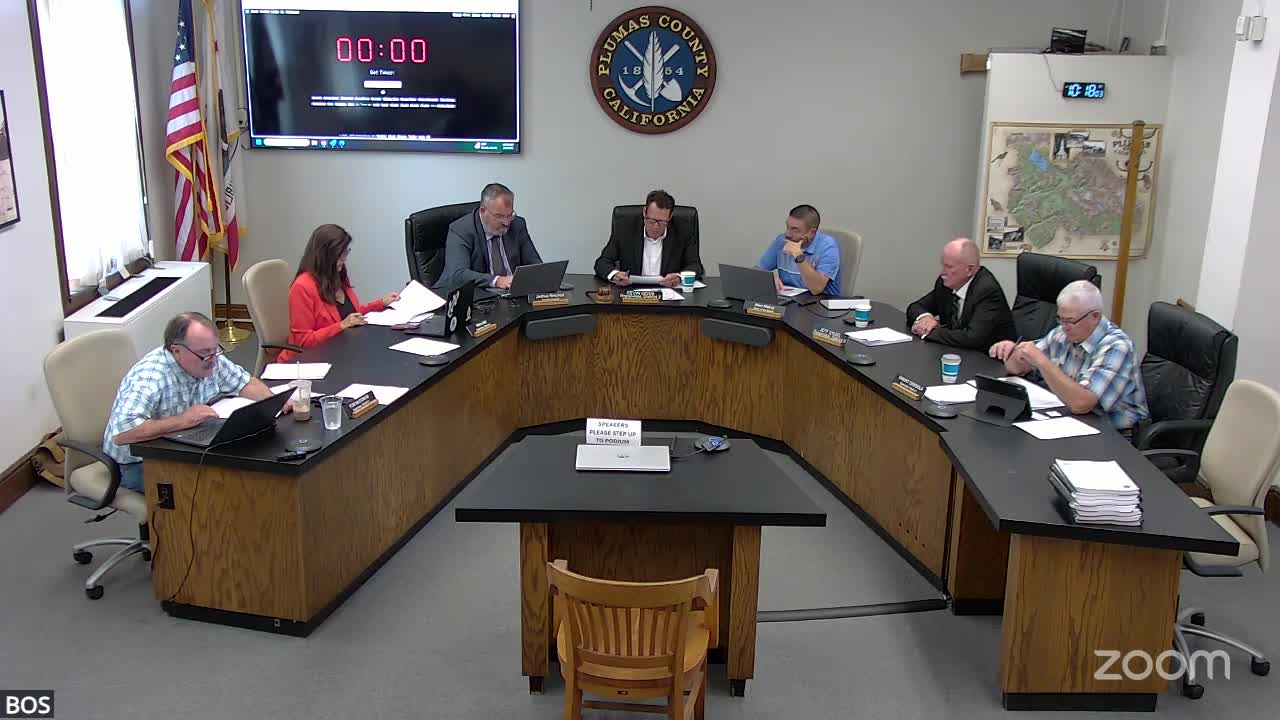
After public testimony from Washoe family members and neighbors, the Plumas County Board of Supervisors unanimously directed county staff and counsel to request documentation from the tower owner and pursue a possible cease-and-desist while also opening communication with tribal parties and federal reviewers.
Plumas County supervisors on Sept. 2 directed county counsel and staff to seek documentation and pursue a possible stop to construction of a 199–200-foot telecommunications tower on Powerline Road near Greenville after residents and tribal family members said the structure stands in sight of the Washoe family cemetery and unmarked ancestral burial sites.
The board’s action followed extensive public comment from local residents and tribal descendants who said the tower’s ground lease and building permit were processed under a Timberland Production Zone exemption that did not require local notice. “The Washoe Cemetery is more than just a resting place. It is a sacred ground,” Dwayne Anthony Washoe Jr. told the board in a written statement read into the record. “The proposed construction of a Verizon cell tower on Sierra Pacific Industries land in such close proximity to this cemetery raises serious concerns.”
The county planning director, Tracy Ferguson, told the board the parcel (Assessor’s Parcel Number 004-030-024; address assigned April 1, 2025: 1006 Powerline Road) is zoned TPZ (Timberland Production Zone). Under Plumas County’s telecommunications ordinance (Article 41, adopted 2019), telecommunications facilities on TPZ parcels are exempt from the ordinance’s standards and may proceed by building permit as a ministerial action, she said. Ferguson said the building permit application was received April 9, 2024; planning review approved June 5, 2024; building department approval June 8, 2024; and the building permit was issued Aug. 5, 2025. A building inspector visited the site on Aug. 28, 2025 and approved footing work to allow foundation work to proceed.
Ferguson summarized the permit packet and plans: a 199-foot tower (described in the plans and repeatedly referenced as 199–200 feet tall), a 30-by-30-foot lease area with equipment cabinets, “1 new diesel generator, 200-gallon sub-base tank,” antennas, radios and other equipment. She said the structure is a foundation-based lattice tower (no guy wires) with a four-foot lightning rod at the top. The lease and tower owner on the permit are recorded as Vertical Bridge (Towers of California LLC) and the anchor tenant as Verizon Wireless.
Residents said they learned only recently that construction had started. John Stewart, a neighbor, said he can see the tower from his desk: “I turn my head to the right, and I see where a tower is going.” Neighbors and property owners — including Hannah Stewart and Scott and Judy Abrams — asked the board to halt construction and to require the tower be moved elsewhere on the parcel. They raised concerns about visual impact, health and property values and they said Sierra Pacific Industries (owner of the underlying parcel) and the tower developer did not notify them.
Several speakers requested that the county obtain federal NEPA documentation and records of tribal consultation required under federal review for telecommunications infrastructure. Ferguson said the Federal Communications Commission requires NEPA review for telecommunications and that Vertical Bridge had told planning staff it completed NEPA filings; she offered to request copies of NEPA documents, RF reports, and any Section 106 (historic preservation) records from the tower owner and the FCC filings.
Trina Cunningham, who identified herself as a tribal community member and former executive director of a tribal consortium, explained a structural gap in state lists used for tribal outreach: many local Mountain Maidu and Washoe family members are not on the Native American Heritage Commission’s notice list because they are not federally recognized, she said, and therefore may not receive direct notice when federal or state processes rely solely on that list.
County counsel and staff briefed the board on process options. The board discussed whether a legal stop could be obtained; counsel cautioned that enforcement and legal standing can be complicated because the project is on private land with a private developer. After debate the board unanimously directed Planning Director Tracy Ferguson, County Counsel Josh Brechtel, and Chair Supervisor Kevin Goss to communicate with the parties, request NEPA and FCC documentation and tribal consultation records from the tower owner, and “attempt to obtain a cease-and-desist order as quickly as possible” if warranted. The board also authorized the chair and counsel to send a formal letter documenting the board’s concerns.
Supervisor Tom Hall (motion maker) and other supervisors said they want the county to open formal lines of communication with the developer and with tribal representatives, while preserving the county’s ability to seek immediate legal relief if the record shows failures in required federal processes. Ferguson told the board she would request copies of NEPA materials, Section 106 historic-preservation documentation and RF reports from Vertical Bridge and the FCC.
The county will also review whether the municipal code should be amended to require notice or additional review in cases where TPZ parcels abut or are surrounded by residential zones or cultural resources. Ferguson said she will also notify supervisors of future ministerial telecommunications permits in their districts going forward.
The board’s direction was procedural: staff were ordered to gather federal documentation and tribal consultation records and to pursue legal options if documentation or consultations were not completed. No final court action had been filed as of the meeting’s end.
Why it matters: Residents and tribal descendants said a tall communications structure threatens a locally significant burial site and private property views within what they described as a still-healing post‑fire community. County staff and the board must reconcile local zoning exemptions with federal NEPA / FCC requirements and tribal consultations. The board’s decision to seek the NEPA record and to consider a legal stop reflects the tension between ministerial building processes and community cultural‑resource concerns.
What’s next: Planning staff will request NEPA / FCC documentation and Section 106 records from the tower owner; county counsel will evaluate immediate legal remedies; and the board signaled it will consider code changes so similar projects receive broader local review and notice in the future.