Get Full Government Meeting Transcripts, Videos, & Alerts Forever!
Get email alerts on the Immigration Enforcement topic
No spam. Unsubscribe anytime.
City attorney outlines limits on local power as federal immigration enforcement cases move through courts
Summary
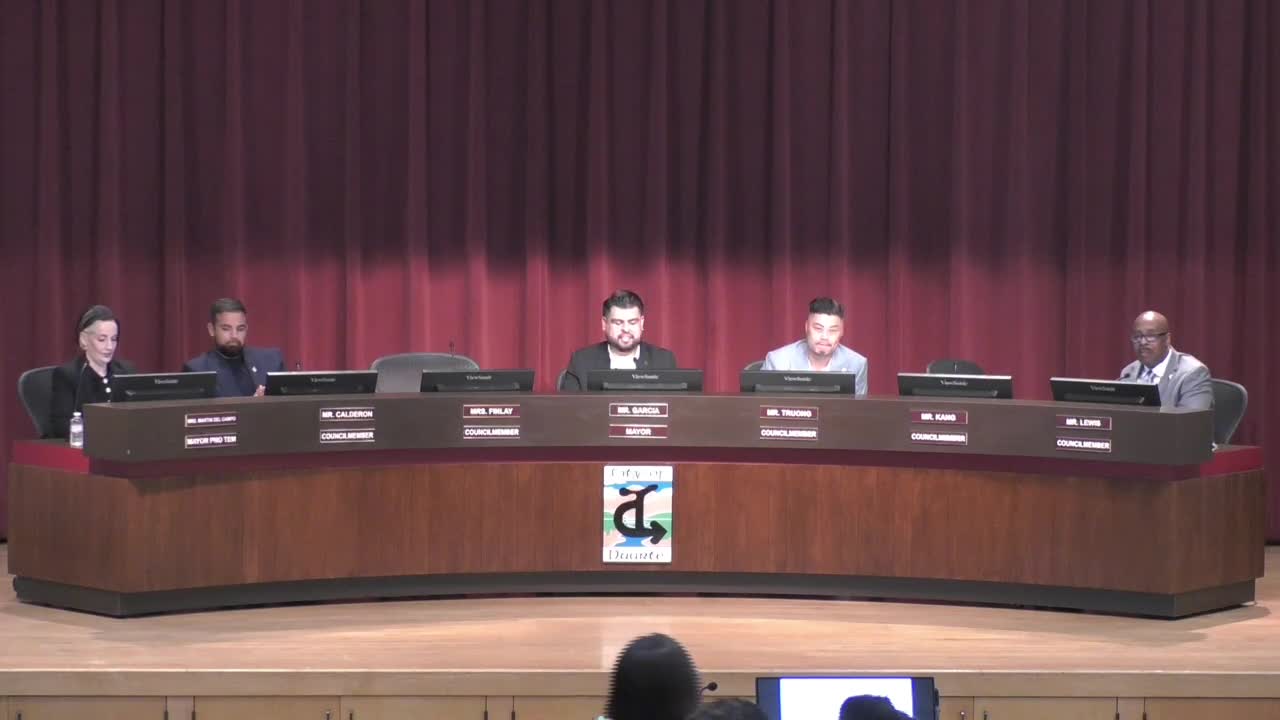
DuarteCity Attorney Phan briefed the City Council on federal preemption of immigration enforcement, recent federal court injunctions and pending Supreme Court review, and clarified what local officials can and cannot do when federal officers operate locally.
City Attorney Phan told the Duarte City Council on Aug. 26 that federal law preempts local authority over immigration enforcement and reviewed several active federal court cases that affect how federal agents may operate in Los Angeles County. The presentation summarized legal developments and the practical limits on city action while urging caution in public reporting.
The update focused on three legal strands: a federal injunction affecting targeted immigration operations in the Ninth Circuit, ongoing litigation over so-called sanctuary policies, and separate suits about the conditions of detention and access to counsel. Phan said the Ninth Circuit upheld a district court order restricting broad, pattern-based immigration detentions and that the federal government has sought emergency review at the U.S. Supreme Court. "The city is preempted by federal law, which grants federal law enforcement officers the ability to carry out immigration enforcement," Phan said.
The nut graf: the briefing matters because the federal court rulings and any Supreme Court action will determine whether nationwide patterns of targeted enforcement and reliance on location, appearance or occupation as triggers for stops are lawful; Duarte and other local jurisdictions do not control federal enforcement but can be affected by the courtsrulings.
Phan explained that the district courtand Ninth Circuit rulings bar immigration officials from detaining people in the Central District of California unless officials have a particularized reason to suspect a violation of federal immigration law and from relying solely on four factors: apparent race or ethnicity; speaking with an accent; presence at particular locations (bus stops, car washes, day-labor pickup sites, agricultural sites); and the type of work a person does. The briefing noted that the injunction did not prevent federal agents from executing search warrants or prosecuting workplace raids based on judicially-authorized warrants.
Phan also reviewed related litigation: a case brought by cities and civil-rights groups seeking limits on immigration operations and expanded access to counsel for detainees; litigation challenging federal threats to withhold funding from so-called sanctuary jurisdictions; and a federal suit in which the U.S. government seeks to block municipal sanctuary measures. "A holding in these cases would apply across California because we are in the Ninth Circuit," Phan cautioned.
Council members asked how residents should respond to possible operations and whether federal agents can use public parking lots to stage activity. Phan advised that federal agents may use public spaces and that local law enforcement cannot direct federal officers. Council members were urged to encourage residents to report unconfirmed sightings to the cityspecifically to the public safety departmentrather than sharing unverified social media reports.
Phan also said impersonating law enforcement is a crime and raised safety concerns when people do not identify themselves, an issue that surfaced in national coverage of related operations elsewhere. A council member asked whether border-patrol-style checkpoints could be established; Phan said Border Patrolwhich has statutory authority near the borderis not setting up checkpoints in the city, and that most enforcement takes the form of targeted surveillance and actions at public locations or workplaces.
Ending: Phan recommended caution in public reporting, noted the legal landscape is changing quickly and said any formal decision about joining litigation or filing amicus briefs would require a separate, agendized council action under the Brown Act.