Get Full Government Meeting Transcripts, Videos, & Alerts Forever!
Get email alerts on the Digital Billboard Signage topic
No spam. Unsubscribe anytime.
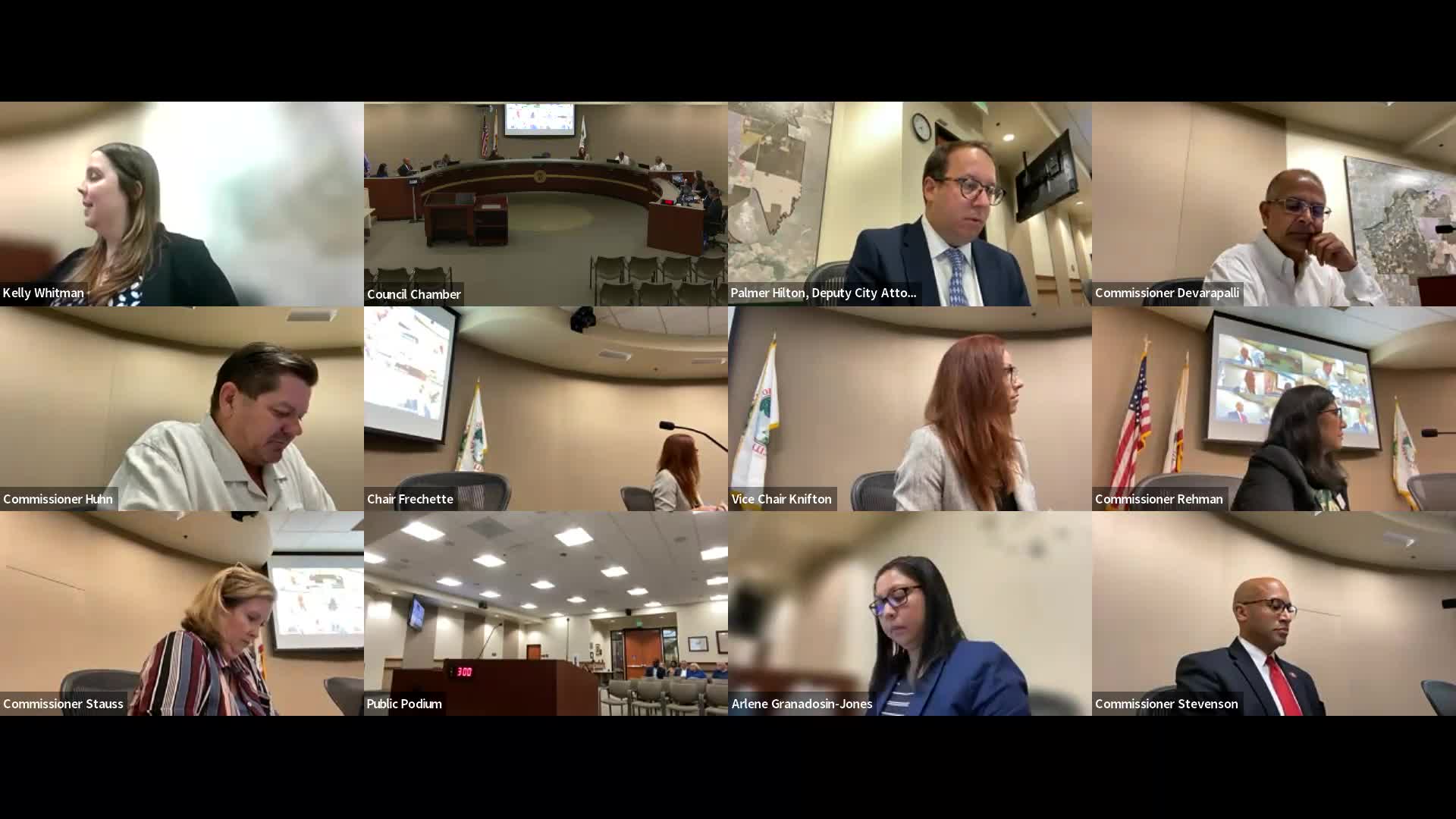
Planning commission recommends council consider Fite Circle digital billboard overlay amid neighborhood objections
Summary
The Rancho Cordova Planning Commission voted to recommend City Council certify an initial study/MND and approve zoning changes, a conditional use permit and design review to allow a 1,200-square-foot digital billboard at 3127 Fite Circle; residents and competitors raised concerns about size, light and perceived preferential treatment.
The Rancho Cordova Planning Commission voted to recommend that the City Council certify the initial study and mitigated negative declaration and approve a zoning text amendment, conditional use permit and minor design review that would allow a digital billboard at 3127 Fite Circle.
The recommendation, made at the planning commission’s public hearing on item 7.1, would add a new digital-freeway-sign overlay area to the city code and clear the way for a digital sign up to 1,200 square feet and 60 feet tall with operating rules to be set in a city council-approved operating agreement. The commission’s recommendation will go to the City Council for final action.
The matter matters to residents because the proposed sign would be sited along U.S. Highway 50 about 85 feet from the Caltrans right-of-way and roughly 300 feet from homes across the freeway; nearby residents and a competing outdoor-advertising firm urged commissioners to reject the requested deviations from the city’s existing sign rules.
Nick Sosa, a planner in the city’s Planning Department, told the commission the proposal is a relocation of a second digital sign previously approved for the Cordova Community Council’s mineshaft property in 2023. He said the project parcel is a 2.2-acre office/industrial property within the Folsom Boulevard specific plan area and that the application includes a zoning text amendment to add the new overlay area, a conditional use permit to operate the sign, a minor design review for site modifications and an operating agreement that can authorize deviations from development standards.
Resident James Garcia said the application would create a de facto monopoly for the Cordova Community Council and that the city should not expand the overlay in a piecemeal way. "Our standards were put there for a reason," Garcia said. He and other speakers argued the proposed 1,200-square-foot allowance—an increase from the current 672-square-foot limit—was not justified by the site’s setback and would result in additional light and visual intrusion for nearby homes.
Helen Whelan Beshaw, who identified herself as a resident of the Tiffany area, said the city has given special treatment to groups with city ties and warned the change could invite litigation. Amy Lerseth, speaking on behalf of Clear Channel, said the relocation and the size increase appear to be a "spot zoning" favor and noted other sign operators have been required to take down existing signs to put up new digital displays.
Representing the applicant, Brian Cooley said the Cordova Community Council (CCC), a nonprofit that runs local events and programming, was legally approved for two digital signs in 2023 and now seeks to relocate the second sign to the western city entrance. "100% of the profits and proceeds other than administrative costs are directly redistributed back in the Cordova community,” Cooley said, asking the commission to weigh the community benefit the CCC provides when considering deviations from the code.
David Niebo, the project’s sign consultant, said the proposed sign would be one of the furthest from the Caltrans right-of-way among the city’s freeway signs and described several technical mitigations: louvers to limit off-angle viewing from the houses across Highway 50, a photometric study showing the sign would operate within the code’s allowable illuminance (no more than 0.3 foot-candles above ambient), and structural design informed by geotechnical borings (he stated refusal at 7 feet and that the footing is designed to extend to approximately 35 feet).
The application seeks two formal deviations in the operating agreement: an increase of the maximum allowed sign face from 672 to 1,200 square feet and an exemption from the code’s 4-for-1 digital-sign removal requirement (the applicant instead proposes cancelling a previously approved western sign on its mineshaft property). Staff noted operating agreements are approved by the City Council only if the agreement achieves a community benefit equivalent to strict code compliance.
Commissioners asked about the overlay map, parking impacts, the justification for the larger face area, illumination thresholds, and structural design for wind. The applicant said the site presently will lose one to two parking spaces for footing and protective barriers but would remain in compliance with parking ratios; the sign vendor said louvers and brightness controls are planned to limit off-axis glare; and staff said the project’s Draft Initial Study/Mitigated Negative Declaration addressed potential environmental effects and included mitigation measures for air quality, biological and cultural resources, geology and soils, and tribal cultural resources. The MND public review period ran from 2025-06-27 to 2025-07-28 and generated two emailed comments (from Sacramento Area Sewer District and an individual identified as Charles Beck) and three public commenters at the hearing.
After deliberation, Commissioner Stevenson moved and Commissioner Hune seconded a motion recommending the City Council: certify the initial study and MND, adopt the mitigation monitoring and reporting program, adopt the zoning-text-amendment ordinance to add the digital-freeway-sign overlay area, and adopt a resolution recommending approval of the conditional use permit and minor design review for the Fite Circle billboard. The clerk’s roll call recorded a 6–1 recommendation in favor; Commissioner Deborah Polley cast the lone no vote.
The item now proceeds to City Council for the operating-agreement decision and final approvals; the planning commission’s recommendation is advisory and does not itself change zoning or grant permits.
Details such as the project address (3127 Fite Circle), parcel size (2.2 acres), proposed sign height (60 feet), proposed display dimensions (60 by 20 feet per face as shown in staff materials), proposed maximum face area (1,200 square feet), distance to Caltrans right-of-way (approximately 85 feet), and the MND public-review dates were discussed in the staff report and public hearing record.