Get Full Government Meeting Transcripts, Videos, & Alerts Forever!
Get email alerts on the Designation Midtown South topic
No spam. Unsubscribe anytime.
Landmarks Preservation Commission designates five Midtown South buildings tied to garment and fur trades
Summary
The Landmarks Preservation Commission voted unanimously Aug. 12 to designate five Midtown South buildings — representing the neighborhood’s early–20th-century garment and fur industries — as New York City individual landmarks.
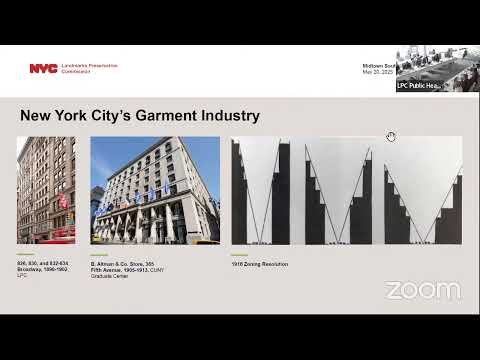
The Landmarks Preservation Commission voted Aug. 12 to designate five Midtown South buildings — the Barbee Building (LP-2687), Fashion Tower (LP-2688), Furcraft/Fur Craft Building (LP-2690), 20 Ninth Street Towers (LP-2689) and the Lefkort Clothing Center (LP-2691) — as New York City individual landmarks. The designations were presented by the commission’s research staff as part of LPC’s Midtown South initiative and passed by unanimous recorded votes. The commission’s research department said the five buildings illustrate Midtown South’s transformation into a national center for clothing manufacturing between roughly 1910 and 1930 and fill a gap in LPC’s existing designations for that era. ‘‘The research department recommends that the commission vote to designate’’ the buildings, staff said during the hearing. Taken together, the buildings represent different strands of early twentieth‑century commercial architecture and the industries that shaped the neighborhood — from loft buildings designed to house showrooms and workshops to ornate Art Deco commercial towers with fashion‑related terracotta ornament. LPC staff noted the research effort was coordinated with the Department of City Planning’s Midtown South planning effort and that the survey identified roughly 90 buildings of interest. The commission’s votes were recorded as follows: Barbee Building (moved by Commissioner Chen; seconded by Commissioner Goldblum; vote 10–0), Fashion Tower (moved by Vice Chair Master; seconded by Commissioner Jefferson; vote 10–0), Furcraft/Fur Craft Building (moved by Commissioner Chu; seconded by Commissioner Ekwembe; vote 10–0), 20 Ninth Street Towers (moved by Commissioner Ginsburg; seconded by Commissioner Chen; vote 10–0), and Lefkort Clothing Center (moved by Commissioner Mann; seconded by Commissioner Wilder; vote 10–0). Research staff described the five sites as follows: the Barbee Building (1517 W. 38th Street) is a 12‑story Renaissance‑Revival loft building by Delano & Aldrich (1908–09) that helped set the stage for the garment center; Fashion Tower (135 W. 36th Street), a 20‑story Emery Roth building (1924–26) notable for its terracotta fashion imagery; the Furcraft Building (242–246 W. 30th Street), a 14‑story building associated with the Fur District and ornamented with animal motifs; the 20 Ninth Street Towers (214 & 226 W. 29th Street), connected towers with glazed terracotta and fur‑trade grotesques; and the Lefkort Clothing Center (275 Seventh Avenue), a 26‑story Art Deco loft building that housed showrooms and the International Ladies’ Garment Workers’ Union health center and later was purchased by the union (now Unite Here). The designations recognize architectural features and the buildings’ roles in manufacturing, showrooms and labor history. During the hearing, several commissioners praised the buildings’ craftsmanship, setbacks that respond to the 1916 Zoning Resolution and the ornament that reflects original uses. Representatives of preservation organizations testified in favor of designation at the earlier public hearing; building‑owner representatives attended some hearings and in at least one case spoke in opposition to designation but were not successful in preventing the vote. The commission’s research staff noted the designations were the product of an LPC survey tied to the Department of City Planning’s Midtown South rezoning work and intended to preserve representative examples of the garment and fur industries’ architecture amid a planning process that anticipates new development in the area.