Get Full Government Meeting Transcripts, Videos, & Alerts Forever!
Get email alerts on the Solar Installation topic
No spam. Unsubscribe anytime.
NYC Landmarks panel approves visible solar array on Douglaston Hill house with one dissent
Summary
The Landmarks Preservation Commission approved a visible rooftop solar installation for a neo-Colonial freestanding house in the Douglaston Hill Historic District, despite objections from neighborhood preservation groups and one commissioner’s opposition.
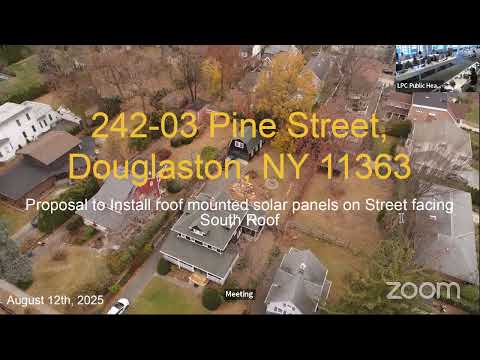
The Landmarks Preservation Commission voted 8–1 on Aug. 12 to allow a street-facing solar array on a neo-Colonial freestanding house in the Douglaston Hill Historic District in Queens. The owner, Bruce Stewart, applied for a Certificate of Appropriateness to install 14 panels on the south-facing, street-facing porch roof that would produce about 4.9 kilowatts (about 5,066 kWh) and also feed an EV charger. The commission’s vote followed testimony from preservation groups and neighborhood organizations urging denial for the panels on the front facade and testimony from the applicant and his contractor. The Victorian Society in New York and the Historic Districts Council’s witness said the panels on the front porch roof would be “very visible” and would “significantly detract” from the main facade, while Queens Community Board 11 recommended approval and the Douglaston and Little Neck Historical Society recommended denial of the front-facing portion. Deputy Director of Preservation Emma Waterloo introduced the item (LPC 25‑10999; property identified in the filing as Block 8106, Lot 55240, 242‑03 Pine Street). Ellen, representing Empower Solar, described two installation options and said omitting the 14 front panels would reduce production by roughly 51 percent and make the project uneconomic. She said the proposed panels are black-on-black SunPower/Maxeon 350‑watt modules, mounted 3–6 inches off the roof, with a 3‑foot unobstructed top zone for FDNY access, and that conduit runs would be routed to minimize street visibility. Commission discussion emphasized the body’s evolving approach toward visible solar. Several commissioners noted that the commission has moved to allow more visible solar on freestanding houses and rowhouses and emphasized reversibility and low profile mounting. Commissioner Jefferson cast the lone “nay,” saying the thin light band at the top of the array changed the roof’s character. The motion approving the application included conditions about low-profile mounting, solid black finished skirts and black mesh critter guards, concealment of conduit (painted to match adjacent trim), and that the installation be reversible. The owner, Bruce Stewart, told the panel he had researched rules, understood the visibility concerns and said the installation is removable and an environmental benefit for his household. The application record also notes the applicant’s intent to use an EV charger fed by the solar system.