Get Full Government Meeting Transcripts, Videos, & Alerts Forever!
Get email alerts on the Zoning Nonconformity Notice topic
No spam. Unsubscribe anytime.
Board recommends dropping public-notice step for nonconforming-use determinations to streamline reviews
Summary
The Albany Planning Board voted to recommend that the Common Council remove the public-notice requirement for determinations of legal nonconformity status while preserving evidentiary review standards; staff said the change would reduce applicant burden and staff workload.
On Aug. 5 the Albany Planning Board voted to recommend that the Common Council approve zoning text amendment 0025 to remove the public-notice requirement for administrative determinations of legal nonconformity status under the Unified Sustainable Development Ordinance (USDO).
City planning staff explained that the determination of nonconformity status is a fact-based administrative decision issued by the chief planning official that confirms whether a lot, structure or use is lawfully established and may continue. Staff described the current two-step process: applicants typically request a zoning compliance certificate first, then apply for a separate determination of nonconformity status, which under the 2021 USDO update requires public notice and a 14-day waiting period after notice is posted and mailed.
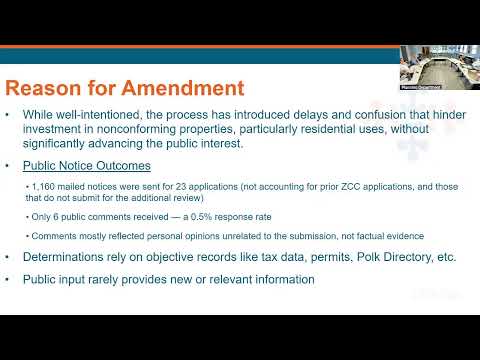
Staff provided application data: since the determination step was added, the department received 23 applications for legal nonconformity status, mailed a total of 1,116 notices and received six comment letters; since 2022 the office received 931 zoning compliance applications. Staff said the public-notice step typically requires mailing notices to property owners within a 200-foot radius (often 50–100 recipients, depending on density), posting notice on the property and filing an affidavit of compliance; the average review time for a complete determination application was reported as about 30 days, not counting the prior zoning-compliance step.
The proposed amendment would remove the public-notice requirement but preserve the evidentiary standards and staff review: staff would be able to resolve nonconformity status as part of the routine zoning-compliance-certificate process rather than as a separate noticed proceeding. Staff told the board the public-notice requirement had low yield (about 0.5% comment rate for the 23 applications) and had created confusion between the two processes, placing an administrative burden on sellers, buyers and staff.
Board members asked clarifying questions about examples such as a preexisting two-family house in a single-family (R-1) district and staff confirmed such a lawful preexisting use could be treated as a legal nonconformity. After brief discussion the board moved, seconded and voted favorably to recommend the amendment to the Common Council; staff noted the formal determination of this code change and public-notice policy will be completed by the Common Council.
The amendment, if adopted by the Common Council, would not change the substantive evidentiary test for nonconforming status; it would remove the separate public-notice step that currently accompanies the administrative determination.