Get email alerts on the Flood Mitigation topic
No spam. Unsubscribe anytime.
City hears timeline for watershed flood-mitigation design work
Summary
Local nonprofit leaders and two engineering firms told the Helena-West Helena City Council the watershed flood-mitigation project is moving from planning into an 18–24 month design phase, with construction targeted afterward and public outreach planned.
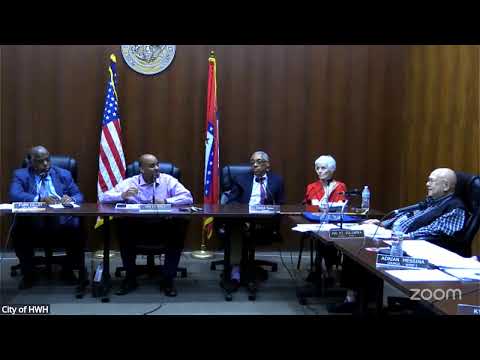
Members of the Helena-West Helena City Council heard an update Tuesday evening on a multi-year watershed flood-mitigation project, including who will design the work, how long design will take and where construction is likely to focus. Frank Bacon, executive director of the Arkansas Black Menace Association, said the planning phase is complete and engineers are beginning design work. The council was told funding and planning began in 2022: the project application received NRCS funding in September 2022, and the group completed planning and paid roughly $3,000,000 for the plan, Bacon said. Bacon said construction is expected to cost "actually $12,000,000" when the project reaches that stage. Duwan Carter, vice president of operations for ICONIC Consulting Engineering (Little Rock office), told the council ICONIC began design on June 30 and is targeting 18 months to complete the design phase, which would put design completion around December 2026. Carter said ICONIC is responsible for the Lick Creek and Big Creek watershed areas and described likely design elements as widening ditches, replacing culverts and adding at least one detention basin sized to handle a 100-year flood event. He estimated construction for ICONIC’s portion at approximately $7,800,000 and said a typical construction cycle would be about two years. Emmanuel Tuombe, president of ABS Engineering (Memphis), said his firm will handle portions of the drainage work in the city and on surrounding outskirts. ABS’s public-engagement representative will coordinate outreach with the city, Tuombe said, and ABS plans to survey the site and communicate with residents before crews are on private property. Council members asked whether the U.S. Army Corps of Engineers would be involved. Carter, who recently retired from the Corps, said he was not aware of a direct Corps role and that the project was funded through an NRCS program. Both firms said surveying crews would be on the ground within about two weeks and that the design teams plan to employ local workers where feasible, particularly during construction. The presenters said they will provide maps and outreach so residents know where crews will be working and when. Bacon told the council he expects the overall program (design plus construction) to yield visible local flood relief within about four years. The council took no formal action on the presentation; engineering teams will continue design work under the terms of their contracts.
AI generated
The text on this page is AI generated. Summaries, highlights, analysis, and video transcripts are all produced from the original source material.
AI can make mistakes, so if you spot one, and we will fix it for everyone.
Note: the source content is unaltered by us. Any content source we link to, be it a video, an audio recording, or a document, is presented exactly as its publisher released it. That publisher is usually a government body, sometimes an individual official or another organisation.