Get Full Government Meeting Transcripts, Videos, & Alerts Forever!
Get email alerts on the Animal Shelter Board topic
No spam. Unsubscribe anytime.
Rosenberg council orders smaller animal advisory board, seats four members to meet state law
Summary
After extended debate about dysfunction and statutory requirements, council voted to reduce the animal shelter advisory board to the state minimum and temporarily appointed a veterinarian, a municipal official, a shelter operations representative, and an animal-welfare representative.
The Rosenberg City Council voted to reduce the city’s animal shelter advisory board to the minimum composition required by Texas law and to seat four people to meet statutory requirements for cities with an animal shelter.
The action came after an extended and sometimes contentious discussion about board size, past meetings and member conduct. The debate focused on whether the council should reappoint a larger slate of volunteers or first seat a small, functional panel that fulfills the statutory makeup required by the Texas Health and Safety Code.
Chief (recorded as the police chief) told council that state statute requires an advisory committee where a city operates an animal shelter and that the committee “must be composed of at least 1 licensed veterinarian, 1 county or municipal official, 1 person whose duties include daily operation of the animal shelter and 1 representative from an animal welfare organization.” The chief recommended a smaller panel so the board can “actually have productive meetings.”
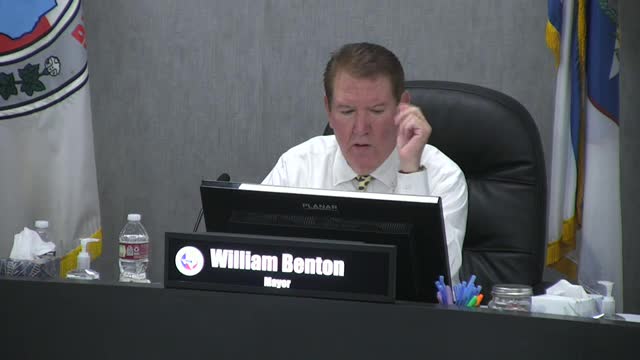
Mayor Richard (recorded as mayor) proposed a four‑member slate drawn from the applicants who had filed: Dr. Aguirre (veterinarian applicant), Assistant Chief Nethery (municipal official recommendation by staff), Omar (the shelter staff representative who confirmed he was willing), and Carolyn Seiler (animal welfare representative). The mayor moved to appoint that group as the minimum advisory committee. The motion tied on an initial vote; council then reworked motions and ultimately voted to seat the four named members to meet the statutory requirement.
Council discussion included criticism from staff that the earlier, larger advisory board meetings had been unproductive and had included personal attacks and social‑media disputes involving the shelter veterinarian. Several council members said they would prefer to install a functional core membership first and then add volunteers later if meetings and outreach demand it. Council also noted that positions serve at the council’s pleasure and can be changed at a future meeting.
The council’s motion directs staff to seat the four positions immediately and left open the option to place additional volunteers on the board at a future meeting; staff and the chief said they would continue outreach and hold the required minimum number of meetings. The council did not adopt any additional rules for the advisory board at this meeting beyond meeting the statutory composition.