Get Full Government Meeting Transcripts, Videos, & Alerts Forever!
Get email alerts on the Building And Fire Codes topic
No spam. Unsubscribe anytime.
Weatherford council hears plan to adopt 2021 building codes, discusses sprinkler thresholds and safety changes
Summary
City staff told the Weatherford City Council they intend to move the city's building and fire codes from the 2009 International Code editions and the 2008 National Electrical Code to the 2021 International Code editions and the 2020 National Electrical Code.
City staff told the Weatherford City Council they intend to move the city's building and fire codes from the 2009 International Code editions and the 2008 National Electrical Code to the 2021 International Code editions and the 2020 National Electrical Code.
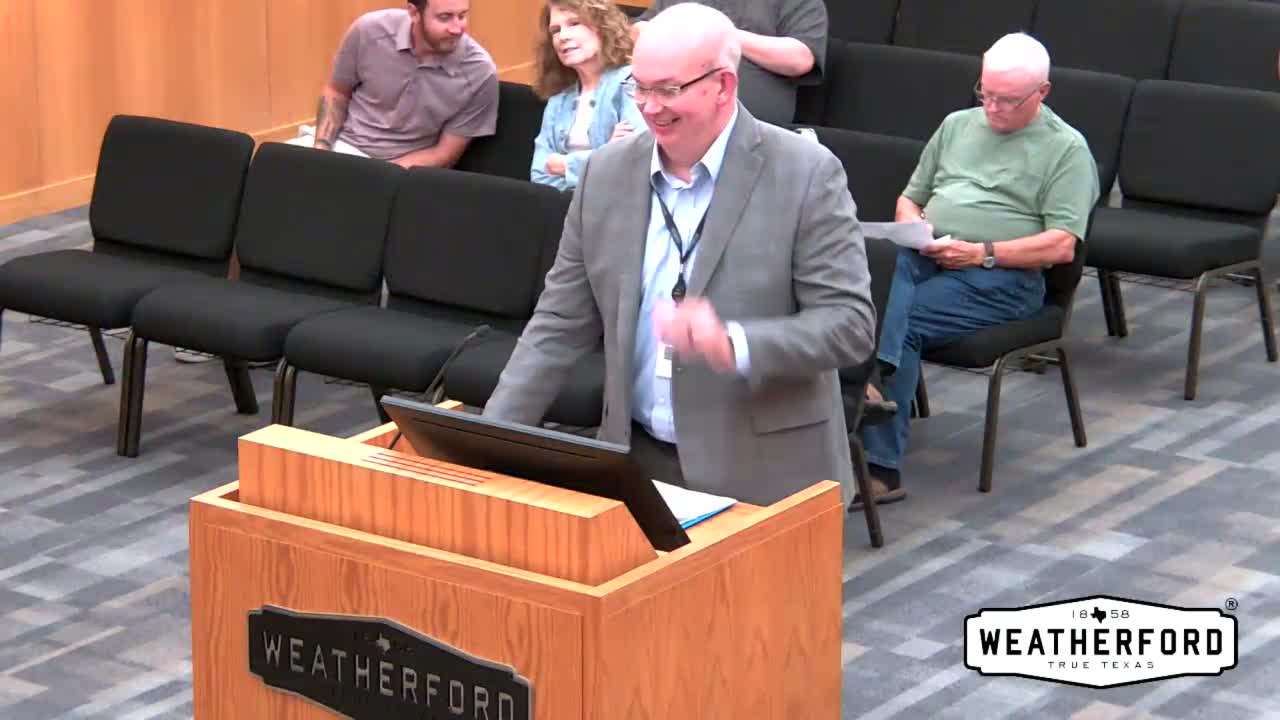
The proposal, presented at the June meeting, would reduce more than 100 pages of local amendments by aligning local rules with the base international codes and would add the International Swimming Pool and Spa Code as a separate book. "We are currently proposing, moving to the 2021 editions of the International Code and the 2020 National Electric Code," said Caleb Kettner, staff member, during the presentation.
Why it matters: city staff said updating the code would make Weatherford clearer and easier for builders and could affect insurance ratings and safety systems. Council members pressed staff for specifics about which uses would trigger new requirements, especially on sprinkler thresholds that have previously applied to all buildings over 7,500 square feet.
Assistant City Manager Chad Marvot told the council the engineering and planning rationale for updating the code is to "be proactive and prepare for growth" and to "safeguard surrounding properties" as development occurs around the I-20 corridor.
Fire Marshal Kevin Dozier outlined major changes in the International Fire Code portion of the package. Dozier described the removal of the blanket 7,500-square-foot sprinkler requirement and explained how the newer code ties sprinkler triggers to occupancy and use type. "For most of them, that's gonna take most buildings up to 12,000 square feet before that sprinkler requirement triggers," Dozier said, adding that higher-hazard occupancies would still have lower thresholds.
Dozier also highlighted expanded requirements for emergency responder radio coverage inside buildings, and new guidance for energy storage systems such as rooftop solar plus battery installations: "How do we take these energy storage systems such as solar panels with backup batteries? How do we do that and install it safely?" he asked.
Council and staff clarified that existing businesses would not be automatically required to retrofit: changes would be triggered by a change of use or major remodeling (generally defined as major modifications exceeding 50 percent). "If the use type stays the same, there's really no changes," Dozier said. Councilmember Luke Williams asked staff to provide a clear, itemized list of the specific business types and thresholds that would be affected so business owners and investors could know whether they must comply.
Staff proposed a next step: a public hearing scheduled for June 24 and, if adopted, an immediate effective date with a grace period allowing projects already under design to continue until Dec. 31, 2025. Kettner said the council would be presented with a formal ordinance for adoption after the hearing.
No ordinance vote was taken at the meeting; the item was a received update and council discussion. Councilmembers emphasized the importance of clarity for developers and small business owners and requested a written list of triggered uses and thresholds before any ordinance adoption.
The council is expected to revisit the item after the June 24 public hearing, when staff will present a draft ordinance that could set an immediate effective date with a transition grace period through the end of 2025.