
Rosenberg kicks off comprehensive-plan update after $250,000 GLO resiliency grant
Get AI-powered insights, summaries, and transcripts
Subscribe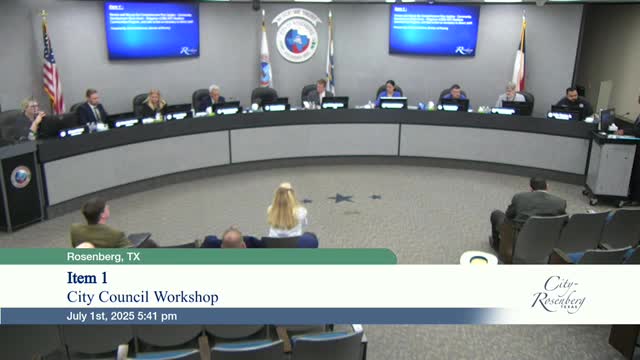
Summary
Rosenberg city staff and consulting teams presented a kickoff for a comprehensive plan update at a council meeting, saying the project will be funded by a $250,000 Community Development Block Grant - Mitigation (CDBG‑MIT) award from the Texas General Land Office.
Rosenberg city staff and consulting teams presented a kickoff for a comprehensive plan update at a council meeting, saying the project will be funded by a $250,000 Community Development Block Grant - Mitigation (CDBG‑MIT) award from the Texas General Land Office.
“City of Rosenberg has secured $250,000 through the Texas General Land Office, GLO, community development, block grant, mitigation resilient communities program,” Mohammed, a city staff member, told the council during his opening remarks.
The consultants leading the effort — Ardura (planning and design) with market analysis partner CDS — described a process of community engagement, data collection and drafting that they said would produce a forward‑looking plan that integrates hazard mitigation, land use and implementation steps. Mindy Snyder of Ardura said the consultant team will run the public outreach and produce maps, graphics and an implementation matrix.
The plan is intended to identify vulnerabilities tied to natural hazards, infrastructure needs and long‑term growth; consultants said it will also help the city compete for future grants. “If you do, you get additional points for that,” the consultant team said, referring to grant reviewers that prioritize projects identified in an adopted comprehensive plan. Ty Jacobson of CDS said the market‑study component will analyze demographic trends, housing and commercial market conditions to inform land‑use recommendations.
Consultants outlined public outreach methods that include a Comprehensive Plan Advisory Committee (CPAC), focus groups, one‑on‑one interviews with council members, online questionnaires, “pop‑up” events at community gatherings and coordination with city communications staff. The advisory committee was described as meeting at key milestones; consultants said they expect to meet the CPAC four to five times during the project.
There was a discrepancy in schedules discussed at the meeting. Mohammed described the overall effort as a roughly 20‑month initiative. Consultants gave a shorter, phased schedule: about a year for the comprehensive‑plan update and an additional roughly eight months to draft Unified Development Code (UDC) amendments tied to implementation. At one point the team also described an 11‑month schedule for core planning tasks; councilmembers and staff discussed finalizing the work plan and schedule after the meeting.
Joyce, a city staff member, confirmed that the consultant contract is a lump‑sum agreement within the grant amount, saying the contract “is within the grant amount.” Council members asked how the plan would help the city secure future funding; consultants cited examples such as TxDOT discretionary programs and other state grant processes that award points or preference when projects are shown in an adopted plan.
Lata Kirishno (consultant) told the council that state law provides the framework for comprehensive plans, noting that Texas Local Government Code section 211.004 gives cities the authority to adopt a comprehensive plan and that having a plan can be a prerequisite or advantage for certain grants.
Council members asked clarifying questions about the grant and schedule. Felix asked how the plan would help with future grants; Jessica asked whether the city could incur costs beyond the grant. Consultants and staff replied that the contract is structured as a lump sum within the grant and that the plan should strengthen future grant applications.
Councilmembers did not take a separate vote to adopt the plan or contract at the meeting; the advisory‑committee appointments were placed on the consent agenda for approval at the regular meeting. A council member moved to adjourn toward the end of the session; the mayor concluded, “I think we’re all yeses,” and the meeting adjourned.
Why this matters: An updated comprehensive plan that explicitly integrates hazard mitigation is often required or prioritized by state and federal grant programs. City staff said the document will be used as a strategic roadmap for future land‑use decisions, infrastructure investment and grant applications.
Next steps: Consultants will finalize the work plan and schedule with staff, launch the project website and online questionnaire, and begin stakeholder interviews and CPAC meetings as the team moves into data collection and community visioning phases.