
Rosenberg council reviews FY26 proposed budget, trims property tax rate and scales back hotel‑motel grants
Get AI-powered insights, summaries, and transcripts
Subscribe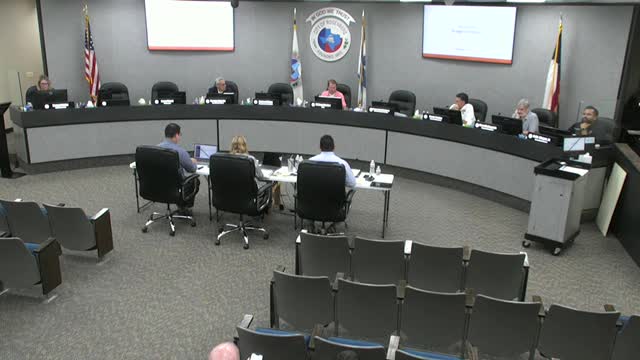
Summary
Council and staff reviewed the city manager’s proposed fiscal year 2025–26 budget, agreed to lower the property tax rate from $0.33 to $0.30 and directed staff to use fund balance to cover the shortfall; council also signaled support to cut hotel‑motel grant funding from $100,000 to $50,000 while deferring final action to the HOT committee.
Mayor (name not specified) opened a workshop to review the city manager’s proposed fiscal year 2025–26 budget and asked staff to present key fund-by-fund highlights.
Lewis, finance director, told the council the proposed budget was filed with the city secretary on July 29 and previously overviewed at the Aug. 5 regular meeting. He said personnel costs and debt service are the largest budget drivers and that staff adjusted the proposal after earlier council direction to reduce the property tax rate.
The budget presented reduces the property tax rate from $0.33 to $0.30 and lowers projected property tax revenue by about $1.5 million; Lewis said staff would shift that revenue shortfall to general fund balance so the city’s services and staffing levels remain as proposed. Mayor (name not specified) and several council members discussed the tradeoffs between a lower tax rate and dipping into fund balance.
Lewis summarized key revenue figures: sales tax (about $21.25 million) and property tax (about $8.9 million) are the major general‑fund revenue streams. On expenditures, personnel and benefits account for the largest shares (personnel ~ $33.6 million across funds; public safety ~ $24.7 million of the general fund), and departments will see across‑the‑board salary adjustments. Lewis said non‑step employees would receive 5%–8% increases, step employees a 2.5% step, and the budget assumes a roughly 20.7% increase in health insurance costs; the employer contribution was raised from 50% to 55% so employees would “not see any type of increase on their paycheck,” he said.
Councilors pressed staff on new positions and whether the tax cut would affect services. Lewis said the budget adds four full‑time positions (an infrastructure plans examiner in engineering; a building inspector in code enforcement; a fire captain; and a maintenance/operations technician in water distribution) and reclassifies the fire marshal to full time; those positions remained in the budget after the tax‑rate reduction and the shortfall would be covered from fund balance.
Council discussion also focused on the hotel‑motel (HOT) fund, which has helped subsidize operations of the Civic Center. Lewis reported the HOT fund has run deficits in recent years and that staff proposed reducing a community grant line from $100,000 to $50,000 because the fund’s balance is declining. Councilors debated whether to cut the grants entirely or reduce them to $50,000; after a brief roll call of preferences the mayor said most members preferred a 50% cut and asked the HOT committee to review details and recommendations before final action.
Other notable items covered: law enforcement forfeiture and restricted funds will fund a $366,000 five‑year equipment plan (body‑worn cameras, in‑car cameras, interview room upgrades and axon equipment); the city’s current debt balance was presented at about $75 million with debt service payments projected at approximately $8.2 million for FY26; capital projects include a $1.2 million Street Improvement Fund (with $1,000,000 for overlays and $200,000 for sidewalk repair); and water/wastewater enterprise CIP items totaling roughly $3.2 million (including meter register replacement, water line and hydrant work on Avenue G, and collection system rehab).
Councilors and staff also discussed operations tied to the Civic Center: staff proposed a transfer of approximately $350,000 from the HOT fund to the Civic Center budget for FY26; Lewis said operating the Civic Center costs roughly $670,000 and brings in about $300,000 in revenue, with salary cost of roughly $300,000 and other building costs (electricity, technology, janitorial, repairs) comprising the remainder. Councilors asked staff to provide more detail on evening rental revenue, nonprofit use policy and whether HOAs should be allowed weekday‑evening use at reduced or no cost; the mayor asked staff to return with figures and policy options.
Fire and EMS staffing needs drew extended discussion. The fire department described a proposed EMS/care‑quality position (described in discussion as an EMS captain or program lead) focused on medical quality assurance, protocol maintenance, training, Medical Director liaison duties and infection control citywide. The chief said about half the department’s calls are EMS related and that the new position would improve compliance and training at relatively low incremental cost compared with other options.
Lewis said the city will present a budget adjustment at the next council meeting to cover a set of one‑time supplemental items (about $285,000 total) from current sales tax receipts; examples include an AC replacement at animal control and vehicle outfitting costs. He also reminded the council that a public hearing on the budget will be held on the 20th (advertisement to run twice in the local paper) and the final vote on the budget and tax rate is scheduled for Sept. 2.
At the close of the workshop the council took a motion that passed (motion text not specified in the transcript) and adjourned.