Get Full Government Meeting Transcripts, Videos, & Alerts Forever!
Get email alerts on the Uas Zipline topic
No spam. Unsubscribe anytime.
Rowlett OKs Zipline unmanned aircraft hub with conditions on paving, fencing and landscaping
Summary
City Council unanimously approved a special‑use permit letting Zipline operate an unmanned aircraft system hub at 5408 Kenwood Drive; the approval includes time‑limited conditions on paving, fencing and landscaping described by staff and P&Z.
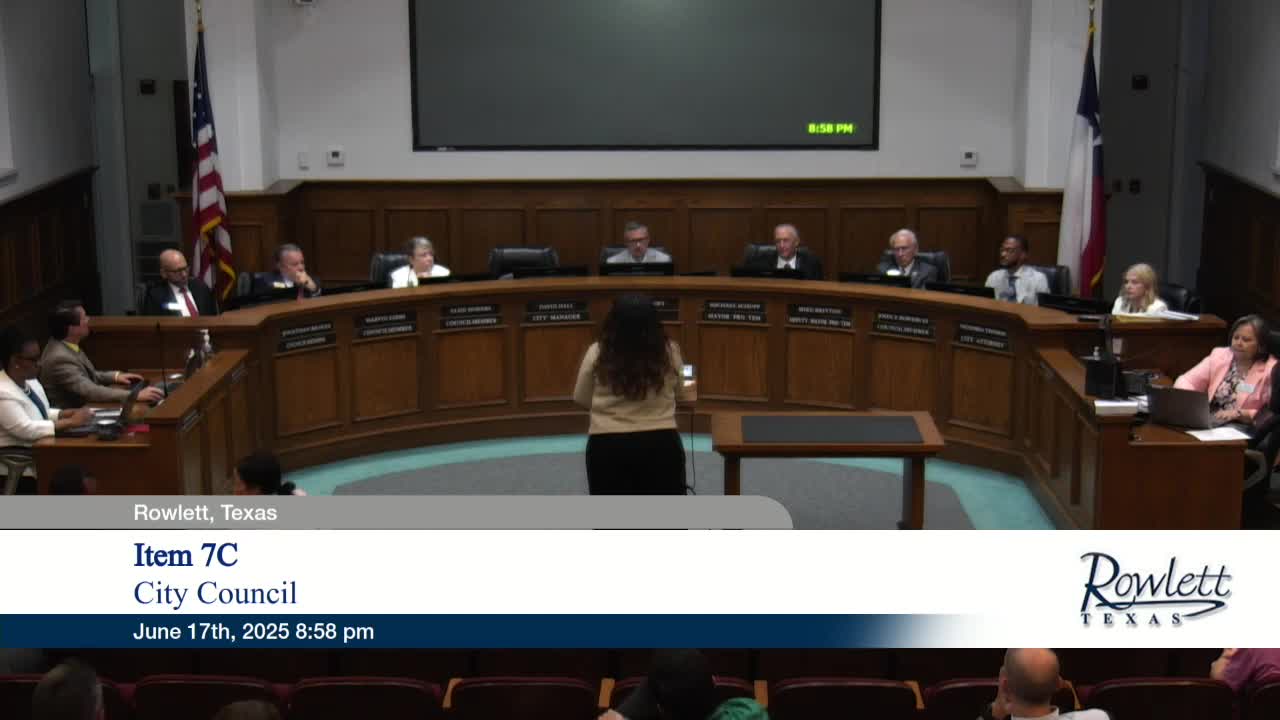
The Rowlett City Council on June 17 unanimously approved an ordinance granting a special‑use permit for an unmanned aircraft system (UAS) hub at 5408 Kenwood Drive, allowing Zipline to operate a small delivery hub subject to conditions recommended by the Planning and Zoning Commission.
Senior Planner Britney Musser told council the site would be a 2.85‑acre property with the UAS hub occupying about 10,600 square feet; the nearest existing residence is approximately 500 feet away. Musser described the site’s compliance with the city’s use‑specific regulations and summarized Planning and Zoning’s recommendation that the applicant limit temporary gravel paving to 12 months (rather than the 18 months requested), install landscaping within 12 months, and replace an 8‑foot chain‑link fence with wrought iron at the end of the temporary period.
Stephanie Cook, Zipline’s presenter, described the company’s operations and said the design changes submitted after Planning and Zoning reflect the commission’s concerns. Cook said Zipline planned to pave most of the site immediately, leaving gravel only beneath temporary generators; she also described plans for signage, lighting, security cameras and a temperature‑controlled container for network equipment that Zipline said would be replaced by a permanent structure.
Cook explained how Zipline’s delivery vehicle — a small insulated “zip” — is lowered on a winch from a larger aircraft and delivers packages with what she described as “dinner‑plate accuracy.” She said Zipline has a safety program, 24/7 monitoring, and automated preflight checks; Zipline representatives noted they have operational experience in nearby Texas communities.
During questions, the council and staff discussed mechanisms to ensure the applicant meets the conditions. Staff said they can use temporary certificates of occupancy and the city’s permitting software to trigger inspections and compliance checks. The city attorney confirmed that any container or accessory structure would be evaluated under the code and could require separate approvals if necessary.
After discussion, Councilmember [motion maker recorded in the packet] moved adoption of the ordinance incorporating the Planning and Zoning conditions; Councilmember Shoop seconded. The motion passed unanimously, 7–0.
Planner Musser and the applicant said they will work with code enforcement to schedule the site’s permanent improvements — paving, landscaping and fencing — and the applicant said it would coordinate with staff on the container and other site details.
Zipline’s approval marks an early adoption of the city’s UAS‑hub standards after a recent text amendment to the code; the city will monitor the site during the temporary period set by the ordinance.