Get Full Government Meeting Transcripts, Videos, & Alerts Forever!
Get email alerts on the City Finance topic
No spam. Unsubscribe anytime.
Rowlett reports $129 million revenue for third-quarter; key funds outperform forecast
Summary
City finance director told council the city ended the third quarter of fiscal 2025 with $129 million in revenue, roughly $5 million above forecast, and expenses below forecast across major funds; property taxes remain the largest general-fund revenue source.
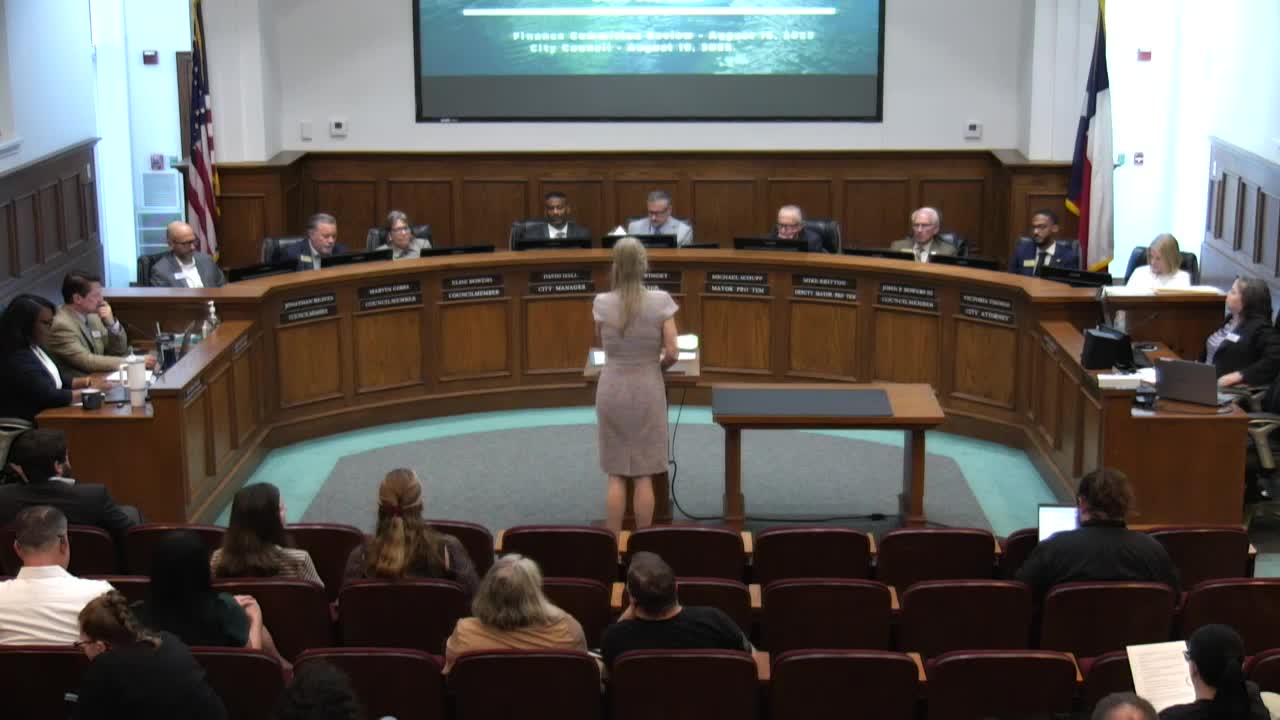
Rowlett’s finance director told the City Council Tuesday that the city closed the third quarter of fiscal 2025 with $129 million in revenue, about $5 million — or 4% — higher than the forecast, and expenses that were roughly $3 million, or 3%, lower than budgeted for the quarter.
The report from Wendy Badgett, the city’s director of finance, said property taxes account for about 60% of general-fund revenue and that the city has collected $42 million in general-fund property taxes, about $435,000 above forecast. Sales taxes, which the Texas Comptroller collects, represent roughly 15% of the general fund; June sales-tax receipts put the city about $160,000, or 2%, above its quarterly sales-tax forecast.
Badgett said other revenue sources that outperformed forecast included $1.1 million in interest earnings, $260,000 in court fines, $200,000 in ambulance fees and $170,000 from natural gas and electric franchise fees. Overall, she reported general-fund revenues exceeded the quarter forecast by approximately $3 million.
In the utility fund, Badgett said water revenues — which cover purchases from the North Texas Municipal Water District — were about $97,000 (1%) above forecast, while sewer revenues were about $22,000 below forecast. Combined, utility fund revenues were about $500,000 above forecast for the quarter; utility fund expenses were roughly $60,000 above forecast, driven largely by higher wastewater-treatment costs.
Other funds largely tracked or outperformed forecasts, Badgett said. The debt-service fund’s expenses were about $26,000 higher than forecast because of higher Dallas County fees tied to property-tax refunds; that was offset by property-tax revenues. The employee health benefits fund exceeded forecasted expenses by $237,000 but had offsetting stop‑loss reimbursements. The refuse fund exceeded forecasted expenses by $136,000 due to increased service volume but collected additional fee revenue to offset those costs.
City council members praised the finance team’s work during the presentation and had no requests to alter the report. Badgett told the council the report had been reviewed in greater detail by the city’s finance committee the day before.