
Senate State, Veterans & Military Affairs debates spending triggers, pauses family tax refunds and advances wolf funding amendment
Get AI-powered insights, summaries, and transcripts
Subscribe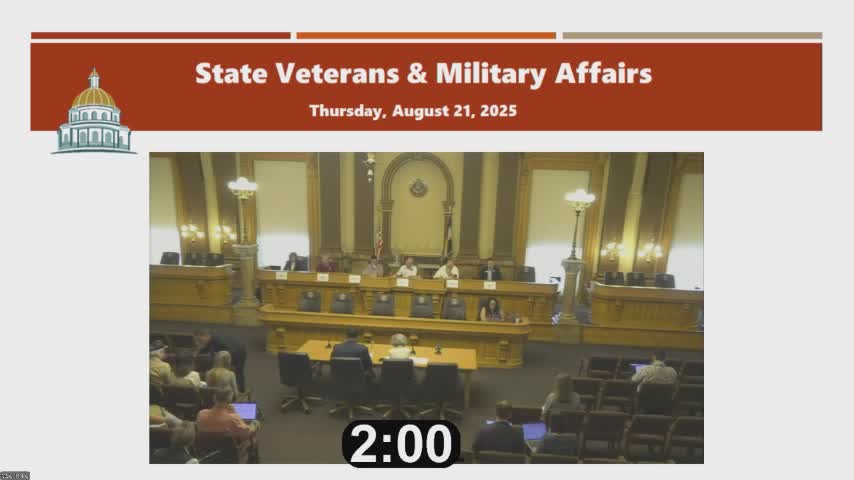
Summary
The Senate Committee on State, Veterans & Military Affairs met in an Aug. 21 special session to weigh measures aimed at narrowing Colorado’s budget gap, from a bill clarifying gubernatorial authority to reduce spending during revenue shortfalls (SB1) to a contentious plan to pause refundable family tax refunds for 2025 (SB9); the committee adopted an amendment narrowing a bill that would redirect wolf‑program funds and sent that measure to Appropriations.
The Senate Committee on State, Veterans & Military Affairs met in a special session Aug. 21 and took up a slate of bills that senators said were keyed to Colorado’s fragile fiscal position. Lawmakers advanced several measures for further review, debated whether to pause refundable credits tied to the Family Affordability Tax Credit and held a lengthy hearing on a proposed pause in taxpayer funding for future wolf reintroductions.
The committee front‑loaded the most consequential fiscal items. Sponsors argued the bills were needed to prevent deeper deficits next year; opponents said some proposals would strip benefits from low‑income families or subvert voter mandates. The hearing on the wolf funding bill (SB5) drew the largest turnout of witnesses — ranchers, county commissioners, conservation groups and state wildlife officials — and produced the meeting’s most visible compromise: an amendment that narrows the bill’s effect while preserving the reintroduction program’s legal pathway.
Why it matters: Colorado is operating in a tight fiscal window. Committee members repeatedly pointed to a forecast showing revenue declines and the prospect that, without adjustments, the state will start the 2026–27 budget year with a large shortfall. Several proposals considered Wednesday would trim or delay near‑term outlays intended to ease the pain from those revenue changes.
What the committee heard and decided
SB 1 — Clarifying spending‑reduction authority (sponsor: Mr. President Coleman; co‑sponsor: Senator Mabley). The bill would consolidate and clarify statutory triggers for an executive order that reduces state spending during revenue shortfalls and require prompt notifications and a formal plan to the Joint Budget Committee. ‘‘Senate bill 0 0 1 reduce spending during revenue shortfalls,’’ Mr. President Coleman said in his opening remarks. Department of State Planning and Budgeting Director Mark Ferrendino testified the bill ‘‘does not change, expand the power of the governor’’ but aligns two statutory mechanisms and adds a clearer 2% trigger policymakers historically used. After sponsor remarks and a short discussion with staff, the committee voted to send SB 1 to the Committee of the Whole with a favorable recommendation (vote: 3–2).
SB 5 — Redirecting funds for wolf reintroduction for health insurance affordability (sponsors: Senator Roberts and Senator Catlin). The committee heard more than 50 witnesses for and against a proposal to redirect general fund dollars that had been allocated to Colorado Parks and Wildlife for procurement of additional translocated wolves, and instead move those dollars to the Health Insurance Affordability Enterprise. Supporters described immediate costs to ranchers and counties and urged a one‑year pause in new translocations so nonlethal conflict‑mitigation measures can catch up; opponents said the bill would subvert Proposition 114 and that delaying reintroductions would harm the nascent wolf population. Colorado Parks and Wildlife Director Jeff Davis and other agency staff testified that the agency needs funding and time to expand range riders and other tools but that an outright prohibition on reintroduction work would put the program at risk.
After hours of testimony and negotiation, the committee adopted an amendment from Senator Ball that removed language that would have barred reintroductions outright and preserved a path for reintroduction using non‑general fund sources. The amendment passed on a roll call and the committee then voted, 4–1, to send SB 5 as amended to the Appropriations Committee.
SB 9 — Pause refundable portion of Family Affordability Tax Credit for tax year 2025 (sponsors: Senator Kirkmeyer and co‑sponsor Senator Brett). Sponsors presented a narrower, amended version of the bill that pauses the refundable portion of the family affordability tax credit for the 2025 tax year (the change would not eliminate the credit; most claimants still would have their tax liability reduced to zero). Supporters argued the pause would reduce a near‑term general‑fund outlay (about $663 million in the fiscal estimate for the current year) and help close an emerging budget gap; opponents — including anti‑poverty and child advocacy groups — argued refundability is the feature that drives the credit’s poverty‑reduction impact and read aloud dozens of beneficiary stories. The committee adopted a technical amendment and then voted against referring the bill to Appropriations. The measure was subsequently postponed under a reverse roll call motion.
Other bills and resolutions discussed briefly
SB 6 (HSA tax credit): A proposal to convert Colorado’s tax deduction for health savings account (HSA) contributions into a 25% tax credit, intended to give low‑ and middle‑income filers a larger incentive to build savings for health care. The committee adopted technical implementing amendments but did not advance the bill to Appropriations; members later postponed it indefinitely.
SB 7 (rural hospitals): Sponsor Senator Liston offered a bill and amendment to redirect select funds to critical access hospitals on the Eastern Plains and the Western Slope. The committee adopted the sponsor’s amendment but did not refer the bill to Appropriations and later postponed it by reverse roll call.
SB 8 (AI nondiscrimination clarifier): A short bill that would state explicitly that state nondiscrimination protections apply when public‑sector actors rely on algorithmic or AI systems. The committee chose not to refer the bill to Appropriations and postponed it by a reverse roll call.
SCR 1 (add‑backs and TABOR): A concurrent resolution from Senators Frizzell and Pelton that would ask voters to require voter approval before the state adds federal exclusions back into Colorado taxable income (a constitutional change tied to TABOR). The committee did not advance the resolution and later postponed it by reverse roll call.
Votes at a glance (committee actions recorded Aug. 21) - SB 1: Referred to Committee of the Whole with a favorable recommendation (vote: 3 yes, 2 no). Vote record captured on the roll call. - SB 5 (wolves): Amendment (L3) adopted (narrowing the bill); committee referred SB 5 as amended to Appropriations (vote: 4 yes, 1 no). - SB 6 (HSA credit): Technical amendments adopted; motion to refer to Appropriations failed and the bill was later postponed indefinitely. - SB 7 (rural hospitals): Sponsor amendment adopted; motion to refer to Appropriations failed and the bill was later postponed. - SB 8 (AI nondiscrimination): Motion to refer to Appropriations failed; bill postponed. - SB 9 (pause refundable family credit for tax year 2025): Sponsor amendment (technical) adopted; motion to refer to Appropriations failed; the bill was later postponed. - SCR 1 (TABOR/add‑backs): Motion to refer to Committee of the Whole failed; the resolution was later postponed.
Key numbers and clarifications - SB 1: Sponsors described a measurable trigger tied to quarterly revenue estimates: 2% of general‑fund appropriations or an equivalent half‑reserve trigger; one discussion noted a $1.2 billion figure when computing ‘‘half of reserve’’ as the previous statutory benchmark. - SB 5: Sponsors said the 2020 ballot information estimated program costs at about $800,000 annually; stakeholders testified the program has already cost taxpayers approximately $3.5 million in the first fiscal year and that compensation and mitigation needs have grown. - SB 9 (FTAC): The committee fiscal estimate showed converting the refundable portion of FTAC to nonrefundable for tax year 2025 would increase near‑term general‑fund revenue by roughly $663.1 million (fiscal year impact noted by analysts on the record). Sponsors warned leaving the refundable feature in place could increase the next budget year’s shortfall by roughly $700 million or more depending on collections.
What’s next - Several bills were carried out of committee or adopted in amended form and will move to Appropriations or be considered later by the full Senate per the clerk’s schedule. Others were postponed by reverse roll call, effectively killing them for now. Committee members signaled more extensive budget discussions and statutory cleanup will be required in the regular session and in the coming months.
Ending note The session underscored competing priorities: addressing immediate fiscal strain and preserving voter‑directed policy and programs that aim to reduce poverty or expand conservation. Committee members repeatedly framed the choices as prioritization: which state obligations are covered now and which will be deferred as Colorado contends with lower collections and pending federal funding changes.