
District proposes aligning graduation requirements with state changes, adds college-and-career flex credits
Get AI-powered insights, summaries, and transcripts
Subscribe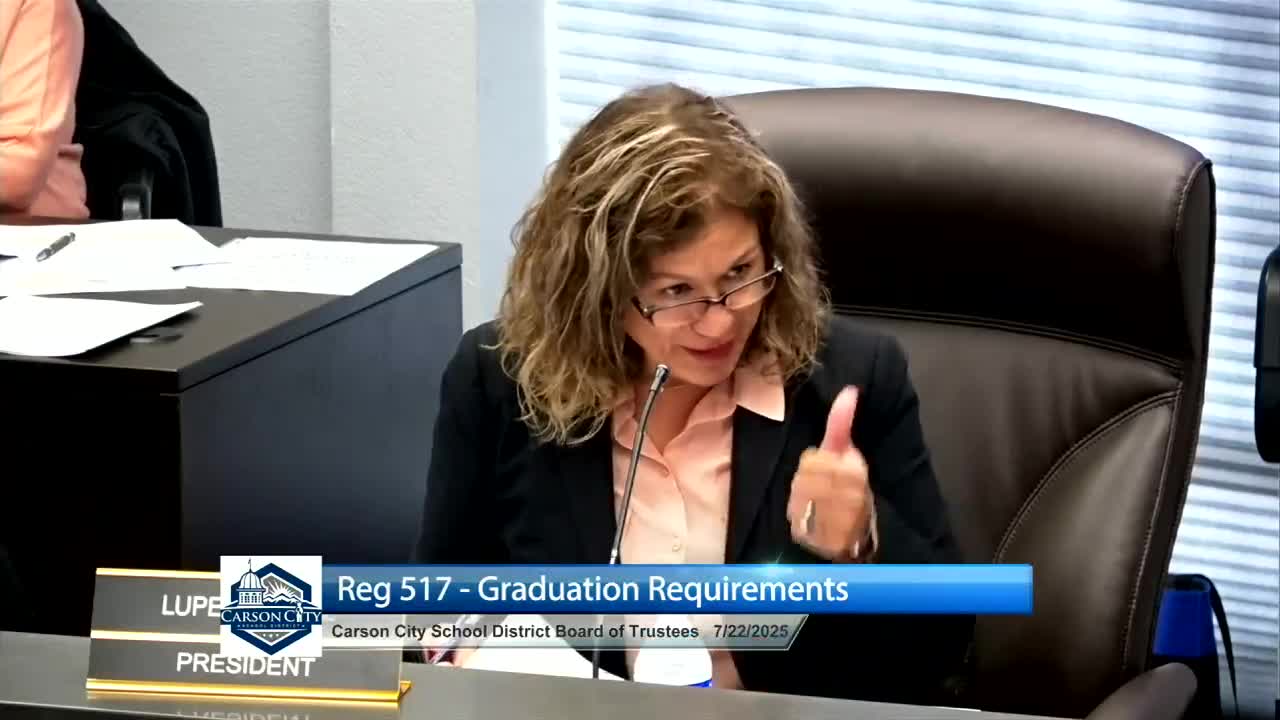
Summary
Carson City trustees heard a first-reading proposal to align the district's graduation regulation with recent Nevada Administrative Code revisions: required math drops from four to three credits, required science from three to two, and students must earn two college-and-career flex credits from specified options.
Carson City School District staff presented proposed updates to Regulation 5.17 on July 22 to align local graduation requirements for a standard diploma with recent Nevada Administrative Code (NAC) revisions and guidance from the Nevada Department of Education.
Why it matters: the proposal reduces the district's previously higher local requirements to match the state baseline and adds a new requirement for two college-and-career flex credits, which may include higher-level CTE courses, additional math/science, or third-year social-studies options.
Tasha Fusen and Brandon Bringhurst said the most significant change is a shift in the composition of required credits for the standard diploma: the regulation would reduce math from four required credits to three and science from three to two, while increasing the "college and career flex" requirement from zero to two credits. The flex credits can be earned by completing Level 2 or 3 CTE courses, a fourth year of math, a third year of social studies, or a third year of science, subject to rules that forbid double-dipping the same course to fulfill multiple graduation categories.
Staff said the change responds to a multi‑year adjustment in statewide graduation standards and is intended to provide students with more flexible pathways, including CTE and career-focused options, while still preserving higher-level coursework for students who choose that path. "It's trying to get kids to filter into that post high school thinking, whether you're going to a 2-year college, a 4-year college, or to a career tech academy," one staff member said.
Trustees asked clarifying questions about counseling contacts and parental involvement. Staff explained that state law requires students meet with a counselor at least once each school year for credit checks and course planning; in practice, counselors often meet with sophomores, juniors and seniors more than once per year while freshmen may be seen once. Board members also asked staff to remove or revise a sentence that suggested parents could waive a student's academic-plan meeting because trustees said that phrasing could be misread as encouraging less parental engagement; staff agreed to remove the outdated language and said it historically had come from state reporting practices.
Trustees also asked about the effect on CTE and elective offerings. Staff said CTE and arts/humanities remain options and that a course may not be used to satisfy more than one category (for example a single CTE course cannot also be counted toward both a CTE requirement and one of the flex credits). Staff characterized the move as aligning district policy with state intent to increase both academic rigor and career/technical opportunities.
No vote was taken; this was discussion and first reading of the proposed regulation. Staff said they will refine the language (including minor typographical corrections flagged during discussion) and return with final regulatory text for the board's consideration.