Get Full Government Meeting Transcripts, Videos, & Alerts Forever!
Get email alerts on the Suicide Prevention Intervention Postvention topic
No spam. Unsubscribe anytime.
District staff present updated suicide prevention, intervention and postvention regulation; trustees press for clarity on roles, Tarasoff/NRS references and re‑
Summary
CCSD directors described an expanded, research-based suicide prevention regulation that increases the multi-disciplinary response team, removes named tools in favor of evidence-based processes, and aligns postvention steps with state toolkits; trustees asked for clearer definitions of teams and statutory references.
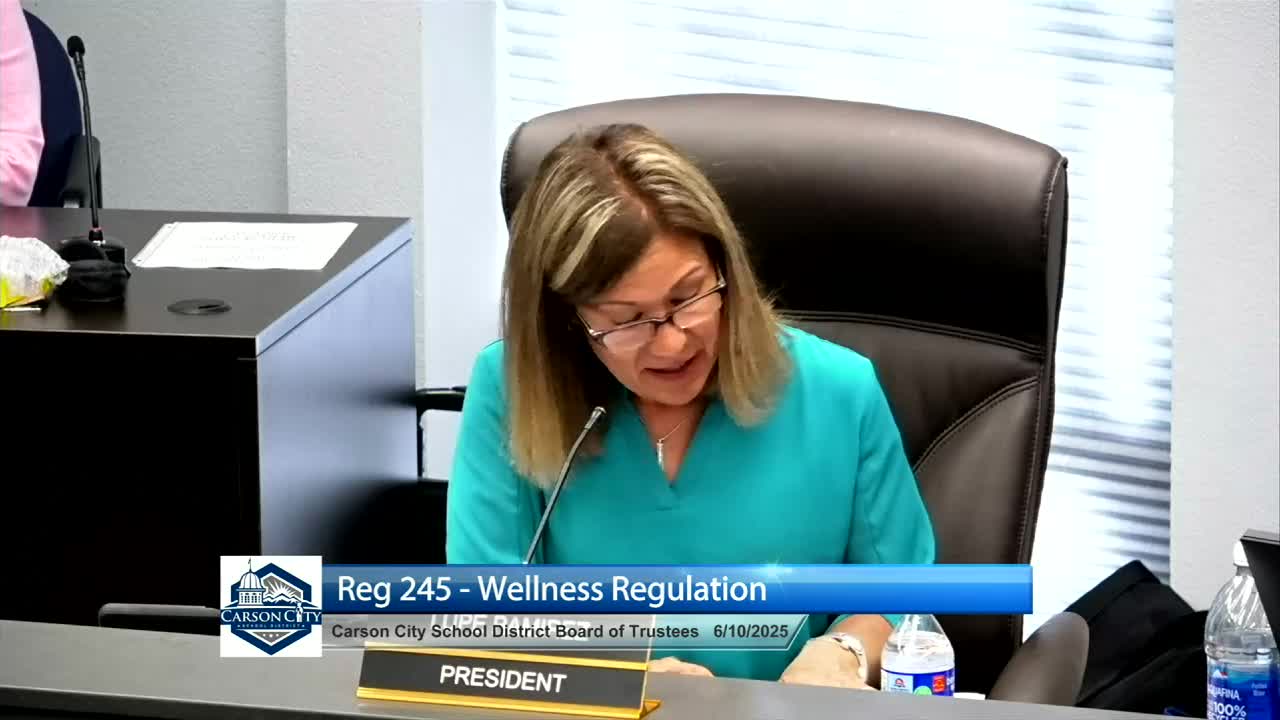
Carson City School District staff on Tuesday presented a substantially rewritten regulation to accompany Policy 270 on suicide prevention, intervention and postvention, emphasizing clarified roles for a multi-disciplinary response team, standardized screening procedures and updated postvention protocols.
Christy Perkins, director of MTSS and student wellness, and Christina Sapien, a licensed clinical social worker who oversees Project AWARE services for the district, told trustees the policy text itself required only modest edits but that the regulation had been substantially revised to remove named tools and obsolete resource references and to expand the list of trained staff and responders.
Perkins said the regulation shifts from naming specific screening instruments to requiring “research-based” tools and processes so the district can adopt current, evidence-based instruments without repeatedly amending a board regulation. “We removed places and programs that don't even exist anymore,” Perkins said, and removed named tools such as the ASQ in favor of generic “research-based intervention” language.
Trustees pressed staff to define responsibilities and team names consistently. Board members asked that references to the site lead and the district crisis team be explicit; Perkins agreed to define the “school site response team” versus the “district crisis response team” and to standardize titles (for example, using “site administrator” in place of “principal” where appropriate).
On screening and crisis response, staff said the district already conducts universal screening (Perkins said the district screens seventh and ninth graders) and that trained staff—social workers, counselors, nurses and other mental‑health professionals—use the Columbia screener when trained. The regulation clarifies that, per Nevada law, certain qualified professionals or law enforcement can initiate a mental-health crisis hold and that only specified medical or licensed mental-health clinicians can certify or release such a hold.
Trustees asked staff to check statutory references and to list both the Tarasoff duty-to-warn doctrine and the relevant Nevada statute (NRS 629.55 was suggested during the discussion) where appropriate. Staff agreed to list applicable statutes and toolkits and to define the district and site response teams in the regulation. They also described SafeVoice, the 988 lifeline and Project AWARE as resources that will remain available to students.
No action was taken; the regulation was presented for discussion and will be revised to clarify team membership, statutory citations and language about parental notification and external provider engagement prior to a future vote.