Get Full Government Meeting Transcripts, Videos, & Alerts Forever!
Get email alerts on the Audit topic
No spam. Unsubscribe anytime.
State Auditor outlines 2023–24 audit scope for Edmonds, flags cash, payroll and SLFRF testing
Summary
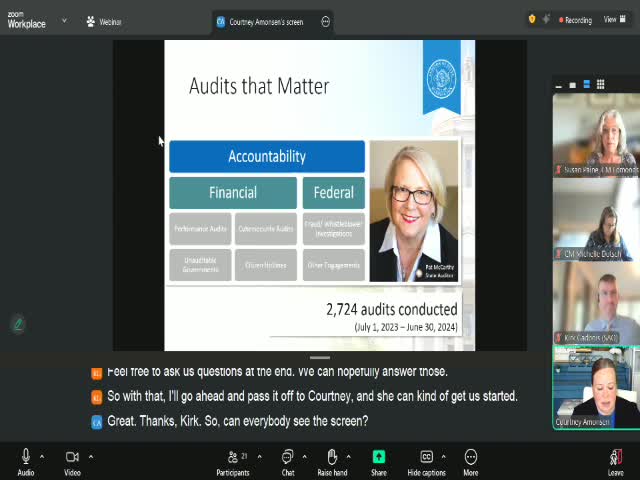
Kirk Gadboly, the State Auditor’s Office supervisor for Edmonds, and audit manager Courtney Amundson told the Edmonds City Council on Aug. 19 they will focus 2023–24 audit work on cash receipting, payroll (including police shift exchanges), theft‑sensitive assets, surplus equipment, financial condition and the city’s coronavirus state and local fiscal recovery funds (SLFRF).
Kirk Gadboly, the State Auditor’s Office supervisor for the Edmonds engagement, and audit manager Courtney Amundson told the Edmonds City Council on Aug. 19 the office is conducting both a two‑year accountability audit (Jan. 1, 2023–Dec. 31, 2024) and the fiscal‑year 2024 financial and federal compliance audits. The auditors said they are using a risk‑based approach and have begun on‑site work that will intensify staff time over the coming weeks.
Why it matters: The audits examine whether the city is following applicable laws, rules and internal policies and whether the city’s financial statements can be relied on for bonding and governing decisions. Auditors also will test federal grant compliance for the city’s largest federal program — the coronavirus state and local fiscal recovery funds (SLFRF) — because SLFRF accounted for roughly 91% of Edmonds’s federal funds in 2024.
Gadboly said the accountability audit will test compliance with the Open Public Meetings Act and other statutory reporting requirements, and examine internal controls and high‑risk areas. “The first area is your cash receipting,” Amundson said. “We’ll be looking at timeliness and completeness of deposits and then as well as looking at voids and adjustments.” She said auditors also will review payroll, with a particular focus on police leave and shift exchanges, and will look at theft‑sensitive assets and surplus equipment procedures.
Auditors described three reporting tiers. Gadboly said the most significant problems become formal findings included verbatim in the audit report; lesser issues may be reported as management letters or exit items for staff action. He urged prompt communication if the city discovers a cybersecurity incident or a suspected loss of public funds, reminding council that state law requires notifying the attorney general’s office if a breach affects more than 500 Washington residents.
Discussion vs. decisions: Council members asked about metrics for assessing financial condition and whether the office’s Financial Intelligence Tool (FIT) could be used for annual budget stress testing. Amundson said the FIT is based on year‑end results and “is certainly a tool that can be utilized” but should not be the sole basis for budgeting decisions. Auditors also described weekly on‑site meetings and a targeted September timeline for completing certain testing to meet federal filing deadlines.
What’s next: Auditors will continue fieldwork, hold an exit conference to present results and provide a management representation letter at audit close. City and audit staff discussed information‑sharing options for sensitive payroll and personnel records to ensure secure review.
Ending: Council members thanked auditors for the presentation; the city will receive draft findings and management letters at exit and have an opportunity to respond before publication.