
Committee advances proposal to let leftover Healthy School Meals funds shore up SNAP after federal cuts
Get AI-powered insights, summaries, and transcripts
Subscribe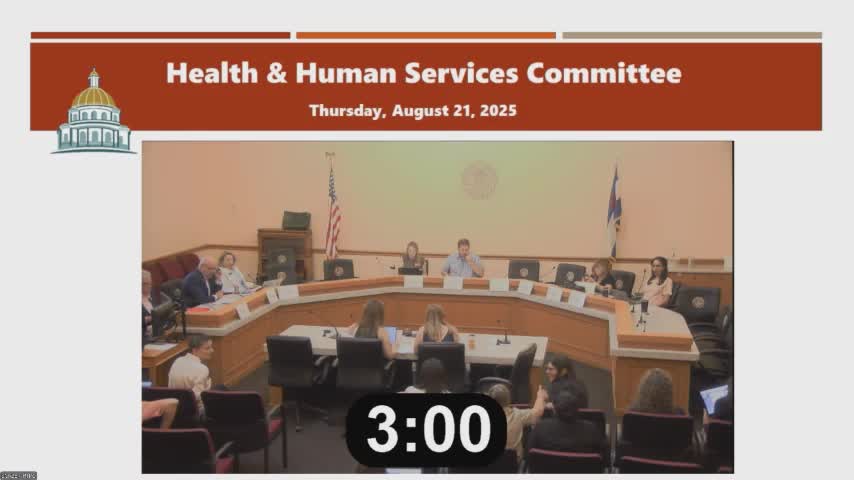
Summary
Senate Health and Human Services forwarded a bill to let remaining funds from the Healthy School Meals for All cash fund be used to support SNAP administration, outreach and nutrition education after the meal program is fully funded, responding to federal cuts in HR 1.
The Senate Health and Human Services Committee advanced Senate Bill 25B003 on a favorable recommendation as amended, a proposal to permit remaining funds from the Healthy School Meals for All (HSMA) cash fund, once HSMA is fully funded, to be used for Supplemental Nutrition Assistance Program (SNAP) needs such as county administration, outreach, and nutrition education.
Sponsors said the measure responds to federal changes in HR 1 that reduce SNAP administrative and program funding and create financial pressure on counties and the state. Senator Wallace, a co-prime sponsor, said the program has helped feed students and saved families about $1,300 per child per year, and argued that allowing any excess HSMA revenue to shore up SNAP will protect families facing federal cuts.
Witnesses from community and state agencies described both the program’s local economic benefits and the scale of SNAP in Colorado. Abby McClelland, director of the Food and Energy Assistance Division at the Colorado Department of Human Services, told the committee, “Each month, about 617,000 Coloradans receive a total of about $120,000,000 in SNAP benefits.” Nourish Colorado and Hunger Free Colorado urged the committee to allow HSMA funds to backfill SNAP Ed and other community nutrition work after HSMA obligations are met; Rekia Rainey of Nourish Colorado said Colorado is losing an annual allocation “of over $6,000,000 for nutrition education” because of HR 1.
Supporters said HSMA’s local food purchasing and grant programs benefit producers and school kitchens. Valley Roots Food Hub described supplying Colorado-grown produce and meat to districts through the Local Food Program pilot. County and human services leaders testified on administrative strain: Heather O’Hare for the Colorado Human Services Directors Association and Commissioner Emma Pinter (Adams County) described county workloads and warned that proposed federal changes could shift tens of millions of dollars of costs to the state and counties.
Opponents said the state should not expand HSMA uses or create a mechanism that may redirect funds away from school meals. An individual witness said the state cannot afford universal meals and questioned program waste; she urged the committee to reject the bill.
The committee adopted two sponsor amendments: L003 (technical change to the effective date) and L001 (changes the timing for when non-meal and administrative expenses may be funded from HSMA, delaying that funding until state fiscal year 2026–27). The committee then moved SB 25B003 to the committee of the whole with a favorable recommendation; the committee reported the motion passed 7–2.
The hearing separated discussion (impacts of HR 1 on SNAP administration, local-food benefits, and nutrition education) from committee action (technical amendments and a favorable recommendation). Sponsors and multiple witnesses asked that HSMA be fully funded first and that any remaining revenues be used to support SNAP administration and nutrition education to mitigate federal cuts.