
Senate committee advances bill to use state funds so Medicaid patients can continue care at Planned Parenthood
Get AI-powered insights, summaries, and transcripts
Subscribe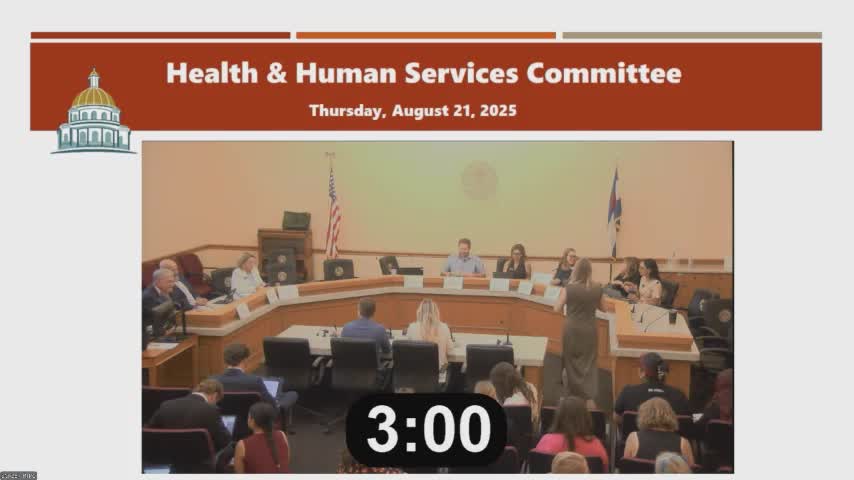
Summary
The Senate Health and Human Services Committee advanced a bill to allow Colorado to use state-only funds to pay claims to federally prohibited entities such as Planned Parenthood while federal Medicaid matching is unavailable, citing canceled appointments and rural provider gaps.
The Senate Health and Human Services Committee on the special-session floor advanced Senate Bill 25B002 on a favorable recommendation as amended, a measure sponsors say will let the Colorado Department of Health Care Policy and Financing (HCPF) use state-only funds to pay Medicaid claims to providers excluded from the federal Medicaid program.
Supporters told the committee the bill is an urgent response to a federal change in HR 1 that removed Planned Parenthood from the federal Medicaid program and led to canceled appointments and interruptions in care. Senator Bridges, a sponsor, said the federal decision singled out Planned Parenthood for political reasons and the state must act to protect health care access for Coloradans.
The bill’s sponsors and witnesses described the immediate effects of the federal action and why state-only funding is needed. Jack Teeter, vice president of government affairs at Planned Parenthood of the Rocky Mountains, said, “We are in the midst of a healthcare access disaster that began 48 days ago on July 4,” and recounted that 991 patient appointments were canceled when the federal restriction first took effect. Lily Boyd, speaking as a Planned Parenthood patient, described how the prohibition prevented her from getting a follow-up appointment and left her to “monitor my symptoms at home” until she required emergency care.
Senator Doherty, co-sponsor, described the bill’s operative mechanism: it “provides state only funding through HCPF to prohibited entities so long as the prohibition is in effect,” and noted the language was crafted to let HCPF stabilize care when federal matching funds are unavailable. He and other proponents said the change is intended to be temporary, tied to the federal prohibition, and that the amendment adopted in committee (L001) clarified which covered services are reimbursable by referring to services covered under Title XIX of the Social Security Act.
Proponents from health organizations urged passage. Isabel Cruz, policy director for the Colorado Consumer Health Initiative, said advocates are “hearing from fewer [patients] because people are terrified to access care right now.” Stephanie Brooks, policy director at Colorado Community Health Network, and Liz Owens of Colorado Access described Planned Parenthood as an integral safety-net provider that serves patients who otherwise face long waits or large travel distances for primary and preventive services.
Opponents argued the state should not replace federal funds. Scott Shamblyn, executive director of Colorado Right to Life, said the bill would use taxpayer dollars to reimburse “organizations that have been disqualified from receiving federal Medicaid dollars” and urged rejection. Several medical and faith-based witnesses, including Dr. Tom Perrill (president, Democrats for Life of Colorado) and Catherine Wheeler (OB-GYN; Colorado chapter, American Association of Pro-Life OB-GYNs), said federally qualified health centers and other providers are better-positioned to absorb patients and questioned whether Planned Parenthood should continue abortion services while receiving federal support.
The committee adopted a sponsor amendment (L001) that clarifies which services are covered by reference to Title XIX of the Social Security Act, and then voted to move SB 25B002 to the committee of the whole with a favorable recommendation as amended. The roll call on the committee motion produced a 6-3 vote in favor.
The measure and testimony made a sharp distinction between discussion and formal committee action: witnesses recounted individual patient harms and operational impacts (discussion), sponsors explained statutory text and proposed direction for HCPF (direction), and the committee’s adoption of L001 and the favorable recommendation to the committee of the whole were the formal actions recorded on the motion and vote (decision).