
Senate committee advances House Bill 1006 to fund Healthcare Affordability Enterprise with tax-credit sales
Get AI-powered insights, summaries, and transcripts
Subscribe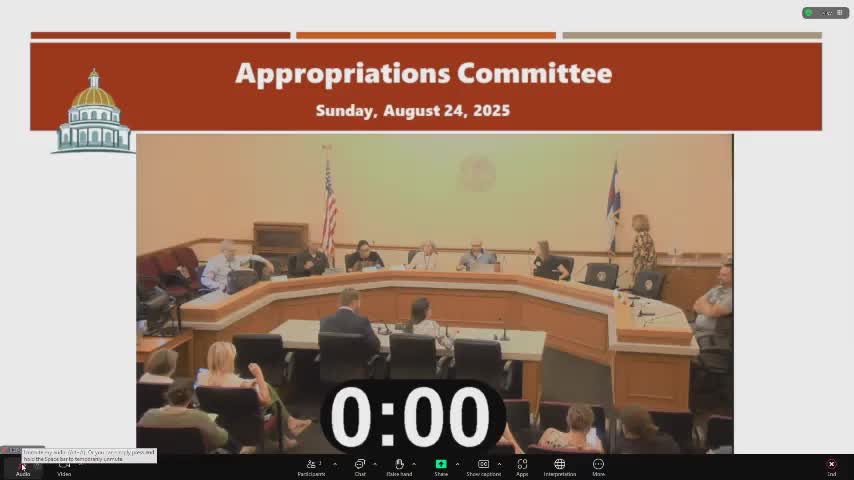
Summary
During an extraordinary special session, the Senate Appropriations Committee voted 5-2 to advance House Bill 1006, which would raise up to $100 million for the Healthcare Affordability Enterprise by selling premium tax credits and routing proceeds through a cash fund created by a companion bill.
At an extraordinary special session, the Senate Appropriations Committee voted 5-2 to advance House Bill 1006 as amended, a measure that would raise money for the Healthcare Affordability Enterprise (HIE) by authorizing the sale of premium tax credits and routing proceeds into a newly created cash fund.
The bill’s sponsors and Joint Budget Committee staff told the committee the change moves the funding source away from the unclaimed property trust fund and toward sales of premium tax credits to generate what sponsors said is about $100 million for the HIE.
Senator Mullica, a bill sponsor, told the committee: “Essentially, what we're doing is we are selling tax credits, for the dollars we needed, before those those dollars were coming from the unclaimed property trust fund.” Mullica said the sponsors negotiated an additional $10,000,000 from a pool of funds the governor had considered for the state’s 150th anniversary into the HIE funding package.
Michelle Curry, Joint Budget Committee staff, said the premium tax-credit sales would flow into a cash fund created by a companion bill and that “that cash fund is going to ... first payout the $100,000,000 to the HIE and then the remaining amount would be going to the general fund.” Curry told the committee the combined authority of the related bills could allow the cash fund to collect up to about $200,000,000 if both measures pass.
The amendment to House Bill 1006 also raises the minimum resale floor for the tax credits from 0.75 to 0.80, sponsors said, to avoid diluting the broader tax-credit market. Sponsors said administrative fees for selling the credits are built into the tax-credit allowance; Curry said the administrative appropriation associated with the HIE portion totals roughly 3 percent of that $100 million, and that the total administrative costs across both bills would be just over $6,000,000.
Senator Kirkmeyer pressed for detail on the prior funding “waterfall” for the enterprise — allocations previously described for reinsurance, Omni Salud, and individual-market assistance — and asked whether those distribution mechanics or administrative shares would change. Curry said the money from the tax-credit sales is intended to replace funds the HIE would otherwise have received and that “none of that is impacted by this bill.” Senator Judah emphasized this point, saying, “The admin cost that you're talking about is separate from that 100,000,000. We cannot use admin from that 100,000,000.”
Sponsors and staff also described a trigger in the bill that pauses tax-credit sales if the federal government renews the premium tax credits: as Mullica put it, “if the federal government renews these premium tax credits, that that essentially this is not needed,” and the sale authority does not begin until after Dec. 31 to allow time for federal action.
Committee members adopted two sponsor requests (amendment L19 and a J-bill designation, J3) without objection, and Madam Vice Chair moved the bill out of committee. The clerk polled the committee; the chair announced that House Bill 1006 passed the committee 5 to 2 and will move to the Committee of the Whole.
The committee made no final policy changes to the HIE distribution waterfall during the hearing; staff said the bill’s revenues are intended to substitute for federal premium-tax-credit receipts the enterprise might lose. Further fiscal mechanics, marketing costs, and the pace of tax-credit sales were described as dependent on implementation steps by the Department of the Treasury and its vendors.