
Committee advances bill to decouple Colorado from federal FDII and expand tax‑haven list
Get AI-powered insights, summaries, and transcripts
Subscribe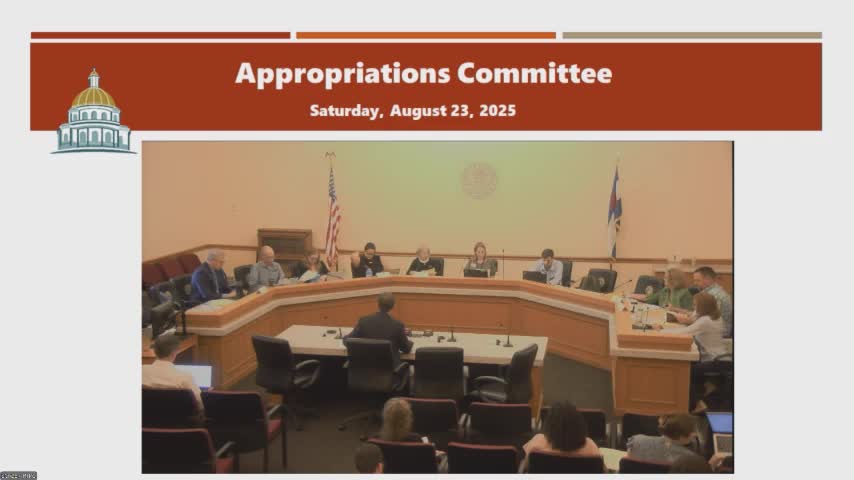
Summary
The Appropriations Committee advanced HB25B‑1002 to the committee of the whole after sponsors said the bill would stop certain federal tax breaks (FDII) from flowing into Colorado and add five jurisdictions to the state's presumptive tax‑haven list.
The Senate Committee on Appropriations voted to advance HB25B‑1002, a bill that would decouple Colorado from the federal foreign‑derived intangible income (FDII) deduction and add five jurisdictions to the state’s list of presumptive tax havens. Sponsors said the measure prevents federal rules from generating unintended state tax preferences for multinational corporations.
Why it matters: Sponsors and fiscal policy witnesses said federal changes (referred to in committee as “HR 1”) created federal tax breaks that can flow into Colorado by virtue of the state’s rolling conformity with federal taxable income. Committee supporters argued FDII and profit‑shifting to low‑tax jurisdictions reduce state revenue available for schools, health care and infrastructure. Opponents raised constitutional concerns about TABOR and asked whether voter referral is required for measures that change revenue.
Sponsor summary: Senator Ball, the Senate sponsor, said HB25B‑1002 does two things: it adds the Netherlands, the Republic of Ireland, Hong Kong, Singapore and Liechtenstein to Colorado’s presumptive tax‑haven list (a rebuttable presumption) and decouples the state tax code from the federal FDII deduction. Ball argued 26 states already decoupled from FDII and that doing so protects Colorado from subsidizing economic activity located outside the state.
Witnesses: Caroline Nutter of the Colorado Fiscal Institute urged the committee to approve the bill, saying federal FDII subsidizes profit‑shifting and that Colorado does not need to mirror the federal preference. County and policy witnesses urged the change as a way to preserve state revenue for counties and for services; industry witnesses and some residents questioned the constitutionality and practical effects, asking whether the change is incidental or requires voter approval under TABOR. Department of Revenue staff confirmed FDII and related pass‑through items are included in the federal rule set that Colorado conforms to and offered to supply detailed statistics on joint vs. single filers as requested.
Fiscal and legal notes: The fiscal note included an estimated FY2025‑26 revenue gain of about $35.6 million. Committee members questioned whether the estimated gains are “de minimis” or incidental under TABOR precedent (RTD v. Tabor Foundation and related case law). Sponsors argued the change is consistent with other states’ actions and that the change is a policy choice to prevent Colorado from granting tax preferences for income sourced or reported outside the state.
Outcome: The committee advanced HB25B‑1002 to the committee of the whole by voice/roll call (final committee vote recorded 5–2). The bill will next go to the committee of the whole for further consideration.