
Appropriations Committee advances repeal of small‑business vendor fee as part of special‑session budget fixes
Get AI-powered insights, summaries, and transcripts
Subscribe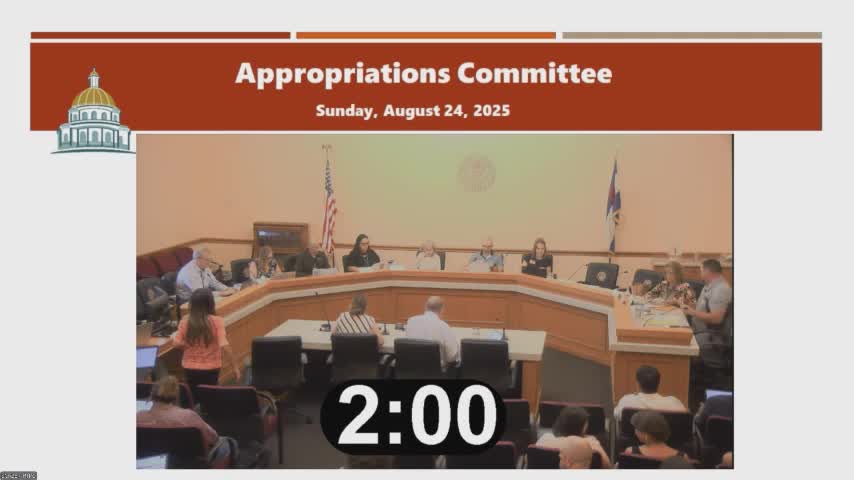
Summary
House Bill 1,005 would repeal Colorado’s vendor fee — the small allowance paid to retailers for collecting state sales tax — generating an estimated $56.8 million to help close the state budget gap.
House Bill 1,005 would repeal the vendor fee — an allowance that lets businesses retain a small portion of state sales tax they collect — and redirect roughly $56.8 million back to the state’s budget, sponsors said. Senator Kipp, a sponsor who described her work on the Sales and Use Tax Simplification (SUTS) effort, told the committee the vendor fee dates to 1939 and is now an “outdated practice” that other states have eliminated. “This vendor discount was created in 1939, before there were calculators… Today, sales tax compliance is largely digital,” Kipp said.
Sponsor rationale and fiscal context: Supporters framed the repeal as a necessary budget‑balancing step after major federal tax changes (sponsors referred to H.R. 1) that they said will reduce state revenue and shift costs to states. Senator Winter, co‑sponsor, told the committee that the vendor fee averages about $80 a month for a small business and argued the savings from federal changes dwarf the vendor fee: “Is it worth losing your child's teacher for $80 a month?” she asked, urging members to prioritize K‑12 pay and Medicaid.
Testimony and opposition: The hearing drew substantial industry testimony and written input. The Colorado Restaurant Association, the National Federation of Independent Business (NFIB) and multiple individual small business owners opposed the bill, urging the committee to preserve the allowance as a modest compensation for businesses’ compliance costs. Michael Smith of NFIB said small businesses “wear many hats and unpaid tax collector shouldn't be one of them,” and Nick Hoover of the Colorado Restaurant Association described sharp cost pressures — higher rent, utilities, food and labor — and warned that removing the allowance would be “another cost” for struggling restaurants.
Policy details and clarifications: Witnesses and sponsors discussed program mechanics: the vendor fee lets businesses retain up to 4% of the state’s 2.9% sales tax with a $1,000 cap per filing period in current law. Several witnesses suggested mitigations if repeal proceeds, including a temporary phase‑out, relief for first‑time filers, and additional investments in SUTS tools to simplify remittance and compliance. Greer Bailey (Colorado Wyoming Fuel Marketers) asked for either a temporary repeal or transitional relief and urged that software and compliance costs be considered in any change. Several testifiers asked that departments offer limited penalty relief for first‑time filers during a transition period.
Equity and economic arguments: Anti‑poverty advocates and fiscal analysts urged repeal to preserve services. Charles Brennan of the Colorado Center on Law and Policy and Caroline Nutter of the Colorado Fiscal Institute said the state should prioritize public programs and that the vendor fee disproportionately benefits certain retailers. Health‑sector advocates said preserving Medicaid funding reduces broader economic harm; Adam Fox of the Colorado Consumer Health Initiative described Medicaid as an “economic multiplier” and warned of job losses and service reductions if federal and state funding decline.
Committee action: After stakeholder testimony and sponsor remarks, the committee moved HB 1,005 to the Committee of the Whole. The motion carried on a roll call vote, 5–2. The committee considered, but did not adopt at the hearing, amendments to phase or delay repeal; several witnesses urged a temporary or phased approach and the sponsors said they would pursue stakeholder work after passage.
Distinguishing discussion from action: The committee’s vote advances policy for floor consideration; sponsors and stakeholders agreed to continue stakeholder meetings on implementation details and potential business relief measures if repeal proceeds.
Ending note: HB 1,005 passed the committee 5–2 and now advances to the Committee of the Whole; sponsors said they will continue working with small‑business groups and revenue agencies to detail transitional supports and administrative changes.