
Senate committee backs continuing state limit on federal QBI deduction
Get AI-powered insights, summaries, and transcripts
Subscribe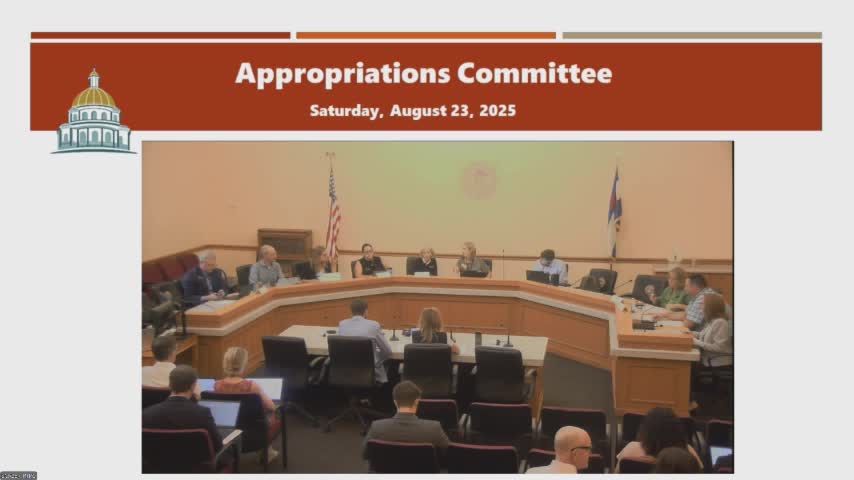
Summary
The Senate Appropriations Committee voted 5–2 to advance HB25B‑1001, a bill that preserves Colorado’s current limitation on the federal qualified business income (QBI) deduction — keeping the $500,000 single / $1,000,000 joint thresholds — amid debate over whether the change requires voter approval under TABOR.
The Senate Committee on Appropriations on Thursday voted 5–2 to advance HB25B‑1001, a bill that continues the state’s current limitation on the federal qualified business income (QBI) deduction for non‑corporate filers, keeping the $500,000 single and $1,000,000 joint income thresholds. The measure’s sponsors said the change preserves state policy as the corresponding federal deduction was altered by federal legislation.
Why it matters: Committee sponsors and witnesses said continuing the limitation prevents a large share of the QBI benefit from flowing to very high‑income taxpayers and protects state revenue used to fund programs such as Medicaid and SNAP. Opponents said the bill is effectively a tax policy change that produces new net revenue in the short term and therefore should be referred to voters under the Taxpayer Bill of Rights (TABOR).
Sponsors explained HB25B‑1001 as a continuation of existing Colorado policy tied to the federal deduction. Senator Heinrichsen, a sponsor, told the committee the federal QBI deduction was created in the 2017 federal tax law and was designed to expire in 2025; he said federal changes have altered that timeline and HB25B‑1001 “continues our current tax policy exactly as it is now.” Senator Cutter, another sponsor, framed the bill as narrowing an outsized benefit: “less than 2% of the taxpayers receive a third of the benefits from this tax break.”
Witness testimony split along fiscal and equity lines. Joshua Mantel of the Bell Policy Center testified in favor, arguing the deduction’s structure makes little sense in Colorado because the state’s corporate and individual rates are the same, and because the cap shields high earners; he said the measure is restricted to higher‑income filers and preserves support for small businesses. Clear Creek County Commissioner George Marlin, speaking for Counties and Commissioners Acting Together, said counties face federal changes that will shift more costs to state and local governments and argued the cap ensures a fair contribution from the wealthiest: “The deduction overwhelmingly benefits the top 2% of earners. Maintaining this limit ensures that those with the greatest means contribute fairly.” Opponents, including resident Erin Meschke, said the policy change amounts to a tax increase and urged voter referral.
Fiscal and legal issues were debated in committee. Committee members and the Department of Revenue’s Director of Tax Policy (Josh Pens) agreed the bill would increase state revenues in the current fiscal year (the fiscal note shows an estimated $45,900,000 increase for FY 2025‑26 and larger amounts in later years), but sponsors characterized that timing as an artifact of mismatched effective dates between federal and state rules and maintained the bill is a continuation of existing policy rather than a new tax. Several senators pressed whether the change triggers TABOR’s requirement for prior voter approval; sponsors argued case law allows incidental or de minimis revenue changes and that courts have upheld similar legislative tax adjustments, while opponents said the change is substantive and should be referred.
The committee recorded a roll call vote on the measure. The motion to advance HB25B‑1001 passed 5–2. The committee record shows Senators Kolker, Wallace, Weissman, the vice chair, and the chair voted aye; Senators Kirkmeyer and Helton voted no.
What’s next: The bill was advanced to the committee of the whole. If enacted, the statute will preserve the current state treatment of QBI for non‑corporate taxpayers with the specified thresholds; the transcript and fiscal note identify Schedule F (farm income) as excluded from the QBI limitation.