Get Full Government Meeting Transcripts, Videos, & Alerts Forever!
Get email alerts on the Reproductive Health topic
No spam. Unsubscribe anytime.
House committee advances bill to allow state-only Medicaid payments to providers excluded by federal HR1
Summary
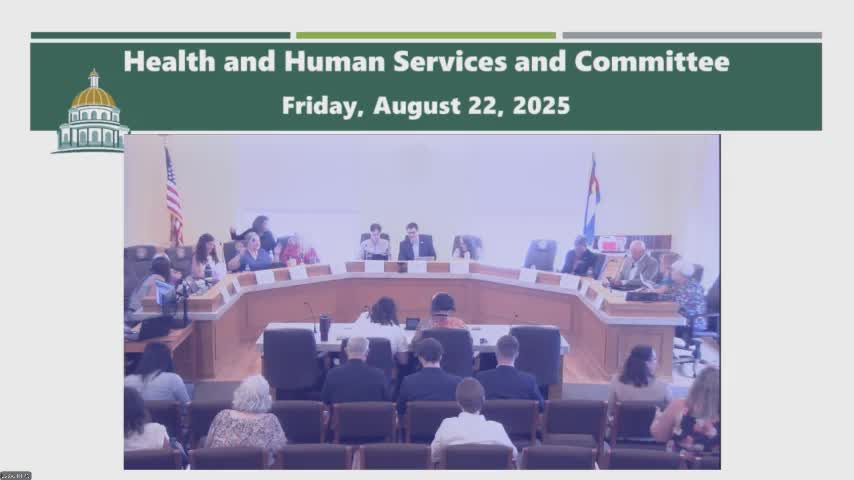
The House Health & Human Services Committee voted 9–4 to advance Senate Bill 2, which would allow state-only Medicaid payments to nonprofit providers barred from federal reimbursement by HR1 to preserve continuity of care for Medicaid patients.
The House Health & Human Services Committee voted 9–4 to advance Senate Bill 2 on a motion to send the measure to the Committee of the Whole, after a day of testimony that pitted sponsors and health-care groups against anti-abortion and fiscal-concerned witnesses.
The bill would authorize the state Medicaid authority to use state-only funds to reimburse nonprofit health-care providers that HR1 bars from receiving federal Medicaid matching payments — most prominently Planned Parenthood of the Rocky Mountains — so that Medicaid-enrolled patients could continue seeing their existing providers while the federal legal fight over HR1 proceeds.
Supporters said the change is a narrow, temporary step to preserve continuity of care for people who rely on Planned Parenthood as a primary care home. Representative Wilford, a co-prime sponsor, told the committee, "On July 4 with the passage of HR 1, Planned Parenthood was immediately removed from the federal Medicaid program," and said the disruption forced nearly 991 patient appointments to be canceled before a temporary restraining order restored services. Assistant Majority Leader Bacon, the other sponsor, said the bill is short and targeted and would let the state stabilize care by paying claims with state-only dollars when a federal match is unavailable.
Proponents and health-care witnesses described the practical effects in testimony. Jack Teeter, vice president of government affairs at Planned Parenthood of the Rocky Mountains, said, "We serve over 11,000 Colorado Medicaid patients annually," and recounted patients who missed urgent tests or follow-up care when federal reimbursement temporarily halted. Lillian Boyd, a patient who testified in support, said she sought follow-up care after a medication abortion but "was left with no choice but to monitor my symptoms at home" and eventually sought emergency care after heavy bleeding.
Opponents challenged both the premise and the cost. Scott Shamblyn of Colorado Right to Life told the committee, "This bill... takes taxpayer dollars to financially sustain abortion providers like Planned Parenthood that have been deemed ineligible for federal funding," and other witnesses called Planned Parenthood financially robust and disputed claims that it functions as a primary-care medical home. Several witnesses, including Dr. Catherine Wheeler and other medical and faith-based speakers, urged a no vote and pressed concerns about regulation and oversight of abortion providers.
Sponsors repeatedly said the funding ask is small relative to the Medicaid program and would be invoked only if federal reimbursement becomes unavailable. Representative Wilford told the committee the measure is meant to "stabilize the federal roller coaster" while litigation over HR1 proceeds; witnesses noted the injunction against HR1 and ongoing appeals could change the need for state-only payments at any time.
Votes at a glance: The committee voted 9–4 to advance SB2 to the Committee of the Whole with a favorable recommendation.
Discussion and next steps: Committee members who supported the bill framed it as a short-term, narrowly targeted way to keep patients connected to trusted providers until the federal litigation concludes. Members opposing the bill said the state should not backfill federal prohibitions and raised fiscal and regulatory concerns. The measure will proceed to the Committee of the Whole, where further debate and any amendments would be possible.
Background: Sponsors cited the July 4 enactment of HR1 and the sequence of court actions that followed — a temporary restraining order and subsequent injunction — as the impetus for the bill. They said Planned Parenthood and similar entities provide preventive and primary-care services to Medicaid patients in parts of Colorado and that sudden exclusion from federal reimbursement disrupted scheduled care.
A final vote on the bill is not yet scheduled. If the federal litigation or a Supreme Court action changes HR1’s status, sponsors said the state’s obligation to use state-only funds would be unnecessary and could be adjusted.